Francis Halzen wins 2026 Nobel Prize in Physics for high-energy neutrino research
The Belgian-American physicist was recognized for decisive contributions to the IceCube Neutrino Observatory, which uses Antarctic ice to detect elusive particles from distant cosmic sources.
Pragya Kumari06 October 2026 12:37
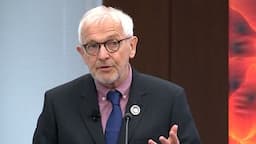
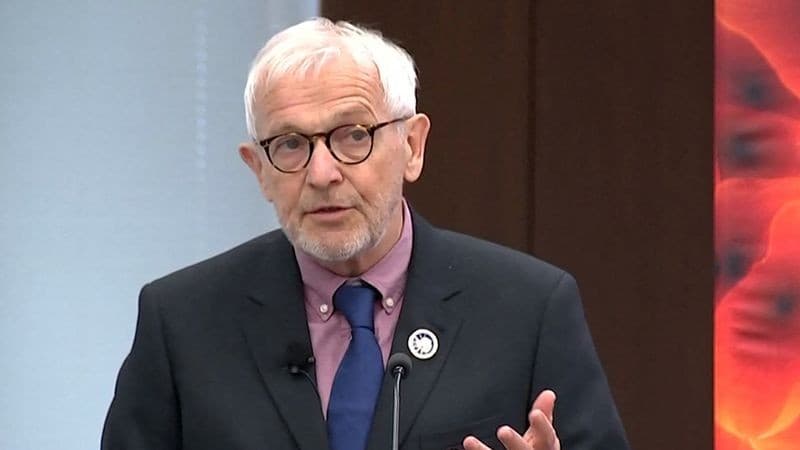
Belgian-American physicist Francis Halzen has won the Nobel Prize in Physics 2026 for his work on the IceCube Neutrino Observatory and the discovery of high-energy neutrinos originating from astrophysical sources, the Royal Swedish Academy of Sciences announced on Oct 6.
Halzen, a physicist and professor at the University of Wisconsin-Madison, has played a key role in developing the IceCube observatory at the South Pole.
The facility is designed to detect and study neutrinos, which are difficult to observe because they interact only weakly with matter.
The Nobel Committee recognized Halzen for “decisive contributions to the IceCube Neutrino Observatory and the discovery of high-energy neutrinos of astrophysical origin."
His research helped establish a new method of observing the universe by using high-energy neutrinos as signals from distant astrophysical environments. The findings contributed to the development of neutrino astronomy as a new field for studying cosmic phenomena.
Born in Tienen, Belgium, in 1944, Halzen began working on the concept of detecting neutrinos at the South Pole in the 1980s. He recognized that the large volume of clear Antarctic ice could be used as a detector for the brief flashes of light produced when high-energy neutrinos interact with matter.
Halzen developed the concept of placing thousands of light sensors deep beneath the Antarctic ice to detect and reconstruct these rare interactions.
The approach eventually led to the IceCube Neutrino Observatory and enabled researchers to identify the direction of high-energy neutrinos and connect them with astrophysical sources.
"Francis Halzen has led an international team of researchers and engineers who have provided us with a fantastic instrument. His tenacity and scientific vision has paved the way for a new kind of astronomy," Mark Pearce, chair of the Nobel Committee for Physics, said in a news release.
Halzen spoke to the Nobel committee by phone from Italy after the announcement.
"It was a great surprise and I obviously didn't expect it," he said.
IceCube is a research facility located at the South Pole in Antarctica, with the University of Wisconsin-Madison serving as its lead institution.
The Nobel Prize in Physics is one of the awards established through Alfred Nobel's will in 1895. Nobel allocated part of his fortune to the person who had made the “most important discovery or invention within the field of physics."
The Royal Swedish Academy of Sciences awards the Physics Nobel in Stockholm. The first Nobel Prize in Physics was presented in 1901.
Through 2025, the Physics Nobel had been awarded 119 times to 230 laureates, including five women. The 2026 prize carries an award amount of 12 million Swedish kronor, which is shared if there is more than one laureate.
Lawrence Bragg remains the youngest recipient of the Physics Nobel, having won the award at the age of 25 in 1915. Arthur Ashkin was the oldest recipient when he received the prize at 96 in 2018.
Other notable Physics Nobel laureates include Albert Einstein, who received the award in 1921, and John Bardeen, the only person to have won the Physics Nobel twice.
Last year, John Clarke, Michel H. Devoret and John M. Martinis received the Physics Nobel “for the discovery of macroscopic quantum mechanical tunnelling and energy quantisation in an electric circuit.”
The prize recognized research into quantum behavior in electrical circuits, which contributed to advances in highly sensitive measurement technologies and developments relevant to computing and communications.
The 2026 Nobel Prize announcements began Monday with the Medicine Nobel being awarded to three scientists for work that led to a tool using light to investigate how the brain works.
The 2026 Nobel Prize carries a monetary award of 12 million Swedish kronor, equivalent to about $1.2 million, whether awarded to an individual, a group of laureates or an organization.




.jpg)