World Teachers’ Day 2026: India’s workforce grows, but staffing gaps remain as educators shape confidence and learning
UDISE+ records over 10.27 million school educators, while SBI Research reports higher education faculty growth, even as pupil-teacher disparities and thousands of vacancies continue across institutions.
Pragya Kumari05 October 2026 09:15
India’s education system has expanded its teaching workforce over the past decade, but the latest UDISE+ and SBI Research data show that the country continues to face uneven teacher distribution, high pupil-teacher ratios in several states and thousands of unfilled teaching positions in higher education.
As the world observes World Teachers’ Day on Oct 5, 2026, India has more than 10.27 million school teachers and over 1.73 million teachers in higher education. Yet the national figures mask significant differences between states, school levels and types of institutions.
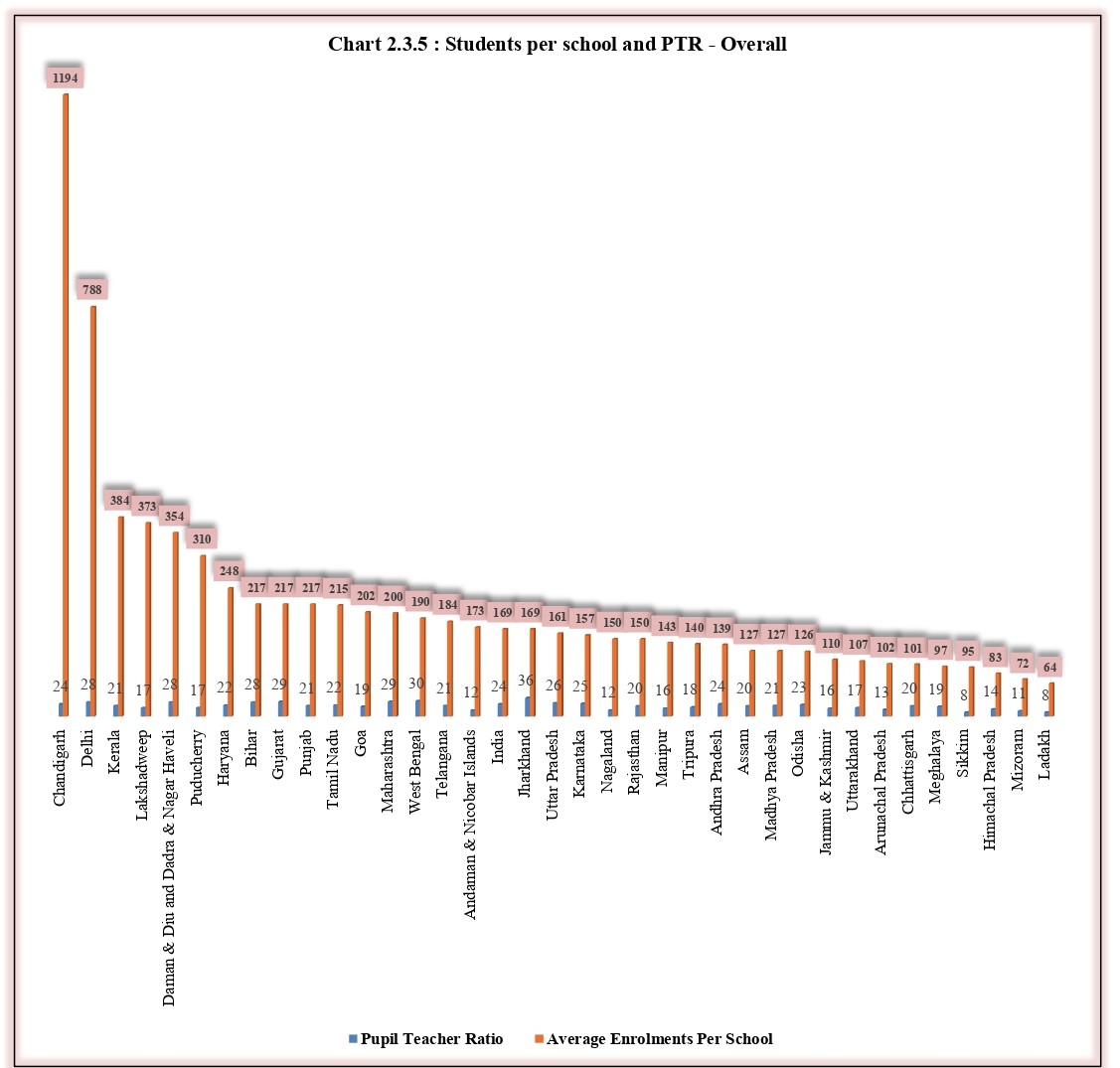
UDISE+ data for 2025-26 show that India has 10,273,020 teachers across 1,466,682 schools serving 247,219,766 students. The national pupil-teacher ratio (PTR) stands at 24, with an average of about seven teachers per school.
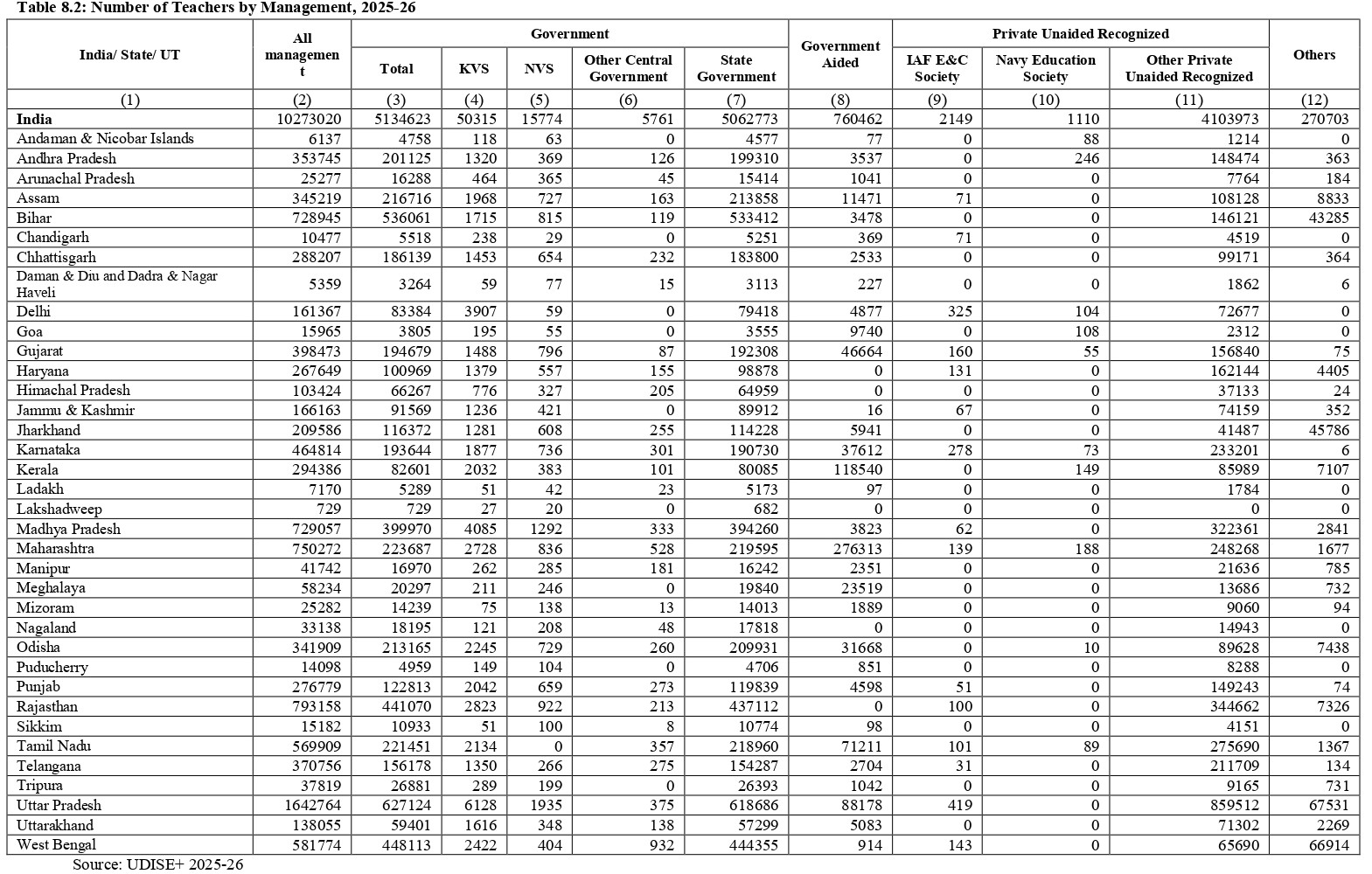
The latest data also reveal substantial differences in teacher availability across states. Uttar Pradesh has the largest school-teaching workforce at 1,642,764 teachers, followed by Rajasthan with 793,158, Maharashtra with 750,272, and Bihar with 728,945. Chandigarh has the lowest total teacher count listed at 10,477.
Despite the size of their teaching workforces, several large states have relatively low staffing density at the individual school level. Bihar, Uttar Pradesh and West Bengal generally average between six and eight teachers per school, while Chandigarh has an average of 50 teachers per school and Delhi 29.
Bihar has 95,285 schools, 20,696,191 students and 728,945 teachers, giving the state a PTR of 28. The average school in the state has eight teachers and 217 students. The state has 2,006 single-teacher schools serving 162,393 students.
The UDISE+ data also point to staffing imbalances within the school system. As many as 20,667 teachers are deployed in schools that currently have zero student enrollment, with West Bengal accounting for 19,502 of them.
At the same time, 100,843 schools across India operate with only one teacher. Uttar Pradesh has the largest number of such schools at 7,874, followed by Rajasthan with 7,200 and West Bengal with 6,769.
The presence of single-teacher schools has implications for students across primary and secondary levels, particularly where one teacher is responsible for multiple grades.
India’s school teacher workforce and distribution
For the 2025-26 academic year, teachers at the higher secondary level account for the largest share of the country's school teaching workforce at 33.2%. Upper primary teachers account for 28%, primary teachers 23% and secondary teachers 15.9%.
State-level patterns vary considerably. West Bengal has the highest proportion of teachers working in the primary category, at 51.2%. Gujarat records the largest share at the upper primary level, with 54.1% of its teachers in that category.
Goa has the highest concentration of teachers in the secondary category, at 51.3%, while Chandigarh has the largest proportion at the higher secondary level, with 66.9% of its teachers working in that category.
The distribution of teachers by the classes they teach also shows that the workforce is spread across different combinations of school levels. At the national level, 2% of teachers teach pre-primary classes only, while 4% teach both pre-primary and primary. Primary-only teachers account for 35%, and 12% teach both primary and upper primary.
Another 16% teach upper primary only, 8% teach upper primary and secondary, 11% teach secondary only, 5% teach secondary and higher secondary, and 7% teach higher secondary only.
The composition of the teaching workforce also differs by social category. General-category teachers account for 40% of the workforce, while SC teachers make up 13%, ST teachers 8% and OBC teachers 39%.
Management-wise, government schools account for 50% of teachers, followed by private schools with 40%. Government-aided schools account for 7.4%, while other management categories account for 2.6%.
UDISE+ data show that State Government schools alone employ 5,062,773 teachers. Across the broader government category, including central government systems, the number is 5,134,623. This includes 50,315 teachers in Kendriya Vidyalayas, 15,774 in Jawahar Navodaya Vidyalayas and 5,761 in other Central Government schools.
School Management Category
Total Number of Teachers
Total Number of Teachers
10,273,020
Kendriya Vidyalayas (KVs)
50,315
Jawahar Navodaya Vidyalayas (JNVs)
15,774
Other Central Government Schools
5,761
State Government Schools
5,062,773
Total Government Schools
5,134,623
Government Aided Schools
760,462
Private Unaided Recognized Schools
4,107,232
Other Schools
270,703
Government-aided schools account for 760,462 teachers. Private unaided recognized schools employ more than four million teachers, making the private sector one of the country's largest sources of school educators. Other schools account for 270,703 teachers.
The private recognized category also includes specialized institutions such as the IAF E&C Society, with 2,149 teachers, and the Navy Education Society, with 1,110 teachers.
PTR remains an important measure of school staffing
The Right to Education Act and the National Education Policy 2020 emphasize an appropriate balance between students and teachers through the pupil-teacher ratio. A lower PTR generally allows teachers to provide greater individual attention and develop more meaningful classroom interactions.
NEP 2020 recommends a PTR of 30:1 at all levels of school education to support interactive learning and improve learning outcomes. Accurate information on student enrollment and teacher availability is therefore important for assessing whether schools have adequate staffing.
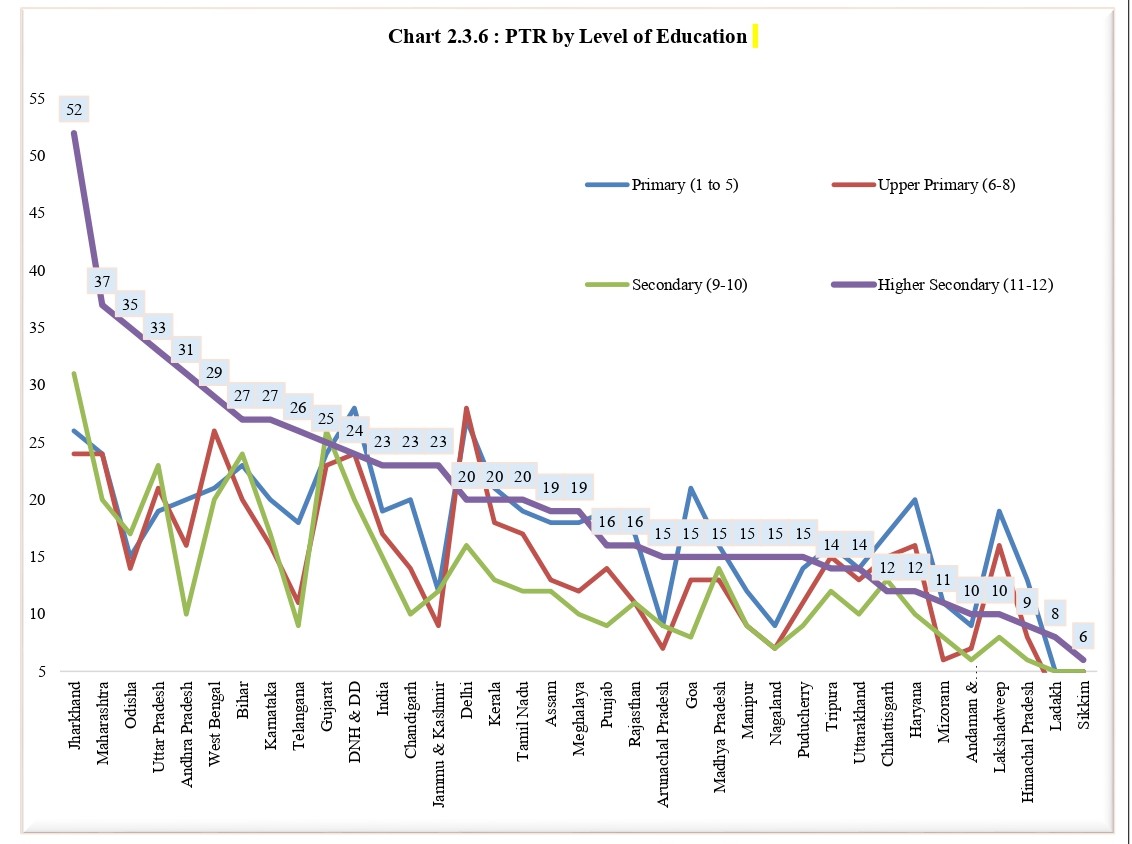
UDISE+ 2025-26 puts India's overall school PTR at 24. However, the ratio varies across states and school levels, and some states continue to exceed prescribed norms, particularly at the higher secondary level.
The data also show differences in the average number of students served by individual schools. Chandigarh and Delhi have among the highest numbers of students per school while maintaining PTR levels within the Right to Education norms, indicating comparatively high utilization of school infrastructure.
In contrast, Ladakh, Mizoram, Himachal Pradesh, Sikkim and Meghalaya have substantially fewer students per school. This points to a different infrastructure challenge, where the issue is not simply a shortage of teachers but also the need to optimize school infrastructure in areas with smaller student populations.
India’s school PTR differs from OECD international comparisons
The school-level picture becomes more complicated when India is compared with other education systems using internationally standardized OECD data.
The latest OECD data show India's student-to-teaching-staff ratio at 27 students per teaching staff member in primary education, compared with an OECD average of 14. At the lower-secondary level, India's ratio is 19 against an OECD average of 13, while at upper secondary it is 21 against an OECD average of 13.
Among major economies, the primary-level ratio is 21 in the United States, 25 in the United Kingdom, 18 in France, 15 in Germany and 15 in Spain. The figures indicate that India's primary-level ratio is higher than the ratios reported for most of these countries.
At lower secondary, the United Kingdom records 14 students per teaching staff member, the United States 15, France 12, Germany 13 and Spain 11. At upper secondary, the corresponding figures are 14 for the UK, 16 for the US, 13 for France, 13 for Germany and 11 for Spain.
The OECD also reports differences among other English-speaking education systems. The United States has 21 students per teaching staff member at primary level, 16 at lower secondary and 20 at upper secondary. The UK records 25, 25 and 33, respectively.
Australia has a ratio of 14 at primary level, while data for its secondary levels are unavailable in the OECD table. Canada records 16 at primary and 13 at upper secondary, with lower-secondary data unavailable. Ireland records 13 at primary and 14 at upper secondary. New Zealand reports 16 at primary, 13 at lower secondary and 14 at upper secondary.
The OECD average student-to-teacher ratio in primary education declined from 15 to 14 between 2015 and 2024.
The OECD figures should not, however, be directly substituted for India's UDISE+ school-level figures. The two datasets use different classifications and methodologies. UDISE+ data for 2024-25 recorded India's PTR at 20 at primary level, 17 at upper primary, 15 at secondary and 23 at higher secondary.
The OECD's internationally comparable dataset, using its own classification, reported India at 27 in primary, 19 in lower secondary and 21 in upper secondary for 2024. The difference reflects the methodology and classification used by the two datasets rather than a contradiction in the underlying education system.
Higher education teacher strength rises 27%
India's higher education sector has also expanded its teaching workforce substantially over the past decade.
According to an SBI Research report based on All India Survey on Higher Education data, the number of teachers in higher education increased from 1,367,535 in 2013-14 to 1,732,294 in 2023-24. This represents an increase of nearly 3.65 lakh teachers, or about 27% over the period.
The rise in teacher strength accompanied the expansion of India's higher education infrastructure. In 2023-24, the country had 1,289 universities, 48,246 colleges and 15,221 standalone institutions, taking the total number of higher education institutions to 64,756.
The composition of the higher education teaching workforce has also changed. The share of female teachers increased from 39% in 2013-14 to 45% in 2023-24.
Representation of teachers from reserved social categories also rose during the decade. The share of SC teachers increased from 6.9% to 10%, while the share of ST teachers rose from 2% to 3%. The proportion of OBC teachers increased from 23.5% to 32%.
Higher education PTR at 23, but state differences are wide
SBI Research puts India's pupil-teacher ratio in higher education at 23 in 2023-24 when universities and colleges operating in regular mode are considered together.
The report describes this overall ratio as broadly comparable with international levels, noting that ratios of around 25:1 to 30:1 are often seen in leading institutions in the United States and Europe, depending on the program of study.
The national figure, however, conceals substantial differences between states.
Tamil Nadu, Kerala and Goa report a higher education PTR of around 14, while Bihar has a ratio of 57. Jharkhand records 48 and Uttar Pradesh 33. The Parliamentary Standing Committee on Education has cited 15:1 as an ideal PTR for higher education.
The higher education figure should be read separately from the OECD school-level comparison. The SBI Research data cover universities and colleges, while the OECD figures discussed earlier concern school education and use an internationally standardized classification of primary, lower-secondary and upper-secondary education.
Vacancies remain a major higher education concern
The increase in India's overall higher education teaching workforce has not eliminated staffing shortages in centrally funded institutions.
SBI Research, citing parliamentary data, says 14,042 of 41,351 sanctioned teaching posts were vacant across central universities and centrally funded institutions. That amounts to a vacancy rate of 34%.
The vacancy situation varies sharply by institution type. Central universities had a vacancy rate of 33%, while 39% of teaching posts in IITs were vacant. The figure was 54% in IIITs, 29% in NITs and 31% in IIMs. IISERs had a comparatively lower vacancy rate of 7%.
Vacancies were particularly pronounced at the professor level, where 56.2% of sanctioned posts were vacant.
The figures present a mixed picture for India's higher education system. Teacher strength has increased substantially over the past decade, but the growth has occurred alongside significant differences in pupil-teacher ratios between states and persistent vacancies in centrally funded institutions.
The global teacher shortage
India's teacher data come against a much broader international challenge. UNESCO estimates that the world will need 44 million additional primary and secondary teachers by 2030 to achieve universal basic education.
Sub-Saharan Africa accounts for about 15 million of the projected requirement, while Southern Asia, including India, faces a projected gap of 7.8 million teachers.
The shortage is not limited to developing regions. Countries across Europe and North America also face difficulties recruiting and retaining teachers. UNESCO has identified heavy workloads, modest pay and insufficient recognition among factors affecting the attractiveness and sustainability of the profession.
The challenge therefore extends beyond increasing the number of teachers. Education systems need to recruit, train, place and retain educators while ensuring appropriate working conditions, professional development, remuneration and institutional support.
Why World Teachers’ Day is observed on Oct 5
World Teachers’ Day is observed every year on Oct 5 to recognize the contribution of teachers and draw attention to the conditions under which they work.
The date marks the adoption of the 1966 ILO-UNESCO Recommendation concerning the Status of Teachers. On Oct 5, 1966, a special intergovernmental conference convened by UNESCO in cooperation with the International Labour Organization adopted the recommendation.
The framework established international standards concerning teachers' rights and responsibilities, initial training, continuing education, recruitment, employment and teaching and learning conditions.
World Teachers’ Day was first celebrated in 1994, nearly three decades after the recommendation was adopted. The occasion has since become an annual platform for recognizing educators while examining the challenges affecting the teaching profession.
India observes Teachers’ Day separately on Sept 5, the birth anniversary of former President and philosopher Dr Sarvepalli Radhakrishnan.
The 2026 theme focuses on the future of teaching
UNESCO has announced the 2026 World Teachers’ Day theme as “Standing with teachers: 60 years of protecting the profession, advancing its status and shaping our futures.”
The theme places the emphasis not only on recognizing teachers but also on the professional, financial and institutional support required to enable them to perform their roles effectively.
Teachers are working in an environment that has changed substantially since the 1966 recommendation was adopted. Digital technologies, changing student needs, climate change, inclusion, migration and displacement are creating new demands for education systems and teachers.
The 2026 observance also comes as UNESCO reviews the 1966 recommendation after six decades. The revision is examining issues including teachers' professional autonomy, participation in policymaking, salaries, workloads and working environments.
The review reflects the changing nature of teaching. Educators are increasingly expected to use technology, respond to diverse learning needs and address social and environmental challenges alongside their traditional classroom responsibilities.
World Teachers’ Day 2026 in Paris
The global World Teachers’ Day 2026 celebration will be held at UNESCO headquarters in Paris on Oct 5. Teachers, education ministers, policymakers, academics, youth and other education stakeholders are expected to participate in discussions on the future and status of the teaching profession.
The event will also include the award ceremony for the ninth UNESCO-Hamdan Prize for Teacher Development.
Teacher-student relationships can significantly influence students’ engagement, confidence and approach to learning. Supportive teachers can make difficult subjects easier, encourage participation, help students regain confidence and motivate them to persist through challenges.
These relationships also highlight why teacher shortages and staffing imbalances matter, as overcrowded classrooms and single-teacher schools can reduce the individual attention students receive.
India’s teacher data present a mixed picture
The latest UDISE+ and SBI Research figures show that India has made considerable progress in expanding its teaching workforce. School education now has more than 10.27 million teachers, while higher education has added nearly 3.65 lakh teachers over a decade.
At the same time, the national averages conceal significant differences. Bihar's school PTR is 28, compared with the national figure of 24, while its higher education PTR is 57.
Uttar Pradesh has the country's largest school-teaching workforce but also thousands of single-teacher schools. West Bengal has nearly 19,500 teachers working in schools with no student enrollment, while more than 100,000 schools nationwide have only one teacher.
Higher education presents a similar contrast. India's overall higher education PTR of 23 is described by SBI Research as broadly comparable with international levels, yet states such as Bihar and Jharkhand have ratios of 57 and 48, respectively.
At the same time, more than one-third of sanctioned teaching positions in centrally funded institutions remain vacant, with professor-level vacancies exceeding half of sanctioned posts.
These figures place the focus of World Teachers’ Day beyond simply counting teachers. The larger question is whether education systems have the right number of teachers in the right places, whether classrooms allow meaningful interaction, and whether institutions can recruit and retain educators under sustainable professional conditions.
As World Teachers’ Day marks 60 years of the ILO-UNESCO recommendation in 2026, the global teacher shortage and India's own staffing data point to the same challenge: strengthening the teaching profession requires not only more educators, but also better distribution, adequate staffing, professional recognition, manageable workloads, appropriate infrastructure and sustained institutional support.