


An unprecedented influx of nearly 60,000 migrants into Spain's North African enclave of Ceuta has triggered a humanitarian crisis, renewed concerns over Europe's external borders, and prompted France and Italy to tighten border controls with Spain.
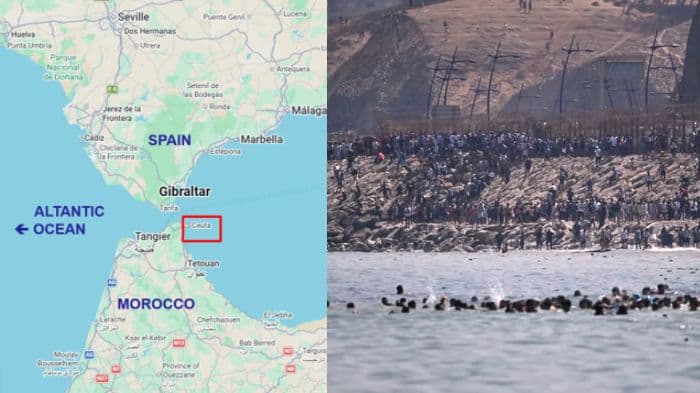
Europe is grappling with one of its biggest migration emergencies in recent years after an estimated 60,000 migrants entered Ceuta, Spain's autonomous enclave on Morocco's northern coast, within a matter of days. The sudden influx overwhelmed local authorities, left over 50 people dead during dangerous sea crossings, and reignited debate over border security, migration policy and the functioning of the Schengen free-travel area.
The crisis has prompted France to strengthen checks along its border with Spain and Italy to temporarily reintroduce border controls for air and sea links with Spain, citing national security concerns.

What happened in Ceuta?
Ceuta is one of two Spanish territories in North Africa, alongside Melilla. Although geographically located on the African continent and bordering Morocco, it is part of Spain and therefore represents one of the European Union's external frontiers.
According to Spanish authorities, around 60,000 migrants crossed into Ceuta by land and sea over a short period, overwhelming reception centres and security forces. Many attempted to reach the enclave by swimming around coastal barriers, while others crossed on foot. The mass movement resulted in dozens of deaths during the dangerous sea crossings.
Spanish authorities later said that about 48,000 migrants had returned to Morocco, significantly reducing pressure on the enclave, although thousands remained.
Why did so many people cross?
Authorities have not identified a single confirmed trigger for the sudden migration wave.
Spanish officials have blamed human-smuggling networks for encouraging migrants to cross by spreading misleading information. Another factor under discussion is a recent Spanish Supreme Court ruling limiting the immediate return of some migrants arriving by sea, which smugglers are believed to have misrepresented to potential migrants.
Some analysts have also pointed to Spain-Morocco diplomatic tensions as a possible contributing factor, although there is no conclusive evidence that Morocco deliberately relaxed border controls to facilitate the crossings. Fact-checkers and officials have rejected several viral claims circulating online about the incident.
Why are France and Italy concerned?
Although Ceuta itself is not part of the Schengen free-movement area, European governments fear that migrants could eventually attempt to move onward into mainland Europe if the situation escalates.
French President Emmanuel Macron said France had strengthened checks at its border with Spain by deploying additional mobile police units, aircraft and drones if required to prevent any spillover from the crisis.
Italy went a step further.
Prime Minister Giorgia Meloni announced the temporary reintroduction of border checks for air and sea travel between Italy and Spain for one month.
The Italian government said the measure is aimed at protecting national security and will focus primarily on third-country nationals arriving from Spain. Spanish and other EU citizens retain their freedom of movement, but they may face additional document checks during travel.
What does this mean for Schengen?
The Schengen Area normally allows passport-free travel across most participating European countries.
However, Schengen rules permit member states to temporarily reintroduce internal border controls in exceptional circumstances, including security threats or extraordinary migration pressures.
Italy's move does not suspend Spain's Schengen membership but temporarily reinstates checks on certain routes between the two countries.
Humanitarian concerns
Beyond the political debate, the crisis has created a humanitarian emergency.
Reception centres in Ceuta were overwhelmed as thousands sought shelter, while emergency services struggled to provide food, medical care and accommodation.
Many migrants risked their lives attempting to swim around breakwaters separating Morocco from the Spanish enclave, resulting in dozens of fatalities.
Spanish authorities, supported by security forces, have continued efforts to manage the situation while coordinating with Morocco to facilitate the return of migrants who chose to go back.
Hunter of Underwater Threats: Why INS Mangrol Is Important for the Indian Navy

Delhi Protests Renew Debate Over Constitutional Right to Peaceful Assembly

Household Inflation Rises to 5.54% in September as Price Pressures Spread

Delhi High Court Allows Urgent Hearing on Protest Site Guidelines
India Rejects China’s Objection to Standardised Names of Places in Ladakh
Karnataka student elections return after 37 years: Why political restrictions and university polls remain contentious
Global education is shifting from simply going abroad to creating more flexible routes to opportunity
Delhi Police files FIR against Congress MP Bimol Akoijam over JNU sexual harassment allegations
Utkal University tightens security after late-night explosions ahead of student polls

IET India Scholarship Award 2026: DTU’s Kush Garg wins top honor for AI device for neurodivergent children

Hunter of Underwater Threats: Why INS Mangrol Is Important for the Indian Navy
Delhi Protests Renew Debate Over Constitutional Right to Peaceful Assembly
Household Inflation Rises to 5.54% in September as Price Pressures Spread
Delhi High Court Allows Urgent Hearing on Protest Site Guidelines
India Rejects China’s Objection to Standardised Names of Places in Ladakh
Karnataka student elections return after 37 years: Why political restrictions and university polls remain contentious
Global education is shifting from simply going abroad to creating more flexible routes to opportunity
Delhi Police files FIR against Congress MP Bimol Akoijam over JNU sexual harassment allegations
Utkal University tightens security after late-night explosions ahead of student polls
IET India Scholarship Award 2026: DTU’s Kush Garg wins top honor for AI device for neurodivergent children
Copyright© educationpost.in 2026 All Rights Reserved.