In a bold display of defiance, hundreds of supporters of Nepal’s pro-monarchist Rastriya Prajatantra Party (RPP) staged coordinated protests across three sensitive locations in Kathmandu on April 20, demanding the reinstatement of the monarchy and the declaration of Nepal as a Hindu state.
Led by RPP chairman Rajendra Lingden, along with senior leaders Pashupati Shumsher Rana and former Inspector General of Police Dhruba Bahadur Pradhan, the demonstrators rallied near the Prime Minister’s official residence in Baluwatar and the Parliament building in Naya Baneshwor — both designated restricted zones.

Police detained three senior pro-monarchy leaders including chairman Lingden, senior vice president, Buddhiman Tamang, and chief whip and former Nepalese King Gyanendra Shah from Singha Durbar premises near Parliament during April 20th demonstration, sources told Education Post.
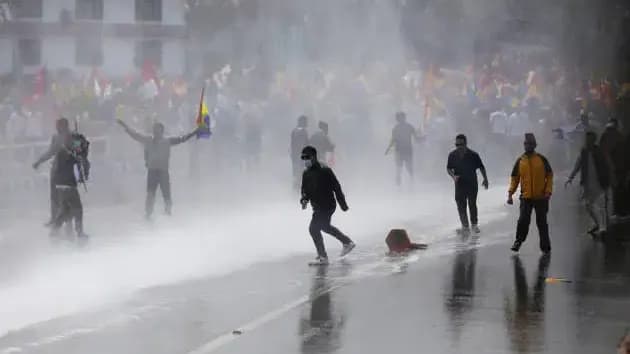
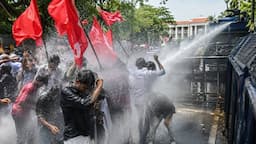
But this did not deter hundreds of protestors who flooded the Bijulibazar-Baneshwor corridor, waving placards and attempting to breach police barricades. They continued protest and kept on chanting slogans such as “Down with the republican system,” “We want monarchy back,” and “Establish Nepal as a Hindu state,”
"We are fully prepared to face arrest by staging a demonstration in the restricted zone. I am ready to be imprisoned for this cause," Lingden was quoted as saying moments before he was detained.
The party has also announced plans to organize protest assemblies across all 77 districts on April 22, signaling a nationwide mobilization effort, he added.
At Bhadrakali, home to Nepal’s government secretariat including the Prime Minister’s Office, another large group of agitators clashed with police in an effort to break through security cordons. Simultaneously, rallies erupted outside the Parliament building, intensifying pressure on the state apparatus.
Security forces responded swiftly, deploying thousands of riot police to critical areas including Maitighar, Bijulibazar, Bhadrakali, Baluwatar, and Naya Baneshwor. Despite a government directive prohibiting gatherings in these areas, RPP supporters announced plans to continue protests indefinitely until their demands are met.
Earlier in the day, Kathmandu also witnessed a massive turnout of school teachers protesting in Naya Baneshwor for education sector reforms and higher wages — adding further momentum to a day of widespread civil unrest in the capital.
The RPP has vowed to escalate its movement, signaling a prolonged campaign aimed at reshaping Nepal’s political landscape.
Notably, Nepal Police on April 11 arrested controversial political activist and healthcare magnate Durga Prasai, ending a dramatic weeks-long manhunt that began after a violent pro-monarchy rally in the capital on March 28.
Trouble escalated across Kathmandu as pro-monarchy demonstrators, rallying behind former Nepalese King Gyanendra Shah’s call for reinstating the monarchy, clashed with security forces on March 28. The clashes left two dead and over a hundred injured in the capital.
The abolition of Nepal’s monarchy in 2008 marked a watershed moment in the nation’s history, ending a decade-long civil war and responding to widespread public demand for change. The fall of the former king was more than a political transition — it was a powerful repudiation of autocratic rule marred by restricted democratic freedoms and systemic human rights violations.
The birth of a federal democratic republic was heralded as a triumph of the people’s will and a bold step toward inclusive governance. At its core, the shift aimed to dismantle the centralized power structure and uplift historically marginalized communities.
However, in the years since, the promise of a new era has been tempered by persistent political instability, revolving-door governments, rampant corruption, and a deepening public disillusionment over unmet socio-economic needs.







.jpg&w=256&q=75)
.jpg&w=256&q=75)
.webp&w=256&q=75)
