


Trump signals White House talks with Netanyahu and Aoun as fresh strikes and civilian deaths cast shadow over ceasefire.
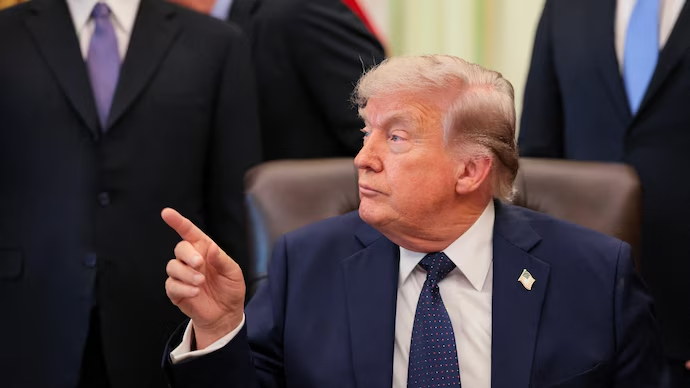
US President Donald Trump has announced a three-week extension of the ceasefire between Israel and Lebanon, offering a narrow but crucial window for diplomacy even as violence on the ground continues to claim lives.
The extension follows a high-level meeting at the White House, where Trump hosted Israeli ambassador Yechiel Leiter and Lebanese ambassador Nada Moawad in the Oval Office for a second round of US-mediated talks.

Calling the discussions “very productive,” Trump said the United States would deepen its engagement with Lebanon to help it counter the influence of Hezbollah, a central player in the conflict. He also stressed that Iran must halt its financial backing of Hezbollah as part of broader efforts to stabilize the region.
“The meeting went very well. The United States is going to work with Lebanon to help it protect itself from Hezbollah. The ceasefire between Israel and Lebanon will be extended by three weeks,” Trump said.
The meeting brought together senior US officials including Vice President JD Vance, Secretary of State Marco Rubio, US Ambassador to Israel Mike Huckabee, and US Ambassador to Lebanon Michel Issa.
Trump said he expects to host Israeli Prime Minister Benjamin Netanyahu and Lebanese President Joseph Aoun at the White House soon, signaling a possible shift toward direct political engagement between two countries with no formal diplomatic ties.
Such a meeting would be rare, reflecting a tentative thaw after decades of hostility.
Yet the ceasefire remains fragile. The talks came just a day after Israeli airstrikes killed at least five people in Lebanon, including journalist Amal Khalil, marking the deadliest day since the ceasefire took effect on April 16.
For families on the ground, the extension offers temporary relief but little certainty, as cross-border tensions continue to simmer.
Hezbollah lawmaker Hassan Fadlallah said the group supports extending the ceasefire only if Israel fully adheres to its terms. He rejected direct negotiations with Israel and urged the Lebanese government to suspend face-to-face engagement.
Clashes between Hezbollah and Israel reignited on March 2, when the group launched attacks in support of Iran amid a broader regional confrontation. Although the Lebanon ceasefire was negotiated separately from Washington’s parallel efforts with Tehran, Iran has pushed for Lebanon’s inclusion in any wider agreement.
Hezbollah said it carried out four operations in southern Lebanon in retaliation for Israeli strikes.
Lebanese authorities say nearly 2,500 people have been killed since Israel launched its offensive following the March 2 escalation— a stark reminder of the human cost behind the diplomacy.
Earlier this month, a 10-day ceasefire enabled by rare direct engagement offered a brief pause in fighting and raised cautious hopes for de-escalation. The new three-week extension builds on that momentum, but with trust low and violence ongoing, the path to lasting peace remains uncertain.
For now, the extension represents less a breakthrough than a fragile pause — one that could either open the door to dialogue or collapse under the weight of a conflict that continues to rage just beneath the surface.

US probes nine universities over J-1 visas, halts PERM processing for eight firms

NLSIU Bengaluru announces NLSAT 2027 date for BA, LLB, MPP and PhD admissions

School Holiday Today, October 12, 2026: Are Schools Closed? Check State-Wise Updates

NIOS Date Sheet 2026: Class 10, 12 October-November Exam Timetable Released, Check Schedule

Yogesh Singh begins second term as Delhi University vice-chancellor
US probes nine universities over J-1 visas, halts PERM processing for eight firms
.jpg&w=256&q=75)
Regional universities face international student slump as visa refusals and political rhetoric deter applicants

AI may lift homework scores but weaken real learning, World Development Report raises concerns
Ken Griffin’s record $3 billion gift to Carnegie Mellon to fuel new Miami campus

Michael Jordan pledges $10 million to UNC social work school in mother’s honour

US probes nine universities over J-1 visas, halts PERM processing for eight firms
NLSIU Bengaluru announces NLSAT 2027 date for BA, LLB, MPP and PhD admissions
School Holiday Today, October 12, 2026: Are Schools Closed? Check State-Wise Updates
NIOS Date Sheet 2026: Class 10, 12 October-November Exam Timetable Released, Check Schedule
Yogesh Singh begins second term as Delhi University vice-chancellor
US probes nine universities over J-1 visas, halts PERM processing for eight firms
Regional universities face international student slump as visa refusals and political rhetoric deter applicants
AI may lift homework scores but weaken real learning, World Development Report raises concerns
Ken Griffin’s record $3 billion gift to Carnegie Mellon to fuel new Miami campus
Michael Jordan pledges $10 million to UNC social work school in mother’s honour
Copyright© educationpost.in 2026 All Rights Reserved.