Russia’s Far East was jolted awake early July 30 by a catastrophic 8.8-magnitude earthquake — the world’s strongest since Japan’s 2011 disaster — sending tsunami waves crashing into coastal towns and triggering widespread alarms across the Pacific, from Japan to Hawaii.
The epicenter was located just 119 kilometers southeast of Petropavlovsk-Kamchatsky, a city of 165,000 on the Kamchatka Peninsula, at a shallow depth of 19 kilometers. The US Geological Survey initially recorded the quake at 8.0 before upgrading it to 8.8, confirming the tremor as a rare and dangerous seismic event. A powerful 6.9-magnitude aftershock struck shortly afterward.

“This earthquake was serious — the strongest in decades of tremors,” said Kamchatka Governor Vladimir Solodov.
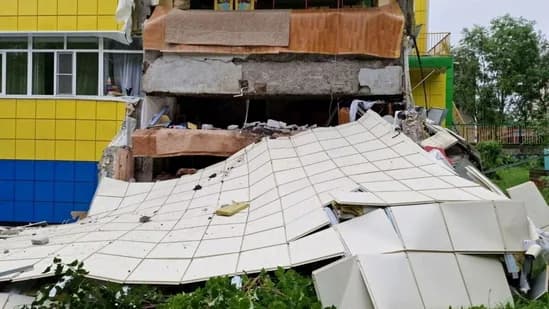
Tsunami waves as high as four meters slammed parts of Kamchatka, prompting evacuations along coastal areas. Russia’s emergency ministry confirmed flooding in Severo-Kurilsk — a town on Sakhalin Island — damaging a port, fish processing plant, and a kindergarten. The town’s residents were moved to safety.
At least a handful of injuries were reported. According to regional health minister Oleg Melnikov, victims included people hurt during the evacuation and one woman who jumped from a window in panic. “All patients are in stable condition,” he told state media outlet TASS.
Global ripple effect
Japan’s Meteorological Agency issued tsunami warnings for much of its eastern seaboard, forecasting waves up to three meters high. On the island of Hokkaido, residents were seen taking refuge on rooftops as fishing boats fled harbors.
In a precautionary move, workers at the Fukushima Daiichi nuclear plant — the site of the 2011 meltdown — were temporarily evacuated. No damage or irregularities were reported at any nuclear facility, Japan’s Chief Cabinet Secretary Yoshimasa Hayashi said.
Tsunami alerts rippled across the Pacific, with the US Tsunami Warning Center cautioning of waves between one and three meters along coasts of Japan, Hawaii, Chile, Ecuador, and the Solomon Islands. Smaller surges were expected along parts of the US West Coast.
In Hawaii, local emergency authorities ordered evacuations of low-lying areas. “Take Action! Destructive tsunami waves expected,” read alerts issued by Honolulu’s emergency management office.
Former U.S. President Donald Trump acknowledged the alerts in a social media post, writing: “A Tsunami Warning is in effect for those living in Hawaii … Japan is also in the way.”
Most powerful since 1952 for Kamchatka
The Russian Academy of Sciences called it the most powerful quake to strike the Kamchatka region since 1952. However, experts said the impact could have been far worse.
“Due to characteristics of the epicenter, the shaking intensity was not as devastating as typical for such a powerful quake,” said Danila Chebrov, head of the Kamchatka branch of Russia’s Geophysical Service. He added that while aftershocks are continuing, stronger tremors are unlikely and “the situation is under control.”
Still, the earthquake marks a grim milestone — the most powerful globally since the catastrophic 9.0 quake off northeast Japan in March 2011 that unleashed a devastating tsunami and triggered the Fukushima nuclear disaster.
As seismic aftershocks ripple across the region and monitoring continues, the quake stands as a stark reminder of the Pacific Rim’s volatile geology — and the razor-thin margin between safety and catastrophe.










.jpg&w=256&q=75)
.jpg&w=256&q=75)
.webp&w=256&q=75)