


MIT has enrolled nearly 500 fewer graduate students since 2024 following a $100 million drop in federal research awards, raising concerns that shifting US science funding towards AI and industry could weaken basic research and long-term scientific competitiveness.
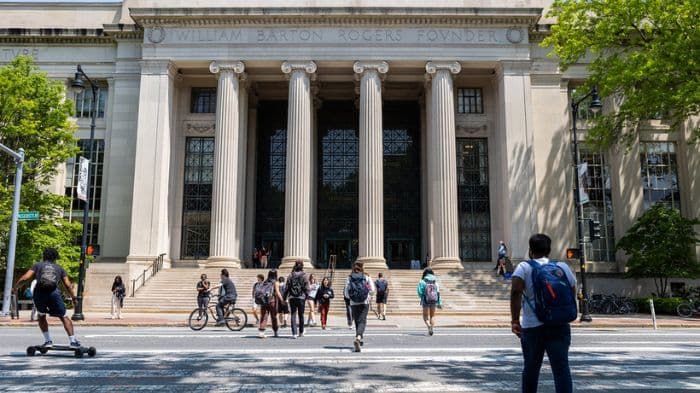
The United States is facing a debate over the future of its research system as the Trump administration seeks to direct more scientific investment towards artificial intelligence, advanced computing and other national priorities.
University leaders have warned that reducing the role of academic institutions in publicly funded research could undermine the basic science that has driven major technological and medical advances.

Speaking at the STAT Summit in Boston on Oct 14, Massachusetts Institute of Technology (MIT) President Sally Kornbluth highlighted the consequences of funding uncertainty for graduate education.
MIT enrolled nearly 500 fewer graduate students in autumn 2026 than in 2024, a decline of around 20%. Kornbluth attributed the reduction to a $100 million decrease in federal research awards to the institution over the same period.
Graduate students depend heavily on research grants for financial support. Kornbluth said the university had become more cautious about admissions because it did not want students to begin doctoral programmes only to find that funding had run out before they could complete their degrees.
According to STAT, a US-based news publication, universities across the country have reduced or suspended admissions to some graduate programmes amid grant cancellations, funding delays and changes in federal research policy.
White House seeks a different model for scientific research
The funding changes reflect a broader shift in the Trump administration's approach to American scientific research. A policy blueprint issued by the White House Office of Science and Technology Policy proposes redirecting hundreds of billions of dollars in research funding from universities towards industry, particularly artificial intelligence and technology companies.
The administration has also announced $6 billion in new national research investments, including support for advanced computing facilities, autonomous laboratories, nuclear-powered spacecraft, next-generation quantum computers and accelerated training in artificial intelligence and engineering.
These investments are intended to strengthen American innovation in strategically important fields. However, university leaders have questioned whether a greater emphasis on targeted technological development can adequately support fundamental research whose practical applications may not be immediately apparent.
Kornbluth argued that universities play a distinctive role in supporting curiosity-driven research, which allows scientists to investigate questions without having to demonstrate an immediate commercial or strategic benefit.
She cited developments such as CRISPR gene editing and microRNA research as examples of discoveries that emerged from fundamental scientific work. In her view, restricting the resources available for this kind of research could produce short-term gains while weakening the pipeline of future discoveries.
Kornbluth warned that the consequences might become apparent only five or 10 years later, with effects extending to future generations.
China adds to concerns over US research competitiveness
The funding debate comes as China strengthens its position in global scientific research. Holden Thorp, editor-in-chief of the Science family of journals, who joined Kornbluth at the summit, said the United States was already facing increasing competition before recent disruptions to federal research funding.
According to forecasts cited in the report, China could overtake the United States in public science research spending within the next two to three years.
Thorp also pointed to the growing presence of Chinese institutions in global research rankings. Data from the Nature Index cited in the report placed nine Chinese institutions among the world's top 10 academic research institutions, with Harvard University the only US institution on the list. A decade earlier, American universities accounted for half of the top 10.
Thorp said submissions from China to the Science family of journals were increasing in both volume and quality. He noted that Science Advances was publishing an equal number of papers from the United States and China, and predicted that the flagship journal Science could reach a similar position within four to five years.
He cautioned, however, that it was too early to determine how the latest changes in US funding would affect research output and leading scientific publications.
Universities face pressure to rebuild public trust
The debate also reflects wider questions about the relationship between universities and the public. Both Kornbluth and Thorp argued that research institutions must respond to declining trust in established institutions and concerns about higher education's accessibility.
Kornbluth highlighted MIT for America, an initiative launched in October that sends students and alumni across the country to support mathematics, computer science and other science, technology, engineering and mathematics (STEM) teaching in under-resourced high schools.
The initiative aims to expand educational opportunities while strengthening connections between universities and local communities.
Thorp also urged universities to address practices that can reinforce perceptions of privilege, including legacy admissions policies that give applicants with family connections to an institution an advantage.
The competing approaches to American science funding are likely to remain a central issue as policymakers weigh immediate technological priorities against the long-term needs of scientific discovery.
While industry and national laboratories can play important roles in innovation, university leaders argue that sustained support for academic research remains essential to maintaining the country's scientific capacity.

NEET-PG transparency plea reaches Supreme Court today

TEQSA proposes revised regulatory fees from 2027, invites feedback

Global Hunger Index 2026: India Ranks 100th, Remains in ‘Serious’ Hunger Category

BITS Design School Student Atharva Lele Secures Global Recognition in AGP Design Contest
Qatar career fair connects graduates with employers across key sectors
China races to place graduates as it readies its 2027 jobs plan
.jpg&w=256&q=75)
Irish university strikes force class cancellations across the country

Philippines audit agency flags lapses in CHEd scholarship programs

Singapore Management University’s Executive MBA enters global top 50 in Financial Times ranking

NUS launches clinical psychology program to expand Singapore’s mental healthcare workforce

NEET-PG transparency plea reaches Supreme Court today
TEQSA proposes revised regulatory fees from 2027, invites feedback
Global Hunger Index 2026: India Ranks 100th, Remains in ‘Serious’ Hunger Category
BITS Design School Student Atharva Lele Secures Global Recognition in AGP Design Contest
Qatar career fair connects graduates with employers across key sectors
China races to place graduates as it readies its 2027 jobs plan
Irish university strikes force class cancellations across the country
Philippines audit agency flags lapses in CHEd scholarship programs
Singapore Management University’s Executive MBA enters global top 50 in Financial Times ranking
NUS launches clinical psychology program to expand Singapore’s mental healthcare workforce
Copyright© educationpost.in 2026 All Rights Reserved.