Dengue is no longer just a seasonal threat — it is a rapidly evolving global health challenge. As cases surge across continents, scientists are turning to cutting-edge technologies to understand, predict and ultimately outsmart a virus that has long defied easy answers.
From decoding infections at the level of individual cells to predicting severe illness before symptoms spiral, researchers are now studying dengue in ways that were unimaginable just a few years ago.

At the forefront are tools like single-cell sequencing — a technique that works like a microscopic detective, tracking what happens inside each infected cell — and advanced protein biomarker analysis, capable of scanning thousands of biological signals from a single blood sample. Together, these innovations promise to reshape how dengue is diagnosed, monitored and treated.
A global scientific push
As climate change redraws the map of dengue risk, an ambitious Indo-European alliance is stepping in. The COMBAT programme brings together leading scientists from India and Europe to tackle some of the disease’s most complex questions — from how the virus behaves inside the body to how vaccines can be made more effective.
Backed by the European Union’s HORIZON Research and Innovation Actions and India’s Department of Biotechnology, the initiative aims to strengthen global surveillance and public health systems as dengue spreads into new regions.
Leading the global effort from Sweden’s Karolinska Institute, Prof Ujjwal Neogi says the project is designed not just to study dengue, but to prepare for future outbreaks. The goal is to build systems that can anticipate and respond to emerging threats, whether in endemic zones or regions previously untouched by the disease.
India’s role: Where genomics meets ground reality
India’s contribution sits at the intersection of advanced genomics and real-world clinical expertise. The effort is led by Prof Arindam Maitra, alongside Dr Sagar Sengupta and Dr Anup Mazumder at the BRIC–National Institute of Biomedical Genomics in Kalyani.
Collaborating with institutions such as the Regional Centre for Biotechnology in Faridabad, the Manipal Institute of Virology in Udupi, Max Hospital in Delhi and Artemis Hospital in Gurugram, the team is working to understand why dengue turns severe in some patients while remaining mild in others.
By analyzing genes, immune responses and biological markers, researchers hope to identify early warning signs of severe disease — insights that could transform patient care.
Inside the lab: Watching the virus in action
In laboratories, the fight against dengue is becoming increasingly visual and data-driven.
High-resolution microscopy now allows scientists to observe the virus attacking human cells in real time — almost like watching a live broadcast of infection. Artificial intelligence is being woven into research pipelines, enabling systems to learn from vast datasets and apply those insights to other emerging pathogens.
Another breakthrough comes in the form of organ-on-chip models — miniature, lab-grown versions of human organs that allow researchers to study infections safely, without human testing. Some of these advanced systems are expected to be deployed in Indian research centres, marking a significant leap in domestic scientific capability.
Vaccine race gathers momentum
Alongside research, vaccine development is accelerating.
The Indian Council of Medical Research, in partnership with Panacea Biotec, is currently conducting a Phase III trial of DengiAll — a single-dose recombinant dengue vaccine. The trial spans 20 sites across 19 states and Union Territories and has enrolled more than 10,300 participants, signalling one of the most extensive efforts yet to develop a homegrown solution.
At the same time, Takeda’s tetravalent vaccine TAK-003, marketed as Qdenga, has cleared a key expert panel under India’s drug regulator for use in individuals aged 4 to 60 years.
The vaccine has shown 84.1% efficacy against hospitalised dengue cases and offers protection regardless of prior infection — a crucial advantage over earlier vaccines that required pre-screening. Already approved in more than 40 countries, with over 10 million doses distributed since 2023, it is emerging as a strong candidate in India’s dengue control strategy.
Meanwhile, researchers at ICMR’s National Institute of Virology in Pune are exploring antiviral treatments, including repurposed drugs, plant-based compounds and siRNA therapies. Several candidates have already reached preclinical stages, while new rapid diagnostic tools are also being developed for wider use.
Why dengue remains a scientific puzzle
Despite the momentum, dengue continues to challenge scientists.
One of the biggest hurdles is antibody-dependent enhancement — a paradoxical phenomenon where antibodies from a previous infection can worsen the disease if a person is later infected with a different strain.
Complicating matters further are the virus’s four distinct serotypes. Any effective vaccine must provide balanced, long-lasting protection against all of them — a task that has proven extraordinarily difficult.
The immune system itself adds another layer of complexity, often prioritising its response to the first strain it encounters. This imbalance can increase the risk of severe illness in subsequent infections, making vaccine design a delicate balancing act.
A growing global threat
The urgency is clear. Dengue cases worldwide have surged dramatically — from about 505,000 in 2000 to 14.6 million in 2024.
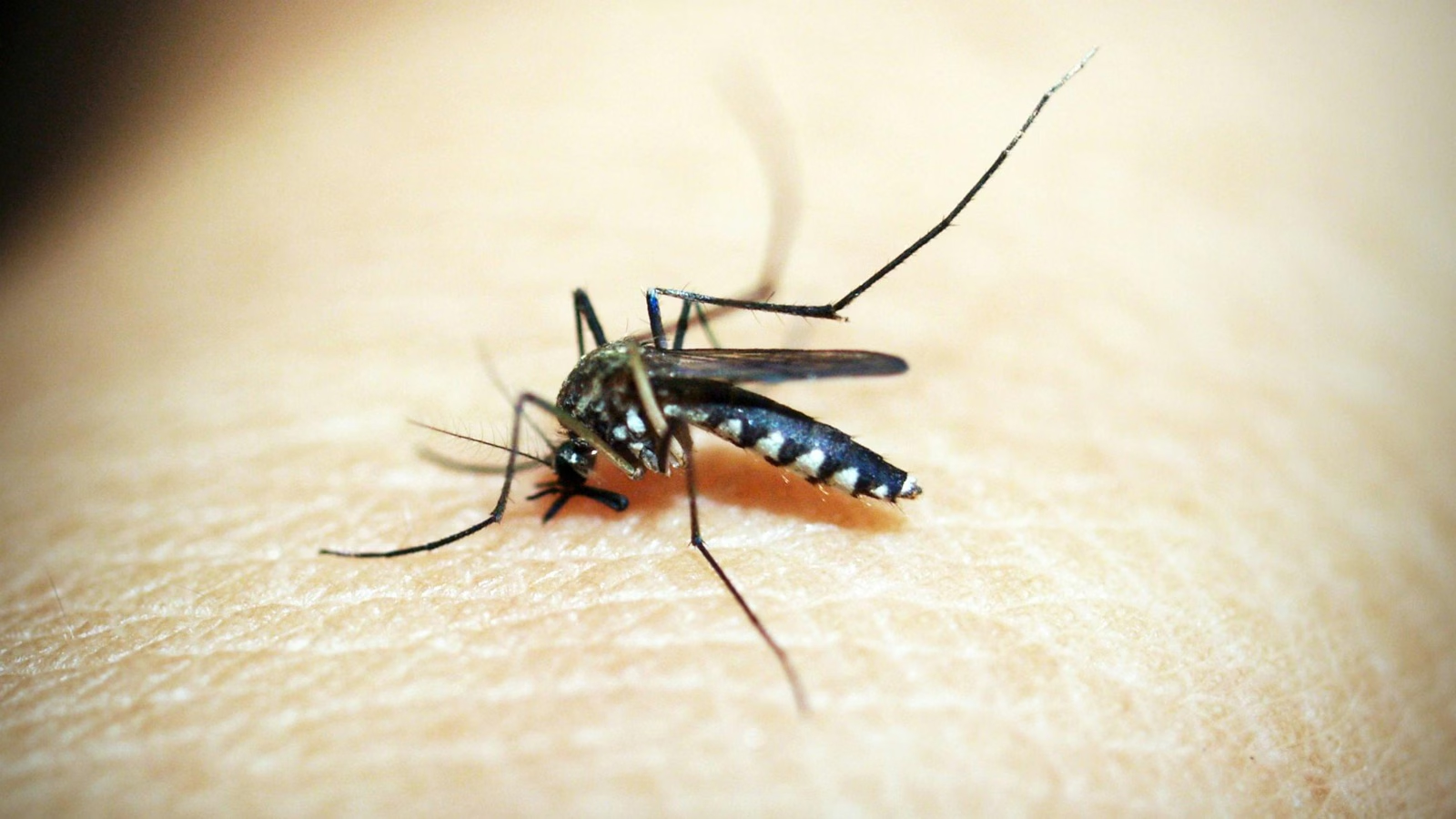
Rising global temperatures — up by roughly 0.9°C over the past two decades — have expanded the reach of Aedes mosquitoes into new territories. At the same time, shifting patterns of rainfall, humidity and heat continue to shape transmission cycles, often with predictable delays of two to five months.
Looking ahead, projections suggest dengue cases could rise by as much as 60% by mid-century, as more regions become hospitable to the disease.
Against this backdrop, the race between the virus and science is intensifying. For the first time, however, researchers believe they may finally have the tools to stay one step ahead.






.jfif&w=256&q=75)




.webp&w=256&q=75)
