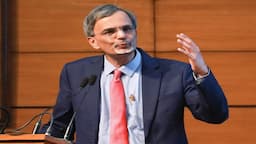
Microsoft Chairman and CEO Satya Nadella has said AI must remain under human control and called for international norms involving governments and technology companies, with an understanding between the United States and China as an essential starting point.
Speaking at the Ideas4India forum in Seattle on September 17, Nadella said powerful AI capabilities were advancing while important questions about controlling the technology remained unresolved.

“We do not yet have the science of alignment, and that's a fact,” he said. “And yet we have powerful technology.”
The guiding principle, he said, had to be its value to people and their continued authority over it. He said, “Any technology that doesn't serve humans or is not in control of humans is not worth doing”.
Nadella used a familiar software development dilemma to describe the problem: when confronted with a critical flaw, should a technology team defer dealing with it or stop the product from proceeding?
He suggested the industry faced a version of that dilemma. At the same time, he acknowledged that the forces shaping AI development made an absolute stance unlikely.
The answer, in his remarks, involved recognising both the technology’s power and the good that could come from making it widely available. Progress had to be accompanied by efforts to avoid unintended consequences.
During an interactive session, Nadella returned to the role of governments. He said the first requirement for governance was some agreed norms between the United States and China.
Such a dialogue, however, could not exclude the rest of the world, he said. His hope was for nation states to come together with the companies developing AI and establish shared norms.
He did not present a detailed negotiating framework. His remarks focused on the need for an understanding of the global AI race and cooperation between public authorities and the businesses creating the technology.
Nadella also argued that sovereignty mattered at the level of individual companies, as well as countries. Businesses continually generated knowledge, and that knowledge needed to remain under their control.
“Countries need to have control of their knowledge,” he said.
He linked those protections to wider participation in AI. Countries and companies needed to feel secure enough to engage fully, without becoming subject to somebody else’s technological frontier.
“It will only happen when all of the world can both benefit from and contribute to this knowledge,” he said of AI’s development and spread.
Nadella also cautioned against treating observed improvements in AI as an immutable scientific law. He described scaling laws as empirical findings that had so far held, drawing a comparison with the historical pattern known as Moore’s law.
India’s Ambassador to the United States, Vinay Kwatra, separately identified decisions about data and its use in model training as questions for government. He also stressed that the corporate sector had responsibilities in India’s AI development.
According to the consulate’s account of the event, Kwatra reaffirmed that India’s AI mission should remain anchored in inclusivity, openness, sovereignty, democratised access, safety and trust. The Seattle gathering followed the India AI Impact Summit 2026 and sought ideas from Indian American technology leaders.
The Consulate General of India brought together more than 40 Indian-origin chief executives and chief technology officers. Participants came from fields including AI, quantum computing, semiconductors, cloud infrastructure, aerospace and enterprise software, with discussions also covering skills and closer India-US research and industrial cooperation.
(Except the headline, this article has not been edited by Education Post)



.jpg&w=3840&q=75)
.jpg&w=256&q=75)