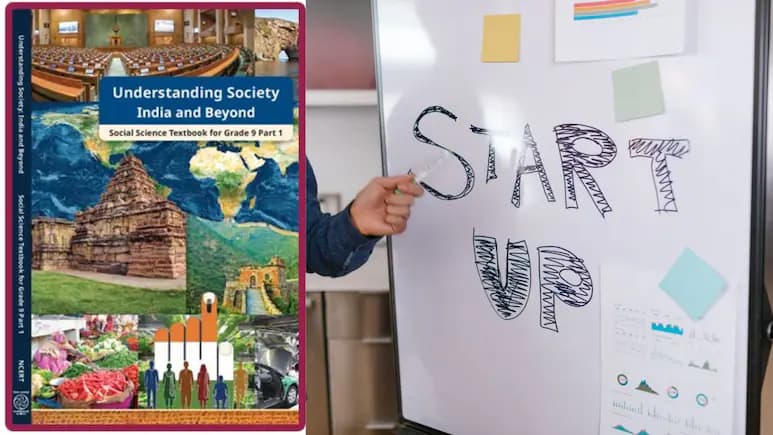
The National Council of Educational Research and Training (NCERT) has introduced Class 9 students to the world of startups and entrepreneurship through a new chapter in its Social Science textbook, Understanding Society: India and Beyond – Part 2.
The chapter, titled “From Ideas to Startups”, moves beyond conventional classroom lessons to introduce students to how businesses are conceived, planned and built. It covers business opportunities, market understanding, business planning, India’s growing startup ecosystem and the use of artificial intelligence (AI) in business decision-making.

In a post on X, NCERT said the chapter explores business opportunities and market dynamics while examining the role of AI in decision-making and drawing on real-life stories of Indian entrepreneurs.
The chapter is structured around three broad questions: how entrepreneurship influences society and the economy, what the key functional areas of a business are, and how an effective business plan can be prepared.
From a few hundred startups to a massive ecosystem
The textbook highlights the dramatic expansion of India’s startup landscape. It notes that the country had around 350-400 startups about a decade ago, while the ecosystem has now grown to nearly 2.3 lakh enterprises.
India, the book states, is now the world’s third-largest startup ecosystem.
The chapter also underlines the broader policy effort to bring research, industry, startups and entrepreneurship onto a common platform. Students are introduced to the fundamentals of running a business, including understanding market activity, identifying opportunities, assessing performance and planning before committing resources.
AI enters the classroom
The new chapter also brings artificial intelligence into entrepreneurship education, explaining how AI can support market analysis and business-related decision-making.
Rather than presenting entrepreneurship only through concepts and definitions, the textbook uses stories of Indian entrepreneurs to make the lessons more relatable and show students how businesses can emerge from modest beginnings.
From ₹80 and a Mumbai terrace to Lijjat Papad
One of the stories traces the beginnings of Lijjat Papad, which started in 1959 with seven women, borrowed capital of ₹80 and a Mumbai terrace.
According to the story, seven homemakers living in a Mumbai chawl began making papads using borrowed supplies and a traditional recipe. Without a factory or formal production setup, the women took dough home each morning, rolled papads while managing their household responsibilities and returned the finished products by evening.
The example illustrates how an enterprise can begin with limited resources, shared skills and a clear understanding of a market.
From a ₹50 salary to a hotel empire
Another story focuses on Mohan Singh Oberoi, who began his working life on a salary of ₹50 and went on to become a prominent figure in India’s hospitality industry.
The textbook notes that Oberoi mortgaged his wife’s jewellery to acquire his first hotel and subsequently built a large hotel business.
Through such stories, the chapter presents entrepreneurship not simply as a career choice, but as a process involving ideas, risk-taking, planning, resources and persistence.
The addition of the chapter marks a significant effort to expose school students to business and entrepreneurship concepts at an early stage, while connecting classroom learning with India’s changing economic and technological landscape.





.webp&w=256&q=75)