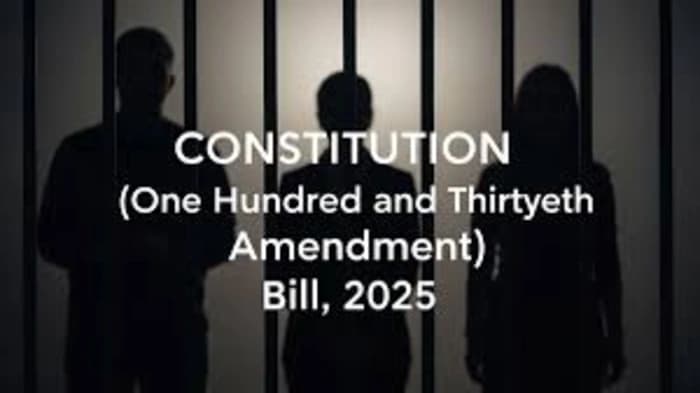
The Bill’s primary provision empowers Governors to act decisively against elected executives under specific conditions:
If the Prime Minister, Chief Minister, or any Minister is arrested and detained for 30 consecutive days on offences punishable with imprisonment of five years or more, the Governor may remove them from office.

Crucially, this action can be taken without a formal conviction, relying solely on the fact of detention and the gravity of the alleged offence.
The Bill aims to address concerns about political leaders allegedly evading accountability through prolonged legal processes and preventing the misuse of power while under serious legal cloud.
Constitutional Implications
While the Bill’s objective is framed as enhancing accountability, it raises significant constitutional questions:
1. Presumption of Innocence
At the heart of constitutional criminal jurisprudence lies the principle that an individual is presumed innocent until proven guilty by a competent court. The Bill’s provision undermines this by allowing removal based solely on arrest and detention, bypassing conviction and judicial adjudication.
2. Separation of Powers
The enhanced role of Governors—who are constitutional appointees often perceived as central government agents—risks politicizing what is fundamentally an administrative and constitutional office. This could blur the separation of powers and open doors to misuse for political vendettas.
3. Federalism and Political Autonomy
State governments may view this as an intrusion by the Centre into provincial autonomy, disrupting the federal balance. The power to remove elected heads without their legislature’s consent could weaken democratic governance and foster instability in states.
Political Debate & Way Forward
The Bill has provoked polarized reactions:
Supporters’ Perspective
Proponents argue it deters political leaders from exploiting their positions to evade justice.
They contend that the amendment promotes clean governance and safeguards public interest by ensuring that individuals facing serious criminal charges cannot wield executive power.
Supporters also claim it will curb mala fide arrests and misuse of legal processes by creating a clear constitutional mechanism for removal in serious cases.
Opponents’ Concerns
Critics warn that the Bill violates fundamental democratic norms, especially the right to fair trial and political mandate.
It risks transforming political rivalries into legal battles, where opposition forces may weaponize law enforcement and Governors’ discretionary powers.
There is a fear that this could lead to arbitrary removals and political instability across states and at the Centre.
The Way Forward
The passage and implementation of the Bill require:
Robust parliamentary debate ensuring all voices, including constitutional experts and civil society, are heard.
Anticipation of judicial scrutiny, particularly under the Basic Structure Doctrine, as courts may be called upon to examine whether the Bill violates core constitutional principles.
Broader public engagement and awareness, given the far-reaching implications for democratic governance, individual rights, and federalism.
The Bill’s future will likely hinge on the balance between demands for accountability and the preservation of constitutional safeguards that protect India’s democratic fabric.










.jpg&w=256&q=75)
.jpg&w=256&q=75)
.webp&w=256&q=75)
