


Fragile ceasefire hangs in balance amid stalled talks, ship attacks and rising global fuel fears.
Lebanese negotiators are seeking to stretch a fragile ceasefire with Israel by at least a month, as diplomatic efforts intensify to prevent the widening US–Iran war from spiraling further across the region.
According to sources cited by CNN, Lebanon is preparing to formally demand an extension of the truce, hoping to buy time for broader de-escalation talks involving Hezbollah. The move underscores how precarious the current pause in hostilities remains, with multiple flashpoints threatening to reignite full-scale conflict.

At the same time, cautious optimism is emerging around renewed diplomacy. US President Donald Trump indicated that “good news” on a second round of talks between Washington and Tehran could surface within days, echoing signals from Pakistani intermediaries who suggested negotiations may resume within the next 36 to 72 hours.
In a late-night statement, Trump said the United States had agreed to delay further military action against Iran following a request from Pakistani mediators, allowing space for Iranian leaders to present a unified proposal. The pause, however, remains conditional—hinging on whether meaningful progress is achieved at the negotiating table.
Strait of Hormuz attacks rattle fragile peace
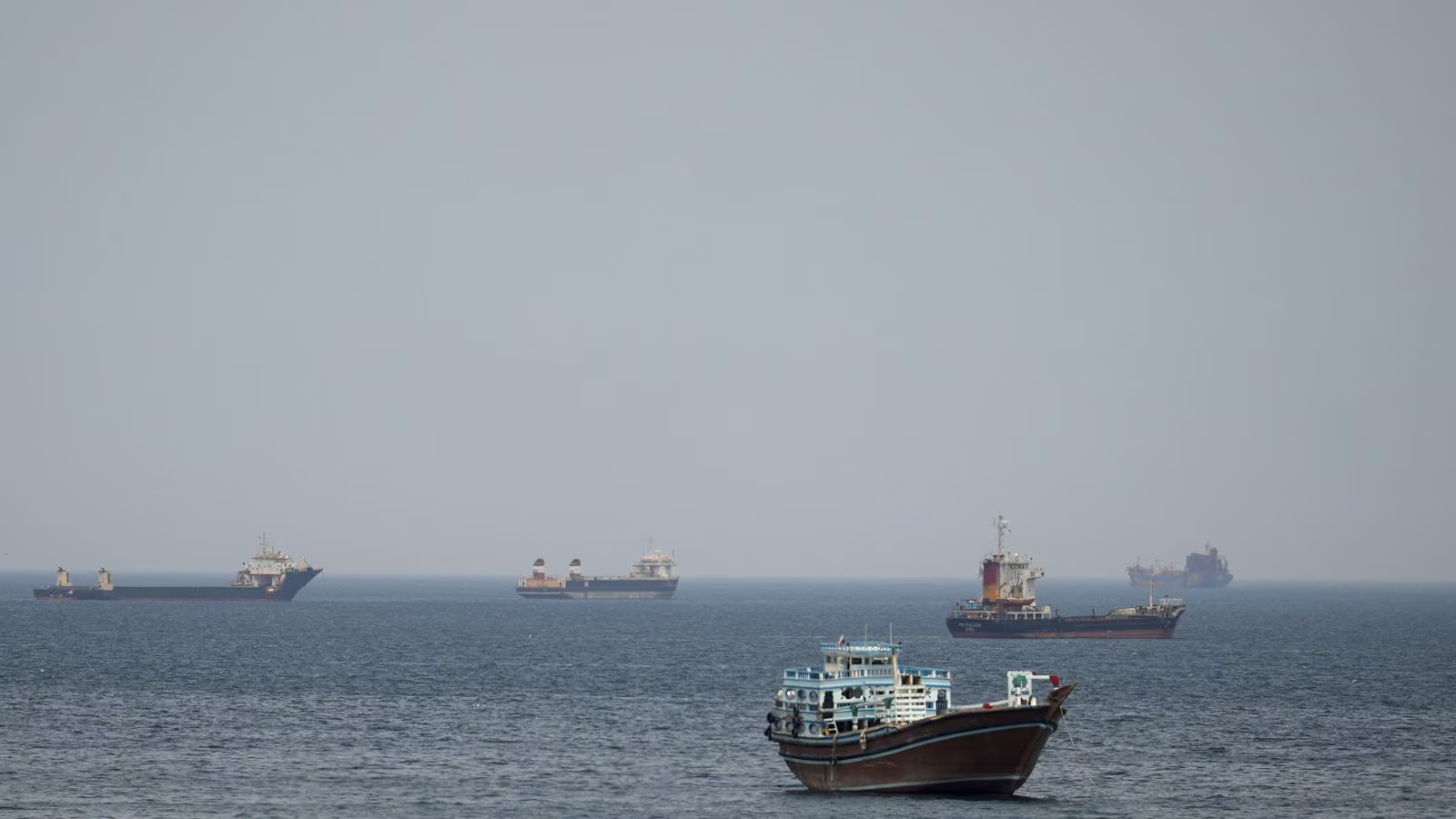
Even as talks inch forward, tensions have sharply escalated at sea. Three cargo vessels were attacked in the strategically vital Strait of Hormuz, in what British military officials described as a significant disruption to maritime security. Reports attribute the strikes to Iran’s paramilitary Islamic Revolutionary Guard Corps.
Shipping companies confirmed that crew members aboard the targeted vessels escaped unharmed, but the incident has complicated already fragile diplomatic efforts and heightened fears of broader disruption to global oil supplies.
Talks stall, pressure builds
On the ground, diplomatic momentum remains uneven. In Islamabad, where critical negotiations are expected, thousands of security personnel have been deployed—yet no Iranian delegation has arrived, according to state media. The delay hints at internal divisions within Tehran’s leadership over how to proceed.
Meanwhile, violence continues elsewhere in the region. Israeli strikes in Gaza killed at least five people, including four suspected militants in Khan Younis and a woman in a displacement camp in Beit Lahiya—another stark reminder of the human cost unfolding alongside high-level diplomacy.
Global stakes rise: Fuel, trade, and diplomacy
The crisis is reverberating far beyond the Middle East. China has stepped in diplomatically, calling the situation a “critical stage of transition” and urging the reopening of the Strait of Hormuz to stabilize global energy flows.
In Europe, alarm bells are ringing. Transport ministers across the European Union are meeting in Brussels amid warnings that the continent may have barely six weeks of jet fuel reserves if disruptions persist.
Internal crackdowns and hardline rhetoric
Inside Iran, the conflict is intersecting with domestic tensions. Authorities executed a man identified as Soltanali Shirzadi Fakhr, accused of links to the exiled Mujahideen-e-Khalq and Israeli intelligence. The judiciary said the sentence was carried out after due legal process.
Iranian officials have also struck a defiant tone. Senior commander Ali Abdollahi claimed Tehran holds the military advantage and warned against what he described as “false narratives” being shaped by Washington.
Military realities complicate ceasefire hopes
Even if a ceasefire holds, the path to stability remains long. US defense officials have warned lawmakers that clearing sea mines from the Strait of Hormuz could take up to six months after the war ends—highlighting the enduring risks to one of the world’s most critical shipping routes.
Adding to the pressure, the United States Central Command confirmed that 31 vessels—mostly oil tankers—have already been redirected under Washington’s ongoing maritime blockade of Iran. Despite the ceasefire extension, the blockade remains firmly in place.
Together, these developments paint a picture of a conflict balanced on a knife’s edge—where diplomacy offers a narrow window of hope, but every new strike, delay, or miscalculation risks pushing the region back toward escalation.

US probes nine universities over J-1 visas, halts PERM processing for eight firms

NLSIU Bengaluru announces NLSAT 2027 date for BA, LLB, MPP and PhD admissions

School Holiday Today, October 12, 2026: Are Schools Closed? Check State-Wise Updates

NIOS Date Sheet 2026: Class 10, 12 October-November Exam Timetable Released, Check Schedule

Yogesh Singh begins second term as Delhi University vice-chancellor
US probes nine universities over J-1 visas, halts PERM processing for eight firms
.jpg&w=256&q=75)
Regional universities face international student slump as visa refusals and political rhetoric deter applicants

AI may lift homework scores but weaken real learning, World Development Report raises concerns

Ken Griffin’s record $3 billion gift to Carnegie Mellon to fuel new Miami campus

Michael Jordan pledges $10 million to UNC social work school in mother’s honour

US probes nine universities over J-1 visas, halts PERM processing for eight firms
NLSIU Bengaluru announces NLSAT 2027 date for BA, LLB, MPP and PhD admissions
School Holiday Today, October 12, 2026: Are Schools Closed? Check State-Wise Updates
NIOS Date Sheet 2026: Class 10, 12 October-November Exam Timetable Released, Check Schedule
Yogesh Singh begins second term as Delhi University vice-chancellor
US probes nine universities over J-1 visas, halts PERM processing for eight firms
Regional universities face international student slump as visa refusals and political rhetoric deter applicants
AI may lift homework scores but weaken real learning, World Development Report raises concerns
Ken Griffin’s record $3 billion gift to Carnegie Mellon to fuel new Miami campus
Michael Jordan pledges $10 million to UNC social work school in mother’s honour
Copyright© educationpost.in 2026 All Rights Reserved.