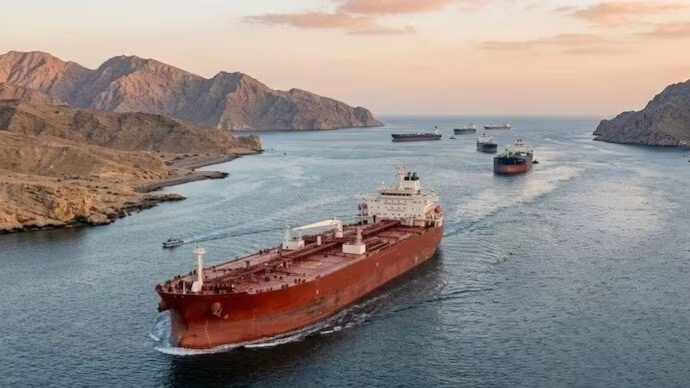
In a significant shift with global trade implications, a two-week ceasefire agreement between the United States and Iran includes a provision allowing Iran and Oman to levy transit fees on vessels passing through the Strait of Hormuz— a critical artery that carries nearly one-fifth of the world’s oil supply.
The narrow 34-km-wide strait, straddling the territorial waters of both nations, has historically functioned as an international waterway without tolls. The proposed move marks a departure from long-standing norms governing one of the world’s most strategically sensitive maritime routes.

Officials in Tehran, quoted by Associated Press, said the funds generated from the transit fees would be directed towards post-war reconstruction, following extensive damage to Iran’s defense, administrative and civilian infrastructure during the conflict.
The ceasefire, agreed early April 8, brings a pause to a 40-day confrontation that began on February 28 and saw the effective closure of the strait amid repeated attacks on commercial vessels — disruptions that triggered sharp spikes in global oil prices. Under the agreement, Iran has conditionally reopened the waterway.
Further negotiations—particularly on the long-term status of the Strait of Hormuz—are expected to be taken up in upcoming talks involving the United States and Israel, scheduled in Islamabad on April 10.
Confirming the diplomatic breakthrough, Donald Trump said Iran had presented a 10-point proposal that offered a “workable basis” for negotiations. He expressed confidence that a comprehensive agreement could be finalized within the two-week window, though specific terms remain undisclosed.
According to Reuters, the proposed transit fee structure would vary depending on vessel type, cargo, and prevailing conditions. Iran’s Deputy Foreign Minister Kazem Gharibabadi indicated that Tehran is already working with Oman to draft a protocol, describing the measure as one intended to “facilitate, not restrict” maritime movement.
However, the proposal has drawn resistance from Gulf nations, including the United Arab Emirates and Qatar, which have reiterated calls for uninterrupted and toll-free navigation through the strait. They argue that any financial mechanism governing passage should be deferred to broader consensus.
Under the United Nations Convention on the Law of the Sea, countries bordering international straits are prohibited from imposing charges simply for passage. Limited fees are permissible only for specific services—such as piloting or port assistance—and must be applied without discrimination.




.jpg&w=256&q=75)





.jpg&w=256&q=75)
