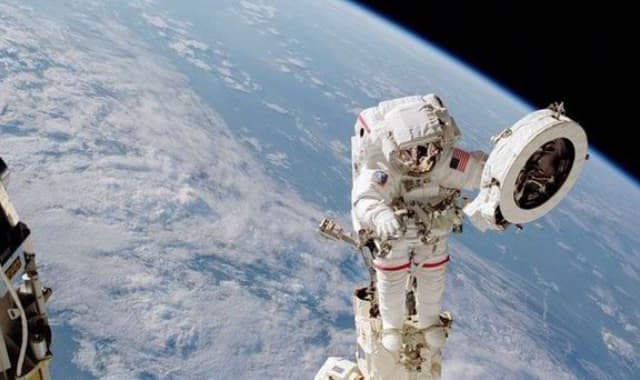
Around 53 percent people will like to travel to space, says a new survey ahead of the 50th anniversary of the historic Apollo lunar landing on July 20.

Around 53 percent people will like to travel to space, says a new survey ahead of the 50th anniversary of the historic Apollo lunar landing on July 20.
Nearly 80 percent of the respondents said they would feel safe if a human-looking robot were piloting that spacecraft, according to the survey by technical professional organization IEEE.

The participants identified solar panel (65 percent), athletic shoe (40 percent) and heart defibrillator (32 percent) as the top three items linked to earlier space travel technology.
The respondents believed the next decade of space travel would have the greatest impact on medicine (26 percent), transportation (23 percent), computer technology (21 percent) and environmental resources (20 percent).
The Apollo 11 mission relied on four computers, considered decades ahead of their time. Interestingly, today’s smartphones are more powerful than the computers the NASA (National Aeronautics and Space Administration) used for the mission.
When asked who they would video call from the Moon with their smartphones if they had the opportunity, 56 percent of those surveyed said they would video call their spouse or partner. Their next choices would be a mother (14 percent), a friend (9 percent) and then father (8 percent).
Nearly 400 attendees at the 2019 Consumer Electronics Show in Las Vegas, held from January 8 to 11, participated in the survey.
The Apollo 11, launched on July 16, 1969, with three astronauts — Neil Armstrong, Edwin Aldrin, and Michael Collins — touched down on the Moon’s surface on July 20.

India’s Blue Economy Push Seeks to Balance Growth and Ocean Conservation

Supreme Court Seeks Panel to Curb Unethical Pharma Marketing Practices

NMC Tightens Rules on Doctors’ Digital Advertising and AI Use

Anthropic Launches Claude Haiku 5.5 as Its Fastest and Cheapest AI Model

Karnataka HC Replaces ‘Visitation’ with ‘Parenting Time’ in Child Custody Cases

Canadian author Anne Carson wins 2026 Nobel Prize in Literature for reshaping contemporary literary forms

AMU students’ protest enters third week as union election demand widens

DPDP Act Explained: What is India’s Digital Personal Data Protection Law and Why is it in the News?

IIT Bombay puts stricter cheating rules on hold, drafts new procedure for exam misconduct

Gujarat launches PARAKH Cell to shift school assessments toward competency-based learning

India’s Blue Economy Push Seeks to Balance Growth and Ocean Conservation

Supreme Court Seeks Panel to Curb Unethical Pharma Marketing Practices

NMC Tightens Rules on Doctors’ Digital Advertising and AI Use

Anthropic Launches Claude Haiku 5.5 as Its Fastest and Cheapest AI Model

Karnataka HC Replaces ‘Visitation’ with ‘Parenting Time’ in Child Custody Cases

Canadian author Anne Carson wins 2026 Nobel Prize in Literature for reshaping contemporary literary forms

AMU students’ protest enters third week as union election demand widens

DPDP Act Explained: What is India’s Digital Personal Data Protection Law and Why is it in the News?

IIT Bombay puts stricter cheating rules on hold, drafts new procedure for exam misconduct

Gujarat launches PARAKH Cell to shift school assessments toward competency-based learning
Copyright© educationpost.in 2024 All Rights Reserved.
Designed and Developed by @Pyndertech