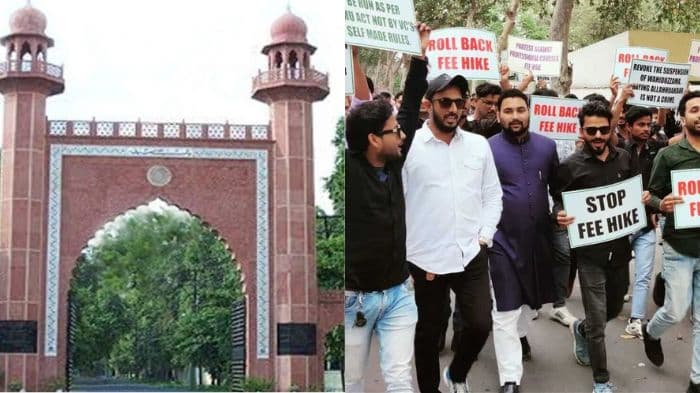
The student protest at Aligarh Muslim University (AMU) has entered its third week, with students continuing to demand the restoration of elections to the AMU Students' Union, which has not had an elected body since the 2018-19 academic session.
The agitation began on Sep 21 and has since escalated from a sit-in and hunger strike to campus gate closures, clashes around the protest site, police action and an increasingly tense standoff with the university administration.

At the centre of the protest is MA Urdu student Yasir Fahad, who has been on an indefinite hunger strike since September 21. As of October 8, reports said the protest had entered its 17th day.
What are students demanding?
The original demand was straightforward: AMU should hold elections to the Students' Union and restore an elected student body.
According to recent reports, students are asking the university to appoint an election authority, announce an election schedule and conduct the polls. The demand is based on the fact that students have not elected their union representatives since 2018-19.
The protesters' demands have subsequently expanded. They are also seeking the withdrawal of FIRs registered against students during the agitation, revocation of suspensions imposed on some protesters and the resignation of AMU Proctor Professor Mohammed Naved Khan.
The university's own website retains records of the 2018-19 AMUSU election, including the names of the elected president, vice-president, honorary secretary and other office-bearers. It also has a dedicated AMU Students' Union page carrying those 2018-19 office-bearers.
This is important because the dispute is not over whether AMU has historically had a students' union. It has. The dispute is over when and how elections to the body should resume.
Why has there been no election for years?
The last election was held during the 2018-19 session. AMU has consequently gone through several academic years without a newly elected students' union.
There have been repeated demands for elections during this period. The issue also reached the Allahabad High Court.
In 2024, AMU student Kaif Hasan filed a public interest litigation seeking directions for the university to conduct students' union elections. The petition argued that the prolonged absence of elections deprived students of representation and was contrary to the principles governing student-union elections.
The Allahabad High Court subsequently asked AMU to respond. In November 2024, the university's position before the court was that elections would be conducted at an appropriate time, but the court found that the instructions supplied by the university did not adequately answer the issues raised in the petition.
The matter continued into 2025. A report in November 2025 said Hasan had filed another petition after the university had indicated that elections would be held in December. He sought appointment of a Chief Election Officer and an election schedule, arguing that the promised process had not materialised.
So the present agitation follows several years of student demands and legal proceedings, rather than emerging suddenly in September 2026.
What triggered the current protest?
The present phase began on September 21, when students started a sit-in at the campus's Duck Point and Yasir Fahad began his hunger strike.
The protesters initially focused on restoration of the students' union, appointment of an election authority and announcement of election dates.
The situation became more complicated after Fahad was suspended. AMU's Proctor's Office currently lists an official suspension order for Yasir Fahad dated Sep 30 along with suspension orders for several other students.
Students have subsequently made revocation of these suspensions part of their demands.
How did the protest escalate?
The protest has gradually spread beyond the original sit-in.
On Sep 28-29, a confrontation broke out at the protest site after a group of youths arrived there. According to media reports, 50-60 youths were present and that a scuffle followed between people at the protest site and the group. Student Faisal Tyagi was reported injured, while there was also a confrontation involving Fahad.
The dispute then escalated further after police and university proctorial officials went to an MM Hall hostel.
According to AMU Proctor Naved Khan, police had received information about people described as “external elements” at the hostel. Four people were taken for questioning; the proctor said three were bona fide AMU students and were released, while a fourth person was detained and later sent to jail. Khan denied that the university had asked police to act against protesters.
Students, meanwhile, linked the police action to the ongoing protest and demanded action over the detention. The dispute led protesters to block the university's four main entry gates on October 3. The gates were subsequently reopened by university security personnel.
Why has Yasir Fahad's hunger strike become a major issue?
Fahad's indefinite hunger strike has become the most visible part of the agitation.
By Oct 7, he had been fasting for 15 days. The university said his health parameters had deteriorated and that medical personnel were sent with an ambulance to shift him to hospital.
Students prevented the team from taking him away from the protest site.
AMU Proctor Naved Khan said the attempt was intended to provide medical treatment and was not an attempt to forcibly end the hunger strike. He said the university had told students that Fahad could return to the protest site after doctors stabilised his condition.
On Oct 8 Fahad's blood pressure had fallen and that a medical team from Jawaharlal Nehru Medical College reached the protest site with three ambulances. Fahad reportedly refused to go to hospital, after which a confrontation developed between students and the proctor.
The health episode has therefore become another flashpoint between the protesters and administration, with students insisting that the university should address the underlying demand for elections.
What happened with the campus gates?
The protest has also affected normal movement around the university.
On Oct 4, students blocked all four entry gates amid the dispute over the hostel incident and the continuing demand for union elections. The university's security personnel later reopened the gates.
On Oct 8, students had again closed the Bab-e-Syed and Centenary gates after the previous night's developments. Messages were also circulating among students about a possible campus lockdown.
However, reports of a decision by AMU to impose sine die closure should be treated carefully. The university administration has denied that any such decision had been taken, describing the information as a rumour.
Why are students talking about FIRs and suspensions?
The protest has produced several confrontations and police cases, which have now become part of the students' demands.
On Oct 7 that protesters said 18 students had FIRs registered against them during the course of the agitation. Students are demanding that these cases be withdrawn.
AMU's official Proctor's Office separately lists suspension orders issued on Sep 30 against Fahad and several other students. The existence of these orders can therefore be independently established from the university's website, although the reasons and the students' objections need to be attributed rather than presented as established wrongdoing.
Where does the university administration stand?
The administration has not accepted the protesters' characterisation of the recent police action as an attempt to suppress the election movement.
Proctor Naved Khan said the police action at the hostel was based on information about people who were allegedly not authorised to be there and denied that university officials had directed police to disrupt the protest.
On Fahad's health, the administration has said that its attempt to take him to hospital was motivated by medical concerns. Khan said doctors considered several of his health parameters serious and that the university wanted to provide urgent treatment.
At the same time, the administration has not announced an election date in the recent reports reviewed for this story.
Teachers' association also raises election concerns
The dispute is not limited entirely to student elections.
The AMU Teachers' Association (AMUTA) has also called for elections to various statutory university bodies. Its secretary, Ashraf Mateen, said several such bodies had been functioning without elected teacher representatives for more than six years.
AMUTA representatives have also called for dialogue with the protesting students. AMUTA president Professor Tufail Ahmad said the association had met Fahad and urged the vice-chancellor to send a senior, non-controversial teacher to engage with the protesters.
That adds another dimension to the dispute: concerns about elected representation are being raised not only by students but also by teachers over representation in some university statutory bodies.
Why does the students' union matter to the protesters?
For the protesting students, the issue is not simply the opportunity to elect office-bearers.
They argue that an elected union provides a formal channel through which students can raise concerns with the university administration over matters such as hostel facilities, food, academic issues and other campus problems.
Student accounts published during the protest have also connected the election demand with earlier complaints about campus facilities and the handling of student grievances. These are students' claims, however, and should not be treated as findings against the university.
The broader argument is that, without an elected union, students have no equivalent representative body through which collective grievances can be formally negotiated with the administration.
AMU's situation is part of a wider debate over student-union elections in Indian universities.
Several major universities, including AMU, Jamia Millia Islamia and Banaras Hindu University, have gone years without regular student-union elections, while institutions such as Delhi University and Jawaharlal Nehru University continue to conduct them.
The debate involves competing concerns. Student groups argue that elected unions provide representation and a democratic mechanism for resolving campus grievances. Universities and authorities have historically also raised concerns around campus violence, political interference and maintaining academic environments.
The AMU dispute has brought that unresolved question back into focus: whether prolonged suspension of elections addresses those concerns, or whether the absence of an elected representative body itself creates another source of campus tension.
For now, the immediate standoff at AMU remains centred on a simple demand from the protesters: appoint an election authority, announce a schedule and hold the students' union elections.
The university has yet to announce a date while the hunger strike and campus agitation continue.