Prime Minister Narendra Modi on Feb 11 emphasized the transformative power of Artificial Intelligence (AI) while stressing the need for global governance to address its challenges.
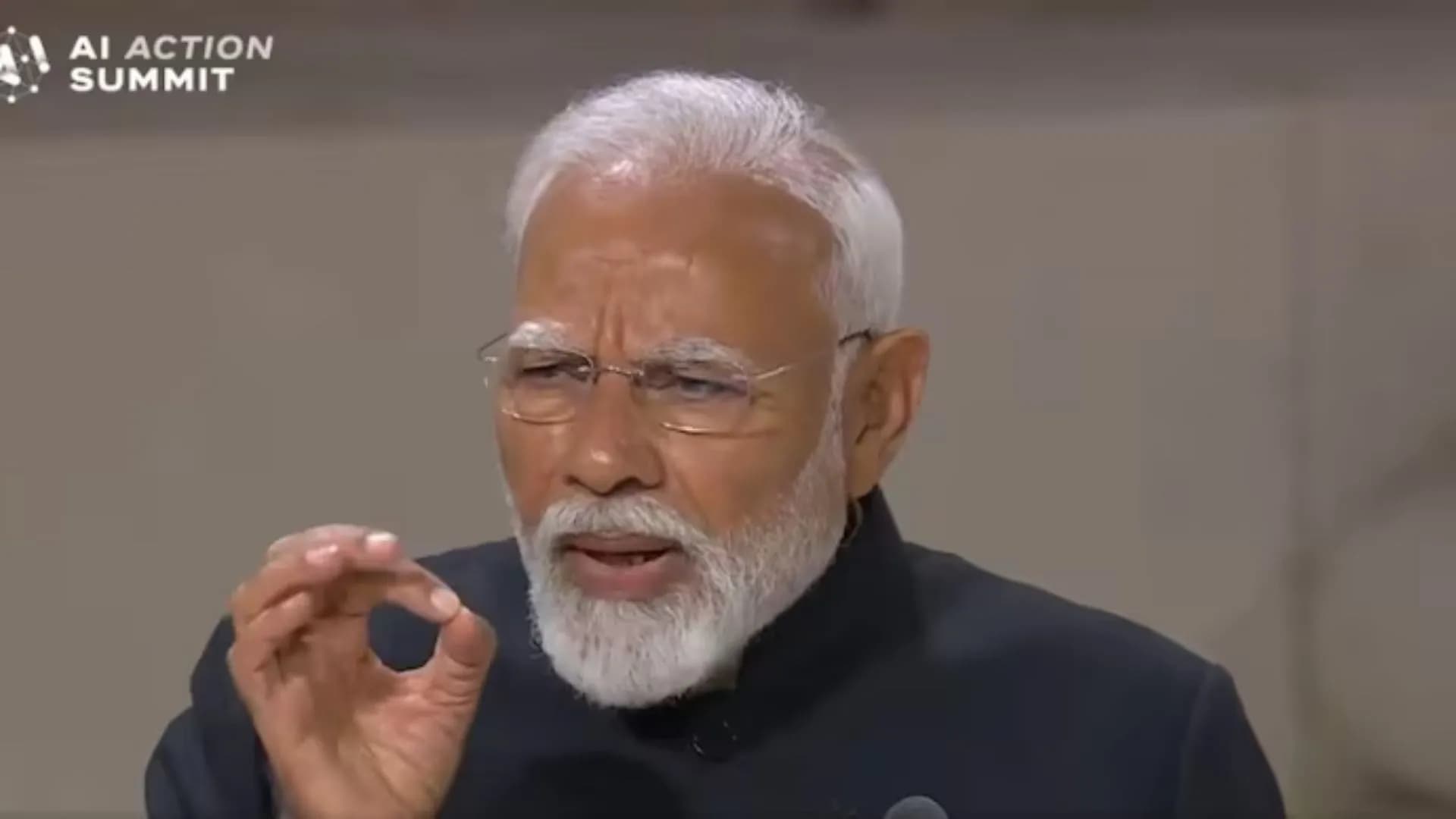
Co-chairing the AI Action Summit in Paris, Modi said AI can help transform millions of lives by improving health, education, agriculture and so much more. It can help create a world in which the journey to sustainable development goals becomes easier and faster.

Asserting that AI was writing the code for humanity in the 21st century, Modi underscored both the immense potential and inherent biases in AI systems, calling for collective global efforts to shape the future of the technology.
Citing an example, Modi illustrated AI’s dual nature, saying, “If you upload your medical report to an AI app, it can explain in simple language, free of any jargon, what it means for your health. But if you ask the same app to draw an image of someone writing with their left hand, the app will mostly draw someone writing with their right hand, because that is what the training data is dominated by.”
“We must develop open-source systems that enhance trust and transparency. We must build quality data sets free from biases," he said.
He also stressed the need to address concerns related to cyber security, disinformation, and deepfakes. “We must also ensure that technology is rooted in local ecosystems for it to be effective and useful,” he said.
He stressed that while AI’s potential is “absolutely amazing,” the presence of biases demands careful scrutiny and correction.
AI’s growing influence
Acknowledging AI’s growing influence, Modi said, “AI is already reshaping our quality of life, economy, security, and society. AI is writing the code for humanity in this century, but it is very different from other technology milestones in history. AI is developing at an unprecedented scale.”
He called for a unified global approach to AI governance, asserting that standards and regulations must be crafted collectively. “There is a need for collective global efforts to establish governance and standards,” he said, adding that governance must not only mitigate risks but also foster innovation and ensure equitable access.
‘Easier and faster because of technology’
On AI’s potential in different fields, Modi said it can transform industries such as agriculture and environmental conservation, ultimately making the journey toward sustainable development goals “easier and faster.” However, he also warned of significant concerns, including cybersecurity threats, disinformation, and deepfakes, which must be addressed for AI to be truly beneficial.
Modi touched upon AI’s impact on employment, acknowledging fears surrounding job losses due to automation. However, he reassured that history has shown new job categories emerge alongside technological advancements. “Work does not disappear because of technology; new types of jobs are created,” he said, calling for increased investment in skill development and workforce reskilling to prepare for an AI-driven future.
Energy consumption, a key challenge
As AI continues to expand, Modi indicated that its energy consumption remains a key challenge. “There is no doubt that the high-intensity energy needs of AI must be looked into. AI needs green power to fuel its future,” he said, urging global stakeholders to consider environmentally friendly energy alternatives for AI infrastructure.
With AI poised to redefine industries and societies worldwide, Modi’s speech at the AI Action Summit reinforced India’s commitment to shaping the global AI narrative.










.webp&w=256&q=75)