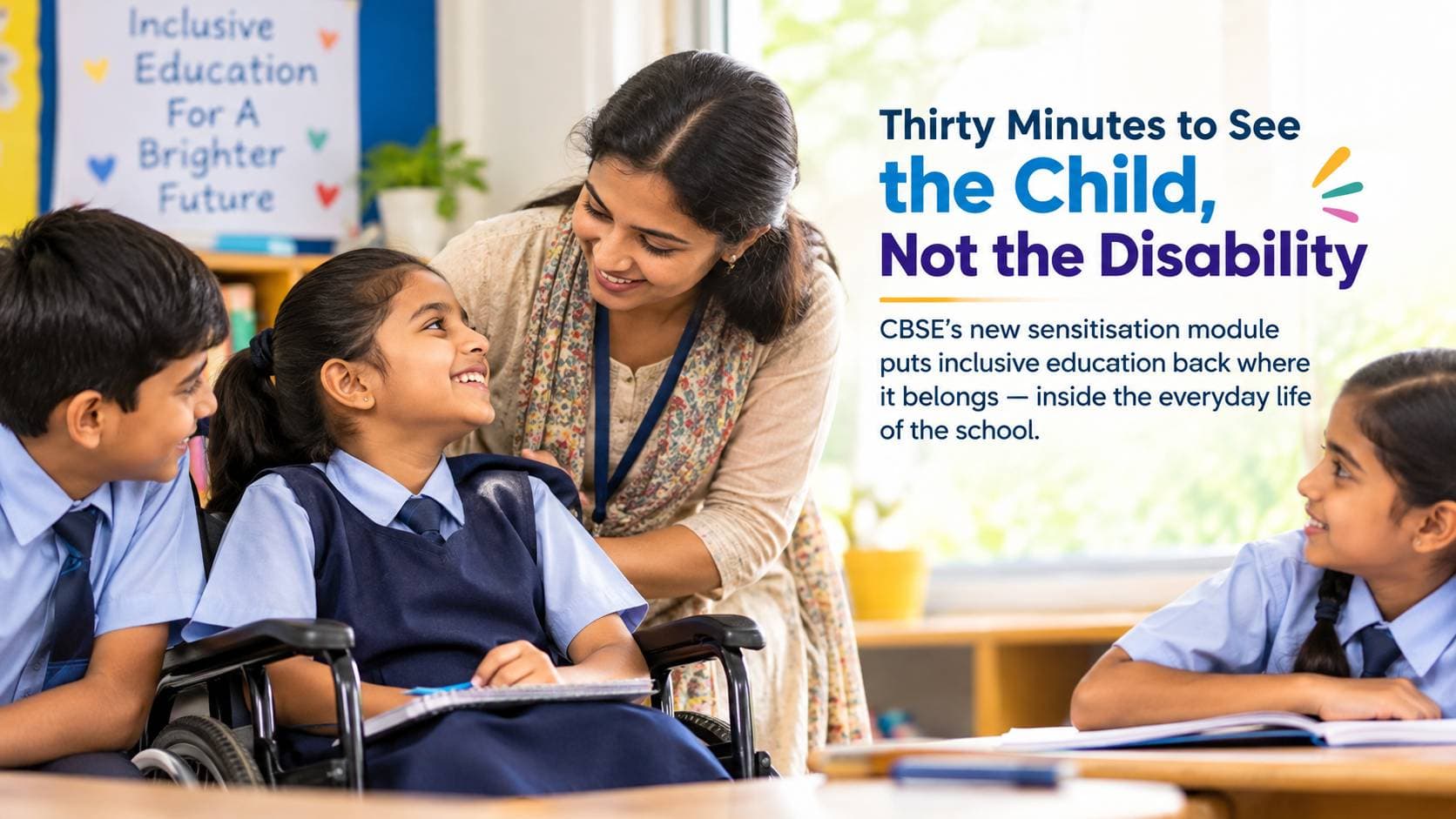
A classroom can have ramps, accessible toilets, special educators and assistive technology and still fail to be truly inclusive.
The missing piece can be something much less visible: how adults in the school understand a child who learns, communicates, behaves or moves differently from the majority of students.

That is why the Central Board of Secondary Education’s latest initiative on inclusive education deserves attention beyond the 30 minutes it takes to watch the prescribed module.
CBSE has asked its affiliated schools to screen a sensitisation module on inclusive education for school staff on October 7, 2026. The Board listed the initiative on its official website on October 5.
On the surface, it may look like another short training exercise in an already crowded school calendar. But its larger significance lies in the question it raises: Can a brief intervention change the way an entire school looks at children with special needs?
The answer may depend less on the length of the video and more on what schools do after the screen goes dark.
The first barrier may not be the staircase
When schools talk about inclusion, the conversation often begins with infrastructure.
Is there a ramp? Is the classroom accessible? Is there a special educator? Can a student with a physical disability reach the laboratory or library? Are examination accommodations available?
These questions matter. But inclusion is not simply an architectural exercise.
A child may be able to enter a classroom and still feel excluded once inside.
A student with autism may be labelled “difficult” because sensory overload results in unusual behaviour. A child with a learning disability may be described as careless or inattentive because reading and writing take longer. A student with a hearing impairment may be assumed to be disengaged because the teacher has not adapted communication. A child with a speech or communication difficulty may hesitate to participate because classmates or even adults repeatedly interrupt or complete sentences for them.
In such situations, the physical classroom is accessible, but the educational experience is not.
This is where sensitisation becomes important.
CBSE's move recognises that inclusion cannot depend exclusively on the presence of a specialist. Every adult who interacts with a child becomes part of that child's educational environment.
That includes subject teachers, class teachers, principals, administrative staff, laboratory assistants, librarians, transport personnel and other school employees.
Why 30 minutes can matter
Thirty minutes is obviously not enough to train a teacher to become a special educator.
Nor can a short video provide the expertise required to understand the complexities of autism, dyslexia, intellectual disability, cerebral palsy, visual or hearing impairment, multiple disabilities or other special educational needs.
But that is not necessarily the purpose of sensitisation.
The first task is often more basic: to change the starting point of the conversation.
Instead of asking, “Why can't this child behave like everyone else?”, a sensitised adult might ask, “What is making this situation difficult for the child?”
Instead of assuming that a child who does not respond immediately is inattentive, the teacher may consider whether the child has understood the instruction.
Instead of interpreting slow writing as laziness, the teacher may consider whether additional time or another form of response is required.
Instead of seeing accommodation as an unfair advantage, the school community may understand it as a mechanism that allows a student to participate on a more equitable footing.
That shift in perspective can be significant.
From sympathy to understanding
There is another important distinction . Inclusive education should not be built around pity.
Children with disabilities do not need an environment in which every adult constantly tells them how brave they are. They need teachers who understand their learning requirements, classmates who respect them and institutions that remove unnecessary barriers.
There is a difference between sympathy and support.
Sympathy can unintentionally reinforce the idea that a child is fundamentally different or helpless.
Support, on the other hand, asks what adjustments will enable the child to participate independently and meaningfully.
The language used in school corridors and staff rooms therefore matters.
A child should not become “the autistic child”, “the dyslexic child” or “the disabled child” before becoming simply a student with interests, ambitions, friendships, strengths and weaknesses.
The sensitisation exercise can help schools examine precisely this culture of language and perception.
The special educator cannot do everything
India's inclusive education framework has increasingly recognised the importance of specialised support. CBSE itself has an Inclusive Education Cell, established to help schools create systems that ensure equal opportunities for persons with disabilities, including through teacher sensitisation and training .
Yet one special educator cannot be expected to carry the entire responsibility for inclusion.
Consider a student who spends six hours at school.
Perhaps one hour is with the special educator. The remaining five hours may involve mathematics, science, languages, sports, lunch, assemblies, examinations, corridors and interactions with peers.
If inclusion exists only during the special educator's session, it is not really inclusion.
The child must experience support in the ordinary classroom too.
This is why sensitising the wider school staff is important. A mathematics teacher may need to modify an instruction. A sports teacher may need to rethink participation. An examination coordinator may need to understand accommodations. A receptionist may need to communicate respectfully with a parent. A bus attendant may need to know how to respond when a child becomes overwhelmed.
Inclusive education is therefore not a department.
It is a school-wide culture.
The classroom is where policy meets reality
Education policies can contain ambitious language about equity and inclusion. But the real test occurs at 10.30 in the morning when a teacher has 35 or 40 students in front of them and one child needs a different approach.
This is where teachers face genuine practical challenges.
How should a lesson be explained to a child who processes information differently?
Should written instructions also be given verbally?
Can the student demonstrate understanding through an alternative format?
How should group activities be structured ?
What happens when the child becomes overwhelmed?
How can the teacher maintain classroom discipline without treating disability-related behaviour as misconduct?
How should classmates be encouraged to help without making the student dependent?
These questions do not always have one universal answer.
A sensitisation module cannot provide every answer, but it can encourage teachers to recognise that difference in learning does not automatically mean deficiency in learning.
That is a crucial educational insight.
A child should not have to earn the right to belong
One of the most subtle problems faced by children with special needs is conditional acceptance.
A student may be welcomed as long as they do not disturb the class.
They may be included in an annual function but excluded from meaningful participation.
They may be invited to group activities but consistently assigned passive roles.
They may be physically present during sports but rarely allowed to compete.
They may be promoted from one class to another without receiving the instructional support required to actually learn.
Such practices can create the appearance of inclusion without its substance.
True inclusion means asking not simply whether a child is present, but whether the child is participating, learning and belonging.
This distinction should be central to every conversation around the CBSE module.
The peer group matters as much as the teacher
Teachers are not the only people who shape a child's experience.
For many students, the most powerful social environment at school is the peer group.
A child may be comfortable with a teacher but dread recess because of teasing.
A student may be academically capable but reluctant to raise a hand because classmates imitate their speech.
Another may avoid group work because repeated rejection has convinced them that they have nothing to contribute.
Sensitisation, therefore, cannot stop with adults.
The eventual objective should be to build classrooms where students understand difference without turning it into ridicule.
This does not mean asking children to become miniature counsellors or special educators.
It means creating ordinary habits of respect: waiting for someone to finish speaking, helping without humiliating, including rather than isolating, and understanding that fairness does not always mean giving everyone exactly the same thing.
Equality is not always the same as fairness
This is perhaps one of the most important lessons inclusive education can teach an entire school.
Imagine three students taking the same examination.
One can read the paper quickly. Another requires additional time because of a documented disability. A third may require an assistive arrangement.
Giving all three precisely the same conditions may look equal.
But it does not necessarily create an equal opportunity to demonstrate learning.
Equity sometimes requires different support for different learners.
This principle extends beyond examinations.
One student may need visual instructions. Another may need repetition. Another may need a quieter seating arrangement. Another may require assistive technology.
These accommodations are not rewards.
They are tools for removing barriers.
When teachers and students understand this distinction, resentment can give way to a more mature understanding of fairness.
Inclusion begins with noticing strengths
There is another danger in disability-focused conversations: the tendency to create a catalogue of limitations.
What can the child not do ?
Where does the child need help ?
What difficulties does the child have ?
Those questions have their place. But educators must also ask different questions.
What does the child do well? What interests them?
How do they communicate most effectively?
What motivates them ? Which activities allow them to demonstrate confidence ?
What can classmates learn from them ?
A child should not enter the classroom carrying a diagnostic label as their principal identity.
Every student has abilities .
Inclusive education becomes more powerful when it moves from a deficit model — what is wrong with the child — towards a strength-based model that asks how the educational environment can help the child flourish.
Parents are partners, not petitioners
The CBSE's broader approach to supporting children with special needs also emphasises collaboration between parents, teachers and special educators. Its 2026–27 Parenting Calendar recommends structured interaction among parents, class teachers and special educators, including transition meetings when a child moves to a new grade.
This is particularly important because transitions can be difficult.
A teacher who knows a child well may leave the school.
The student may move from primary to middle school.
The number of subject teachers may increase.
Academic expectations may suddenly become more demanding.
A carefully maintained transition process can prevent parents from having to explain the same circumstances repeatedly.
More importantly, parents should not be made to feel that they are asking for favours.
They are partners in the child's education.
The school's responsibility is to listen to them while also ensuring that decisions remaineducationally sound and centred on the student's needs.
What happens after the video?
This may ultimately be the most important question surrounding the CBSE initiative.
A school can screen the module, take attendance, record photographs and tick a compliance box.
Or it can use those 30 minutes as the starting point for a deeper conversation.
For example, schools could ask staff members three simple questions after the screening:
What assumption about children with special needs did I have before watching this?
What might I do differently in my classroom or workplace?
What barrier in our school could we remove without waiting for a major budget?
Such questions can turn passive viewing into reflection.
Schools could also conduct short follow-up discussions led by special educators, counsellors or trained professionals.
Subject departments could examine whether teaching materials are accessible.
School leaders could review emergency procedures for students with disabilities.
Examination teams could revisit how accommodations are implemented.
Sports departments could explore meaningful participation.
And student councils could be encouraged to discuss respectful peer culture.
The 30-minute module would then become a catalyst rather than a conclusion.
Beyond the compliance culture
Indian schools operate under a large and complicated regulatory framework. Compliance is unavoidable.
But inclusion becomes fragile when it is reduced to documentation.
A photograph of a sensitisation session does not prove that a school has become inclusive.
A ramp does not prove accessibility.
The appointment of a special educator does not automatically create inclusive classrooms.
Nor does screening a video.
The real evidence lies in everyday behaviour.
Does a teacher wait patiently for a student to respond?
Does the school intervene when disability-based teasing occurs?
Does a child receive appropriate learning support?
Can parents raise concerns without feeling dismissed?
Are accommodations implemented consistently?
Can students with disabilities participate in school life beyond the classroom?
Do teachers talk about their strengths as readily as their difficulties?
These are harder questions — but they are the questions that matter.
A wider educational lesson
There is something potentially transformative about teaching an entire school community to understand disability.
It benefits not only students with special needs.
A classroom designed with multiple ways of explaining a concept can benefit students who are learning a new language.
A teacher who gives clear instructions helps children who struggle with attention.
A culture that discourages ridicule creates a safer environment for everyone.
Flexible approaches to demonstrating learning can help students with different strengths.
In this sense, inclusive education is not an additional layer of schooling.
It can improve schooling itself.
The larger objective is therefore not to create a separate educational universe for children with disabilities. It is to make mainstream education sufficiently flexible to accommodate human difference.
The child behind the label
Imagine a child sitting in a classroom while adults discuss their diagnosis.
Perhaps the child is listening.
Perhaps they understand more than the adults assume.
Perhaps they are wondering whether their classmates will accept them.
Perhaps they have a favourite subject, a favourite song, a talent for drawing or an extraordinary memory.
The child is not a case file.
The child is not an accommodation request.
The child is not a problem to be managed.
The child is a learner.
That simple recognition could be the most valuable message any sensitisation exercise delivers.
CBSE's October 7 initiative provides schools with an opportunity to pause and examine how inclusion works in practice. The Board has already been moving towards a broader ecosystem of student support; its 2026 guidance on mental health and social-emotional learning, for example, asks schools to build sensitive, inclusive and non-discriminatory environments involving teaching, non-teaching and administrative staff. CBSE
The direction is therefore larger than one 30-minute film.
It points towards a school in which inclusion is not assigned to one specialist, one classroom or one annual awareness day.
Thirty minutes — and what comes next
The clock will eventually stop.
The screen will go blank.
Teachers will return to mathematics, history, science, languages and homework. Administrative staff will return to their desks. Students will move to their next period.
That is when the real test begins.
Will the teacher remember to give a child a little more time?
Will a staff member think twice before describing behaviour as “naughty”?
Will a school reconsider whether a supposedly routine activity unintentionally excludes someone?
Will classmates learn that helping does not mean patronising?
Will the child feel that the school has made space for them rather than merely permitted them to occupy it?
If the answer to even some of these questions is yes, then 30 minutes will have achieved something far greater than its duration suggests.
Because inclusive education ultimately does not begin with a ramp, a form, a certificate or a video.
It begins with the willingness to see the child before seeing the disability — and to redesign the school around the belief that every child belongs there.







.webp&w=256&q=75)