Nandigram to Now: The Incident That Changed Bengal’s Electoral Politics Forever
From a violent land protest in 2007 to a historic regime change and evolving electoral patterns, Nandigram continues to shape how West Bengal votes and contests power
Prabhav Anand04 May 2026 09:53
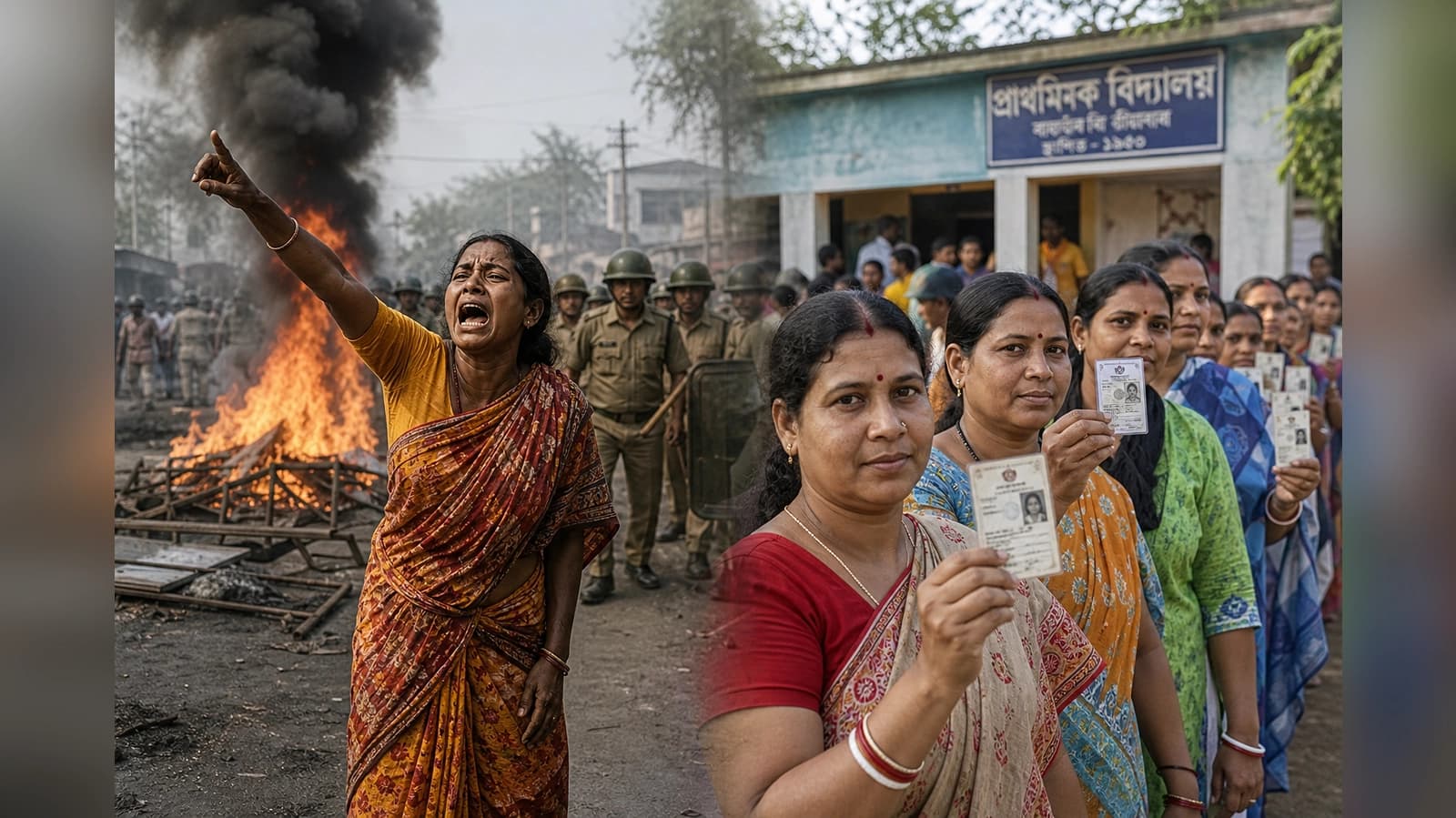
As counting unfolds in the Assembly elections 2026 in West Bengal, the relative calm reported across phases stands out in a state where elections have long been synonymous with confrontation, territorial control and, at times, bloodshed.
To understand why this matters, one must return to 2007, to the fields of Nandigram — a place that turned a local land dispute into a political moment that would redraw the state’s electoral map.
The crisis began with a proposal by the then Left Front government to acquire farmland for a Special Economic Zone. What might have remained a policy issue quickly spiraled into a mass uprising. Villagers, fearing displacement, organized resistance. Roads were blocked, administrative access collapsed, and the state’s authority was openly challenged.
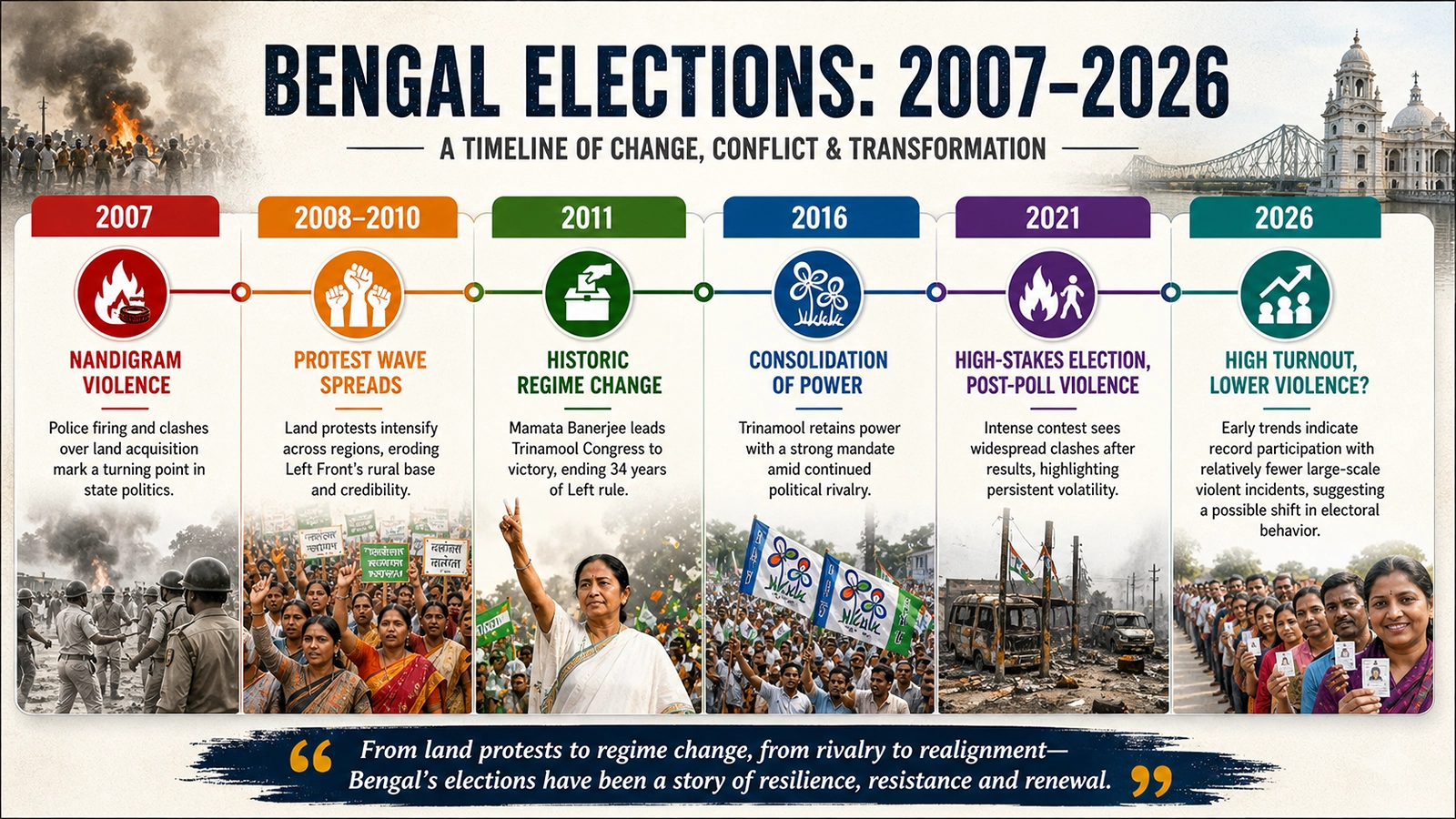
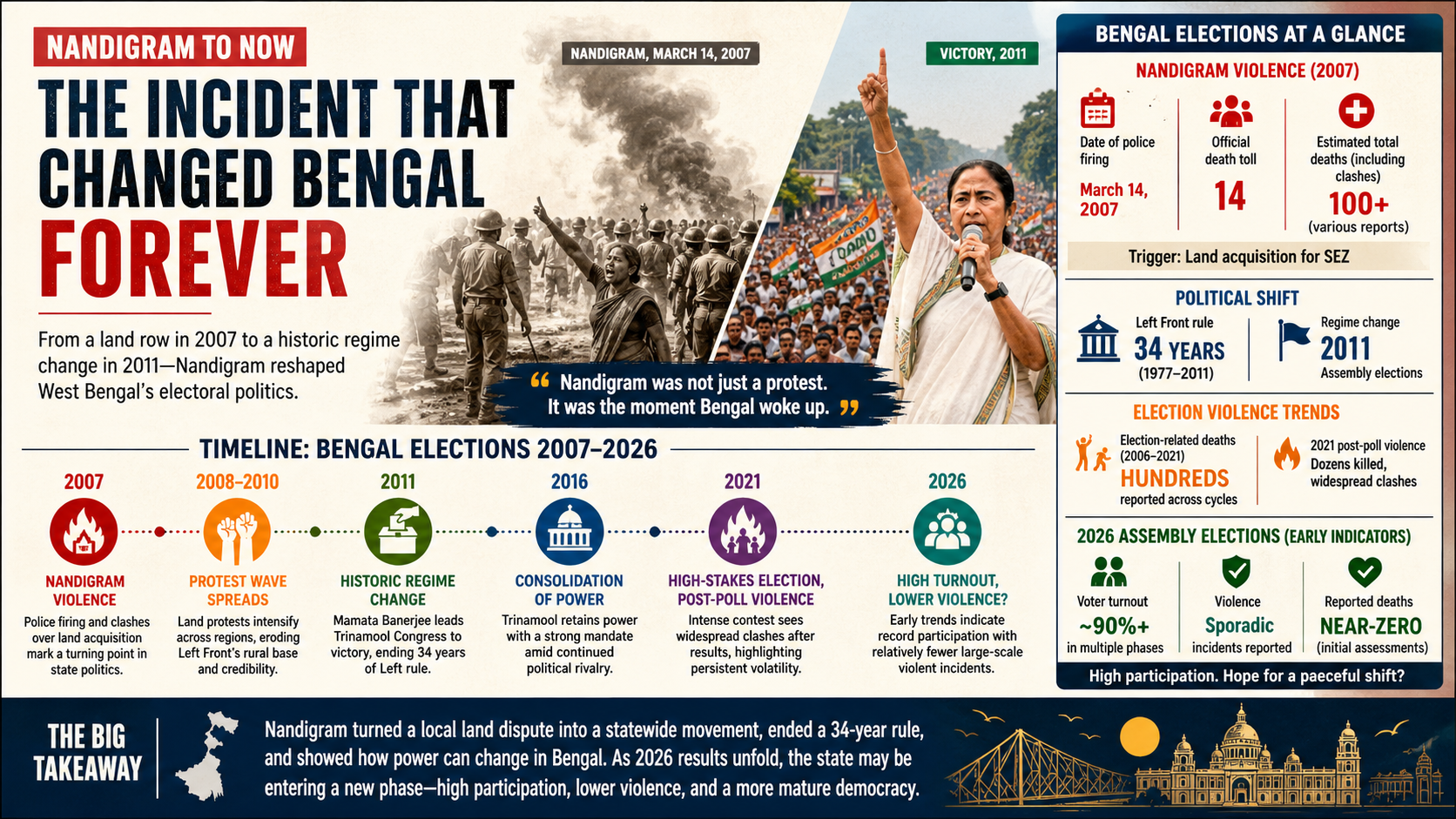
On March 14, 2007, police moved in to regain control. The operation ended in firing that killed at least 14 people, according to official figures, while broader violence in the region over time pushed the death toll significantly higher. Clashes, arson and armed confrontations followed, transforming Nandigram into one of the most volatile political flashpoints in recent Indian history.
But the real impact of Nandigram was not confined to those violent months. It reshaped political imagination in Bengal. What had been a dominant and seemingly unshakeable Left Front government — in power since 1977 — suddenly appeared vulnerable. The incident exposed a disconnect between the ruling establishment and rural voters, particularly on issues of land and livelihood.
Into this vacuum stepped Mamata Banerjee, who turned Nandigram and the parallel agitation in Singur into the foundation of a broader political movement. Framing the protests around dignity, identity and rights, she mobilized support across rural and urban constituencies alike. The slogan of “Ma, Mati, Manush” was no longer just rhetoric; it became a vehicle for electoral transformation.
By the time the state went to the polls in 2011, the shift was unmistakable. The Trinamool Congress swept to power, ending 34 years of Left rule — one of the longest-running democratically elected communist governments in the world. The result was not just a change in government; it was a structural realignment of Bengal’s politics, with Nandigram at its core.
Yet the years that followed showed that while power had changed hands, the nature of electoral competition had not fundamentally softened. Elections continued to be fiercely contested, often accompanied by clashes between rival political groups. The 2016 election consolidated Trinamool’s dominance, but the underlying volatility remained. In 2021, a high-stakes contest once again exposed the fragility of peace, with widespread post-poll violence underscoring how deeply entrenched political rivalries had become.
This is what makes the 2026 election cycle particularly significant. Early indicators point to high voter turnout — crossing 90 percent in several phases — reflecting intense public participation. Yet, unlike previous cycles, reports of large-scale violence have been limited, with incidents described as sporadic rather than systemic and initial assessments indicating near-zero fatalities.
Whether this signals a durable shift or merely a temporary pause remains an open question. Bengal’s electoral history cautions against quick conclusions. The structures that once produced confrontation — local power struggles, party networks and high-stakes political competition — have not disappeared.
And still, the shadow of Nandigram looms over every election. It was the moment when politics in Bengal stopped being predictable and became deeply contested, emotional and mass-driven. It demonstrated how a single incident could fracture decades-old dominance and reorganize voter loyalties almost overnight.
Nearly two decades later, as ballots are counted and results begin to take shape, Bengal may once again be at the edge of transition — not of power, but of process. If the current trend holds, the state could be moving toward an electoral culture defined less by violence and more by participation.
But history, as Nandigram showed, has a way of returning at unexpected moments. And in West Bengal, the distance between protest and power has never been very far.





_1600x900.jpg&w=256&q=75)



.jpg&w=256&q=75)
.jpg&w=256&q=75)
