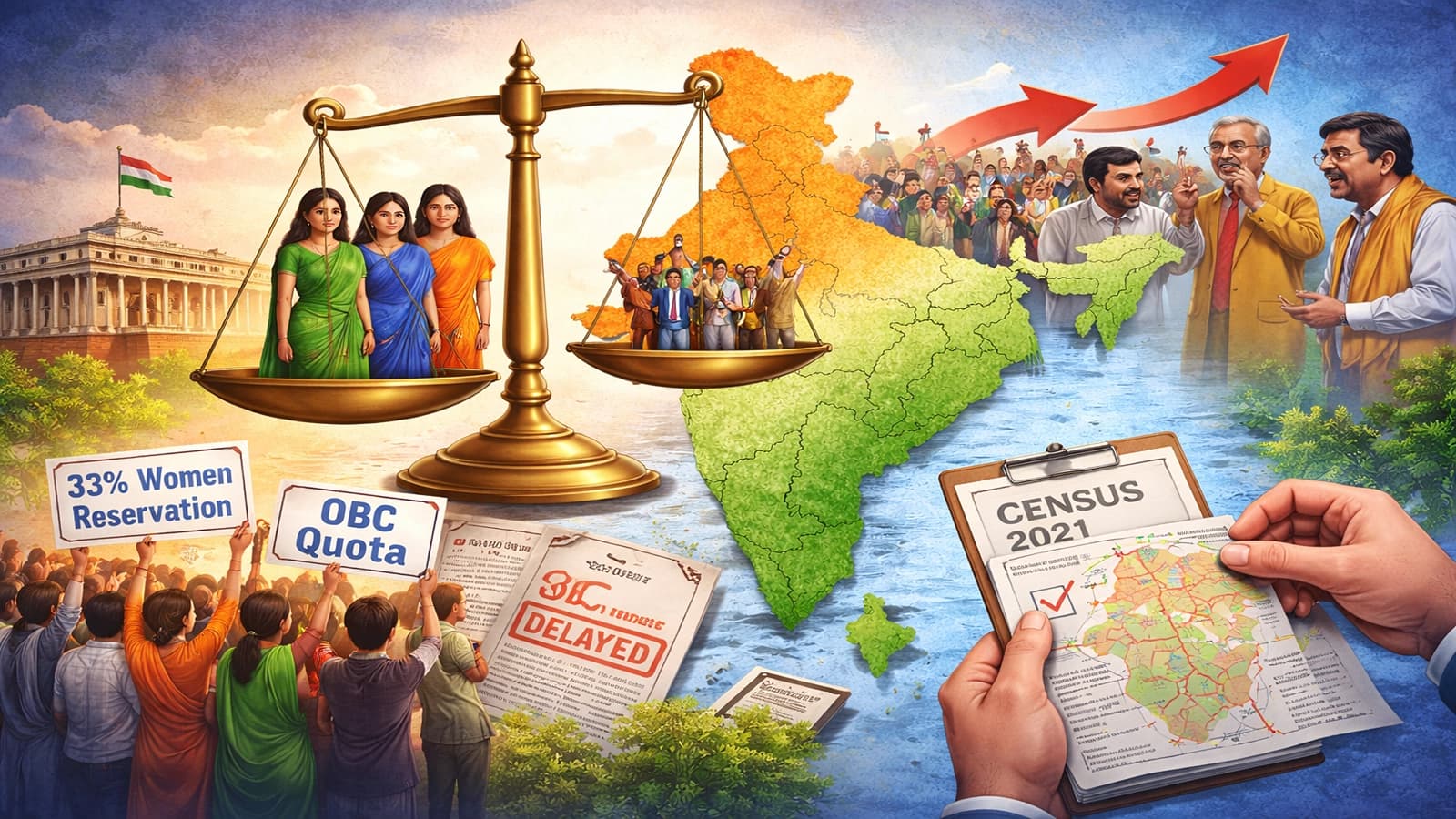
Delimitation and Women’s Reservation: Reform, Power, and the Fragile Balance of Indian Democracy
Why the promise of women’s representation is entangled with delimitation, delayed census, and a looming shift in India’s political power balance.
Prabhav Anand20 April 2026 11:13
There are moments in a nation’s political evolution that appear routine on the surface but carry the potential to reshape its future in profound ways. India’s current debate around the Delimitation Bill 2026 and the implementation of the Nari Shakti Vandan Adhiniyam is one such moment. For many citizens still asking what is the delimitation bill in India, the issue goes far beyond a legislative update—it touches the very foundation of representation and democratic balance.
At first glance, the narrative seems straightforward. A long-pending demand for reserving one-third of seats for women in Parliament and state assemblies has finally been legislated. Yet, the fine print tells a different story. The implementation of this reform has been tied to the completion of a fresh Census and a subsequent delimitation exercise. This has sparked widespread curiosity around delimitation bill explained discussions and debates over delimitation bill 2026 voting, as timelines remain uncertain.
To understand the depth of the issue, one must first grasp what is delimitation in India. In simple terms, delimitation refers to the redrawing of electoral constituency boundaries based on population changes. The delimitation meaning in politics lies in ensuring equal representation—so that each vote carries roughly the same weight across regions. However, in a country as vast and diverse as India, this process is never purely technical; it is deeply political.
Delimitation, governed by law and executed by a commission, is not merely administrative. It determines how power is distributed. For those still wondering what is delimitation bill, the answer lies in its impact—it decides who gets represented, how much influence a region holds, and ultimately, how democracy functions in practice.
The freeze on seat redistribution, extended through constitutional amendments, was a conscious political compromise. It aimed to ensure that states which successfully controlled population growth were not penalized, while also maintaining balance in federal power. For decades, this arrangement preserved stability. But with the proposed delimitation bill 2026, that balance is now under strain.
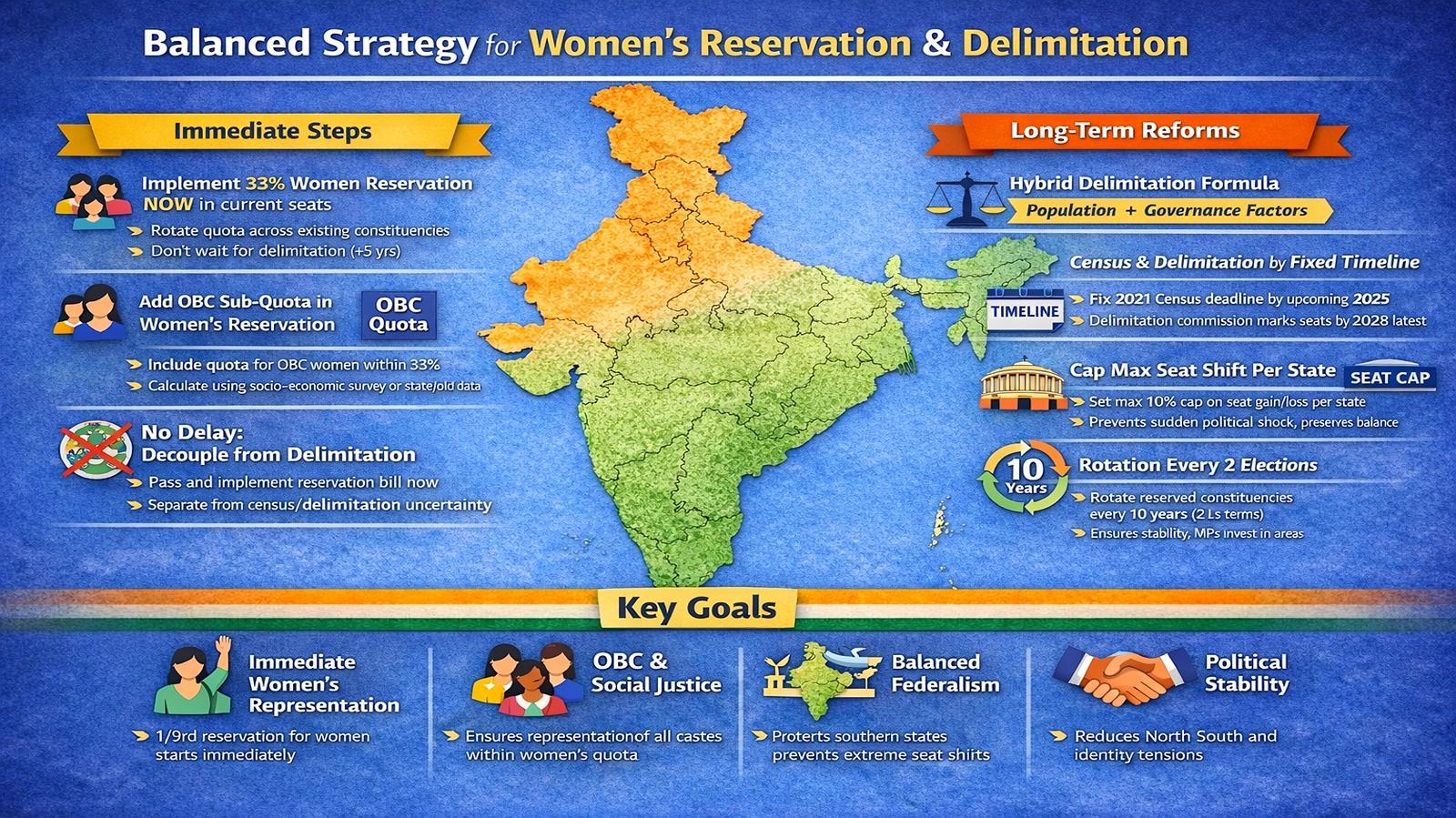
Proposed roadmap for immediate women’s reservation and balanced delimitation to ensure equity, justice, and stability.
When delimitation resumes after 2026, the consequences are expected to be significant. Northern states, with higher population growth, may gain more parliamentary seats. Meanwhile, southern states could see their relative influence decline. This raises critical concerns about fairness, especially when governance outcomes differ across regions. These concerns have fueled debates online and offline, with discussions ranging from what is delimitation bill in India to whether the delimitation bill defeated narrative could emerge politically if opposition intensifies.
It is within this context that women’s reservation becomes intertwined with delimitation. By linking the two, the government has effectively delayed immediate implementation. This has raised questions about whether the reform is a genuine step forward or a strategically deferred promise.
Opposition leaders have pointed out that while there is broad agreement on women’s reservation, the conditional implementation tied to delimitation creates uncertainty. The lack of clarity around delimitation bill 2026 voting and execution timelines further strengthens the perception that the reform may not deliver immediate change.
Regional leaders, particularly from southern states, have voiced deeper concerns. If delimitation shifts political power geographically and women’s reservation is applied within that new structure, the combined effect could significantly reshape India’s political landscape. This goes beyond gender representation—it touches federal balance and regional equity.
Adding another dimension is the demand for an OBC sub-quota within women’s reservation. Without internal categorization, there is a risk that benefits may not reach marginalized communities effectively. This debate has become a key part of the broader delimitation bill explained discourse, highlighting how representation is not just about numbers but also about inclusivity.
The government has positioned the bill as a historic reform, emphasizing its commitment to women’s empowerment. Politically, this narrative is compelling. However, it does not fully address structural concerns surrounding delimitation and its long-term implications.
The risk now is that this issue evolves into a broader federal fault line. If certain regions perceive that they are losing influence despite better governance outcomes, it could lead to political and social tensions. In this context, understanding what is delimitation in India becomes essential not just for policymakers, but for citizens as well.
One possible way forward is to decouple women’s reservation from delimitation. There is no inherent structural barrier to implementing the quota within the existing framework. This would allow immediate benefits while avoiding delays linked to the delimitation process.
At the same time, reforms in delimitation itself are necessary. Instead of relying solely on population, a hybrid approach that includes governance indicators could ensure a more balanced outcome. This would address concerns that have fueled debates like whether the delimitation bill defeated scenario could become a political flashpoint.
Transparency and consensus-building will be crucial. Institutions must ensure that the process is inclusive and perceived as fair. After all, democracy is not just about legality—it is about legitimacy.
Ultimately, the debate around the Delimitation Bill 2026 and women’s reservation is about trust. Trust between regions, trust in institutions, and trust in the system’s ability to deliver equitable representation. For those still searching what is delimitation bill, the answer lies in this trust—it is a tool that can either strengthen or strain the democratic fabric.
India has navigated complex transitions before. The challenge now is to ensure that reform does not come at the cost of stability. The goal should not be to win a political argument, but to build a system that endures.
In the end, the success of this reform will not be judged by the passage of a bill or the outcome of delimitation bill 2026 voting. It will be measured by whether it strengthens India as a union of diverse yet equal voices. That is the real test—and one that cannot afford to fail.