The uncertainty surrounding voter deletions in West Bengal is deepening, with conflicting figures, missing lists and administrative lapses leaving thousands anxious and confused about their electoral status.
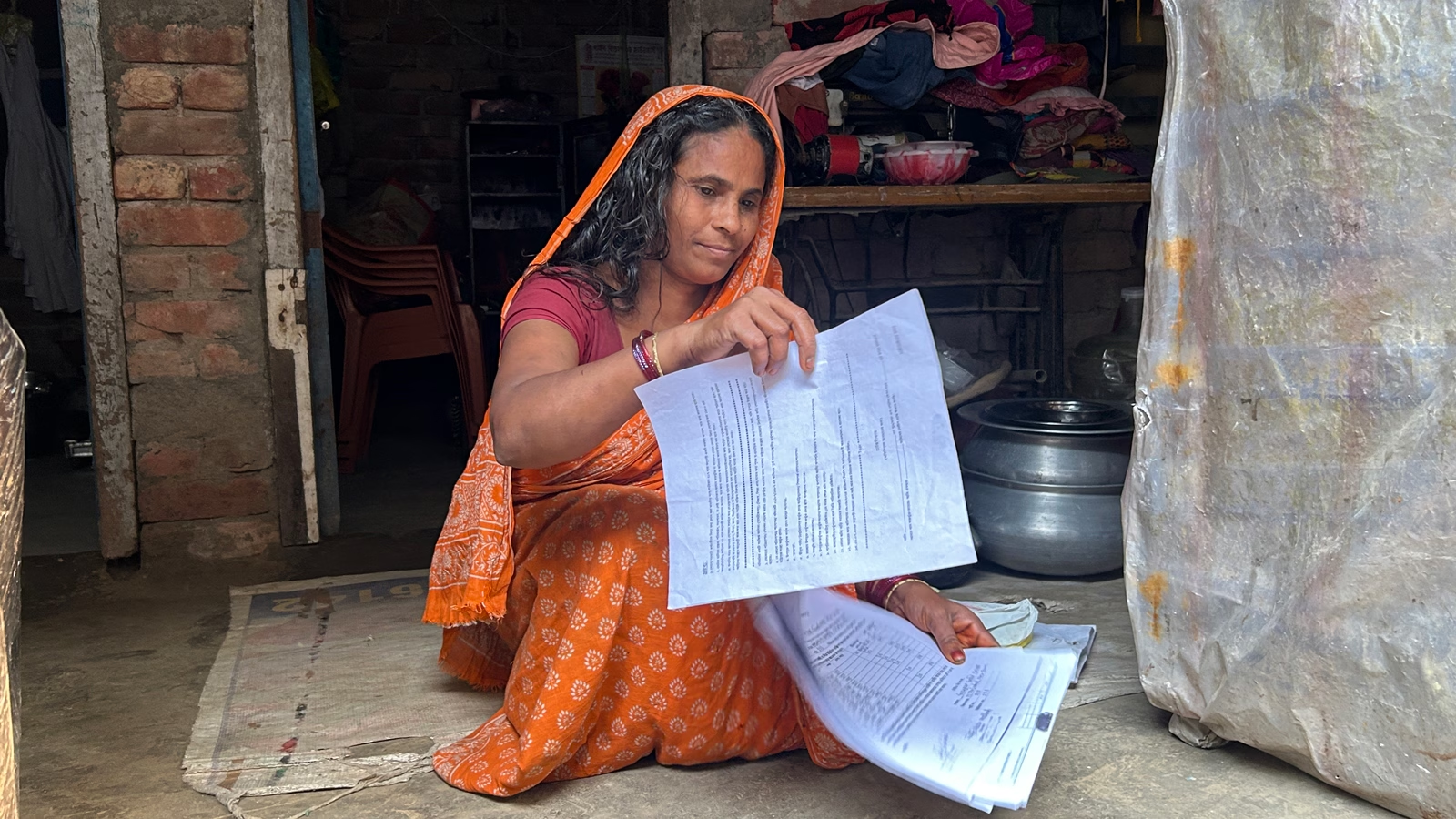
On the ground, the lack of clarity is stark. In Tara Hadia village of Bhangar, 43-year-old Rashida Bibi stands outside her home, grappling with a reality she does not fully understand. While every member of her family remains on the voter list after the Special Intensive Revision (SIR), her name has been struck off following adjudication.

In many ways, she is among the few who at least know their fate.
Two days after the Election Commission (EC) announced the preparation of its first Supplementary List post-adjudication, there is still no comprehensive disclosure of who has been deleted — or how many. Despite stating that lists of “deletions” and “inclusions” would be displayed at polling booths, this has largely not been implemented.
Only a handful of booths offer glimpses into the process. At Booth No. 49 in Bhangar, six out of 103 voters under adjudication have been deleted — all women, five of them from the minority community. In nearby Booth No. 50, five out of 65 have been removed, again predominantly minority women.
The opacity is compounded by sharply divergent estimates. One EC official informally pegged deletions at nearly 40% of the 32 lakh names adjudicated — roughly 13 lakh voters. Chief Minister Mamata Banerjee, in a recent speech, cited 8 lakh deletions out of 27 lakh cases. Her political rival Suvendu Adhikari claimed the figure was closer to 14 lakh out of 32 lakh.
The EC has not issued an official consolidated number.
Even the digital system has added to the confusion. Less than 24 hours after the EC announced the first Supplementary List, its online portal briefly showed almost all voters in the state — including those already cleared — as “under adjudication”. The poll body later termed this a “technical glitch”, attributing it to a backend error and insisting it was only a display issue.
But for many voters, the damage was already done.
In Booth No. 49, Purnima Ghosh, 40, breaks down as she recounts her situation. Every member of her household — her husband, in-laws and extended family — remains on the rolls. She does not.
Despite submitting documents linking her to her father, whose name appeared in the 2002 electoral roll, her name was deleted. “My daughter keeps asking what we will do now,” she says. “I have no answer.”
Sonamoni Khatun, 32, faces a similar predicament. Flagged during scrutiny for being one of seven siblings, she says she submitted the same documents as her brothers and sisters — all of whom were included. “I don’t know why only I have been removed,” she says.
For others, the shock is even sharper. Romicha Bibi, a voter since 2006, says she has lost count of how many elections she has participated in. Now, without explanation, her name is gone.
Even officials on the ground appear uncertain. Md Abed Ali Mollah, the Booth Level Officer at Booth No. 49, says he had cleared all documents months ago after working late into the night during the verification process. “Despite that, I could not prevent six deletions,” he says.
At Booth No. 50, inconsistencies within families have added to the confusion. In one case, out of nine siblings flagged for scrutiny, seven were cleared while two were deleted — without any stated reason. Their father, a voter since the 1970s, questions the logic behind the decision.
“We don’t even have the money to go to court,” says one of the affected, Tanuja Bibi, who now faces the prospect of appealing before a tribunal that is yet to be set up.
The situation is no clearer in high-profile constituencies. In Bhabanipur, where Mamata Banerjee faces Suvendu Adhikari, post-adjudication data is available for only 42 of 267 booths. Attempts to access full lists have largely failed.
Political reactions have been sharp and polarized. The Trinamool Congress has termed the exercise an “organised offence”, alleging targeted deletions of minorities and women. The CPI(M) has accused the EC of failing in its duty to protect genuine voters. The BJP, in turn, has blamed the state government for the prevailing “chaos”.
Meanwhile, institutional remedies remain out of reach. Tribunals to hear appeals are yet to be established, though officials say efforts are underway to secure infrastructure.
Caught in the middle are voters like Tanuja Bibi, whose fear captures the widening anxiety: “If I am driven away from my country, what will I do?”