


The education ministry reports 1,491 majors across 41 industrial categories, increased public funding, student assistance programs and reforms designed to align training with workforce requirements and improve access.
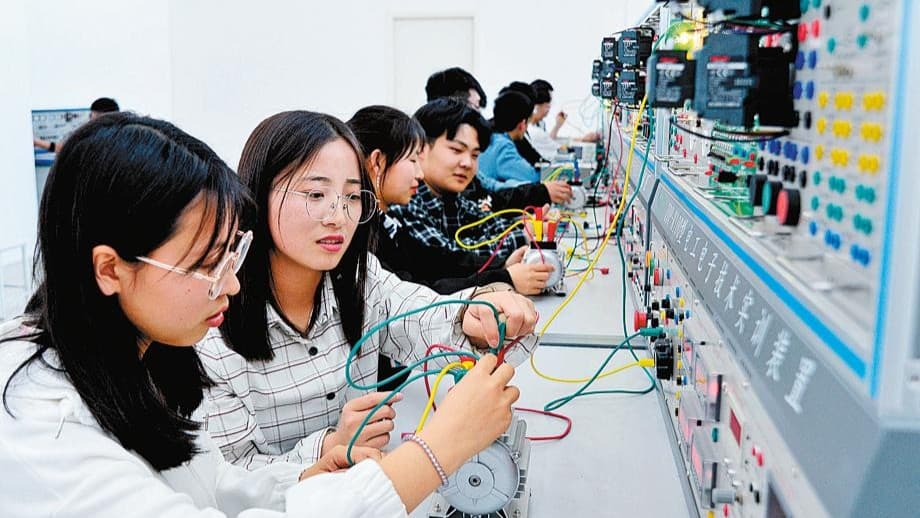
China has expanded its vocational education system to include 124 vocational undergraduate universities, while another 52 regular higher education institutions now offer vocational undergraduate programs, the Ministry of Education said at a news conference on Oct 12.
The expansion is part of the country's efforts to strengthen skills-based higher education, improve access to college-level qualifications and align vocational training more closely with industry requirements.

Vocational undergraduate education represents the undergraduate tier of China's vocational education system.
It was introduced to overcome the "ceiling" that had traditionally restricted vocational education to the junior college level, creating opportunities for students to pursue higher qualifications through vocational pathways.
China has developed the world's largest high-quality modern vocational education system, Peng Binbai, director of the Ministry of Education's Department of Vocational and Adult Education, said at the news conference.
The country's vocational education network currently includes 9,151 secondary vocational schools and 1,554 higher vocational colleges, reflecting the scale of its efforts to provide education and practical training across different levels.
“The system offers 1,491 majors, covering all 41 major industrial categories and reaching nearly every sector of the national economy,” Peng said.
The range of programs is intended to equip students with the skills and professional competencies required by different industries, while supporting the development of a workforce capable of responding to changing economic and technological needs.
The ministry has also been working to strengthen collaboration between educational institutions and employers through industry-education integration initiatives.
It has partnered with 14 provincial-level regions to conduct pilot reforms aimed at building a modern vocational education system. As part of these efforts, authorities have established 34 national municipal industry consortia and seven national industry-education integration communities, Peng said.
These initiatives seek to improve coordination between vocational institutions and industry by bringing education providers, companies and other stakeholders into closer cooperation.
The approach is intended to make vocational programs more responsive to workplace requirements and strengthen the connection between classroom learning, practical training and employment.
China also increased financial support for vocational education during the 14th Five-Year Plan period, which ran from 2021 to 2025. National vocational education funding rose 23.3% to 757 billion yuan ($113 billion) over the period, Peng said.
A multichannel funding system has taken shape, with government investment remaining the primary source of financial support.
The funding framework is accompanied by a financial-aid system that includes scholarships, grants, student loans, tuition waivers, work-study opportunities, subsidies and fee reductions.
According to Peng, these measures are designed to ensure that students can continue their education regardless of their families' financial circumstances. The stated objective is to prevent children from being denied educational opportunities because of financial difficulties.
The country's legal framework has also been revised to strengthen the position of vocational education within the wider education system.
The revised Vocational Education Law formally establishes that vocational education is as important as regular education, providing a legal basis for recognizing the value of both pathways.
In addition to the national legislation, 27 provincial-level regions have introduced local regulations governing vocational education. These measures reflect efforts to develop the legal and policy frameworks needed to support the sector's expansion and implementation across different regions.
Vocational education also serves a large number of students every year. Approximately 5 million students enroll in secondary vocational schools annually, while higher vocational education provides opportunities to nearly 6 million young people each year, Peng said.
He also highlighted the role of vocational education in expanding access to higher education for families with limited educational backgrounds.
Nearly 3 million families see their first-generation college students pursue vocational education each year, he said, pointing to the sector's contribution to education fairness and wider access to college-level learning.
The ministry has additionally introduced a plan to develop clusters of high-skilled talent to meet industry needs.
Under the initiative, leading enterprises, high-level educational institutions and industry organizations take leadership roles in coordinating reforms across courses, textbooks, teaching staff, internships and practical training.
The approach is intended to bring different parts of vocational education into closer alignment with the requirements of employers and industrial development.
By involving companies and industry organizations in curriculum and training reforms, authorities aim to ensure that students acquire practical capabilities alongside theoretical knowledge.
“More than 3,000 industry and enterprise standards have been converted into teaching standards for vocational education,” Peng said.
The changes are intended to reshape how vocational students are trained, moving away from a traditional emphasis on transferring knowledge toward a broader focus on developing comprehensive capabilities.
Through the expansion of vocational undergraduate programs, increased public funding, legal recognition and closer industry partnerships, China is seeking to strengthen vocational education as a major component of its higher education and workforce development systems.
The reforms cover access to qualifications, financial assistance, course design and practical training, with the stated aim of improving educational opportunities while preparing students for the needs of the national economy.

Singapore Management University’s Executive MBA enters global top 50 in Financial Times ranking

NUS launches clinical psychology program to expand Singapore’s mental healthcare workforce

DGT Partners with Medhavi Skills University to Expand Industry-Linked ITI Training

IIM Ahmedabad Opens Admissions for Second Batch of Blended MBA in Business Analytics and AI

Wits researchers develop light-powered neural network to decode complex signals
Singapore Management University’s Executive MBA enters global top 50 in Financial Times ranking
NUS launches clinical psychology program to expand Singapore’s mental healthcare workforce
Wits researchers develop light-powered neural network to decode complex signals
How China is expanding vocational education through undergraduate degrees, industry partnerships and financial aid

Singapore Institute of Technology launches new school for lifelong learning and career development

Singapore Management University’s Executive MBA enters global top 50 in Financial Times ranking
NUS launches clinical psychology program to expand Singapore’s mental healthcare workforce
DGT Partners with Medhavi Skills University to Expand Industry-Linked ITI Training
IIM Ahmedabad Opens Admissions for Second Batch of Blended MBA in Business Analytics and AI
Wits researchers develop light-powered neural network to decode complex signals
Singapore Management University’s Executive MBA enters global top 50 in Financial Times ranking
NUS launches clinical psychology program to expand Singapore’s mental healthcare workforce
Wits researchers develop light-powered neural network to decode complex signals
How China is expanding vocational education through undergraduate degrees, industry partnerships and financial aid
Singapore Institute of Technology launches new school for lifelong learning and career development
Copyright© educationpost.in 2026 All Rights Reserved.