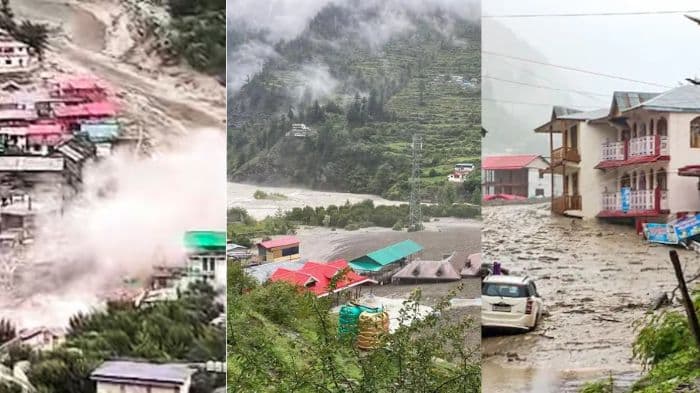
A catastrophic cloudburst struck Dharali village in Uttarakhand's Uttarkashi district on Aug 5, triggering flash floods and landslides that have so far killed at least five people, with more than 100 missing, according to state officials.
The sudden deluge swept through riverside settlements, destroying homes, guesthouses, shops and a market, and damaging roads and bridges critical to the Gangotri pilgrimage route.

Rescue operations are being conducted “on a war footing”, said Chief Minister Pushkar Singh Dhami, who returned from Andhra Pradesh to oversee efforts.
He confirmed that rescue teams, including the Indian Army’s Ibex Brigade, National Disaster Response Force (NDRF), State Disaster Response Force (SDRF), ITBP and local police have evacuated around 150 people and deployed some 150 army personnel, using drones, tracker dogs, earth-moving equipment and helicopters.
Locals estimate 20–25 hotels and homestays were completely washed away, and substantial parts of Dharali market were destroyed.
The flash flood washed out stretches of National Highway 34, including a 100-metre washout at Papadgad, severing access to nearby towns.
An army base in Harsil also sustained damage, and at least 11 soldiers remain missing. Schools have been shut in Dharali and nearby Harshil districts.
In Himachal Pradesh, heavy monsoon rains triggered multiple cloudburst incidents in Kinnaur district, washing away a bridge over the Tangling drain, stranding over 400 pilgrims on the Kinnaur Kailash trek.
These pilgrims were rescued by ITBP rope and zip-line teams. Landslides along highways blocked roads and disrupted connectivity in multiple regions.
Statewide, the broader monsoon season has brought widescale disruption: in 2025 alone, Himachal has reported 190+ deaths, loss of infrastructure worth over ₹1,700 crore, and closure of over 700 roads due to cloudbursts and landslides across districts like Mandi, Shimla, Solan and Kullu. Tens of thousands have been displaced, and schools and essential services remain interrupted.
Prime Minister Narendra Modi expressed condolences via post on X and assured central support. Union Home Minister Amit Shah instructed immediate deployment of seven NDRF and ITBP teams.
Uttarakhand CM Dhami thanked the Centre and said restoration of electricity and communication lines is a priority. Uttar Pradesh CM Yogi Adityanath also offered assistance.
Meteorological authorities report over 210 mm of rainfall in 24 hours in some parts of the region, marking it as one of the most intense localized downpours or cloudbursts seen this season.
Experts warn that rising trends in such extreme weather are driven by climate change and unsustainable development in fragile Himalayan zones.
A red alert remains in place across Uttarakhand, Himachal, Kerala, West Bengal, Tamil Nadu and Arunachal Pradesh.
The Uttarakhand flash flood recalls past tragedies such as the 2013 Kedarnath disaster, which claimed over 6,000 lives.
Meanwhile, this summer’s monsoon across the Himalayas in Uttarakhand and Himachal has exposed vulnerabilities—damaged hydropower installations, washed-out roads and bridges, displaced communities and mounting humanitarian stress. Relief agencies continue evacuation and infrastructure restoration under worsening weather conditions.