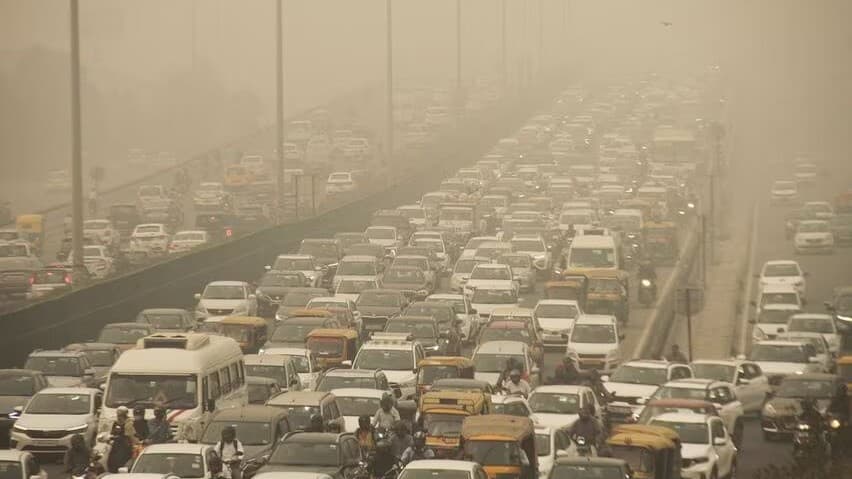
As per the System of Air Quality and Weather Forecasting and Research (SAFAR-India), Delhi's air quality continues into the'very bad' category on Oct 23 at 7 am, with an Air Quality Index (AQI) of 349.
"The pollution is so bad even before Diwali; people are really suffering," one of the locals said.

Delhi Environment Minister Gopal Rai has written to the transport ministers of Haryana, Uttar Pradesh, and Rajasthan, requesting them to stop allowing diesel buses from their states to enter Delhi as the air quality in the nation's capital worsens.
"I am writing to express my deep concern about the rising air pollution levels in Delhi as winter approaches. A significant contributor to this pollution is vehicular emissions, especially from the large number of diesel buses entering the city from Uttar Pradesh,” Rai said in the letter.
“Diesel emissions have a well-documented impact on air quality, and this influx of buses is exacerbating the situation, posing severe health risks to Delhi's residents," he added.
Earlier, the national capital's average AQI was recorded at 310 on Oct 22, making it "very poor," following which Graded Response Action Plan (GRAP) Stage II was enforced.
The use of coal and firewood, including in tandoors at hotels, restaurants, and open eateries, as well as diesel generator sets (apart from emergency and essential services), is prohibited in Delhi under the second phase of the GRAP.
Keeping AQI in mind, the Delhi Pollution Control Committee (DPCC) has announced a blanket ban on firecrackers within the National Capital Territory (NCT) of Delhi till Jan 1, 2025, in an effort to reduce air pollution levels ahead of Diwali.
The prohibition extends to the production, distribution, and storage of firecrackers as well as their use in internet marketing activities.
Depending on the severity of the problem, the air quality is categorized into four stages: "poor" (AQI 201-300) in Stage I; "very poor" (AQI 301-400) in Stage II; "severe" (AQI 401-450) in Stage III; and "severe plus" (AQI > 450) in Stage IV.