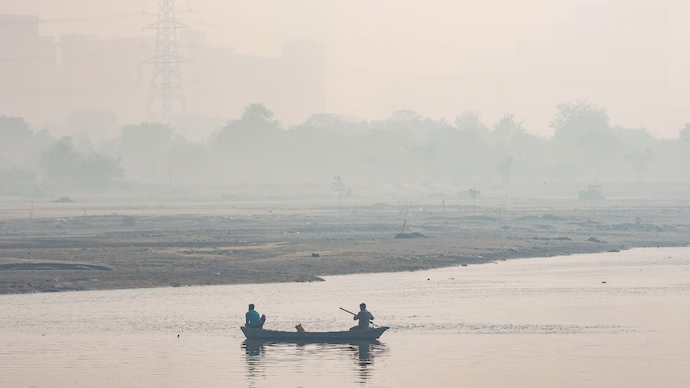
A dense shroud of smog cloaked Delhi and its adjoining regions for the second straight day on November 12, pushing the city’s air quality deep into the ‘severe’ zone and marking the worst pollution levels of the year so far.
According to data from the Central Pollution Control Board (CPCB), major monitoring stations recorded alarming Air Quality Index (AQI) levels at 7 a.m. — Anand Vihar (438), Bawana (451), Chandni Chowk (449), ITO (433), Dwarka Sector 8 (423), and Rohini (442). The citywide average AQI stood at 428 on November 11 evening, when Delhi’s air quality first slipped into the ‘severe’ category this season.

Officials said stagnant weather, near-calm winds, and rising local emissions triggered the rapid deterioration. This is the first time since December 2024 that Delhi’s air quality has crossed into the ‘severe’ range — a level that poses health risks even to healthy individuals and can lead to serious respiratory issues among the vulnerable.
In response, authorities enforced Stage III of the Graded Response Action Plan (GRAP) across Delhi-NCR after an emergency meeting of the Commission for Air Quality Management (CAQM). A nine-point action plan was rolled out, including a ban on construction and demolition activities not compliant with dust-control norms, as well as the closure of stone crushers and mining sites.
Vehicular restrictions have also been tightened: BS-III petrol and BS-IV diesel four-wheelers are now barred from plying in the capital, except for essential services and vehicles used by people with disabilities. Diesel-run medium goods vehicles (MGVs) registered up to BS-IV standards have also been restricted unless engaged in critical operations.
To minimize exposure for children, schools have been directed to move classes up to Grade 5 to hybrid mode — allowing both in-person and online learning. Government offices and civic bodies across Delhi, Gurugram, Faridabad, Ghaziabad, and Gautam Buddh Nagar will operate with staggered timings to ease traffic congestion and curb emissions.
Authorities have urged citizens to adopt cleaner commuting practices such as carpooling, walking short distances, and using public transport. Residents have also been advised against using coal or wood for heating, with the Delhi government recommending electric heaters for domestic and security staff to reduce open burning during cold nights.
As the capital wakes each morning to a dim orange haze and a biting chill, Delhiites once again find themselves bracing for a familiar, suffocating winter — one defined not by fog, but by a man-made smog that refuses to lift.