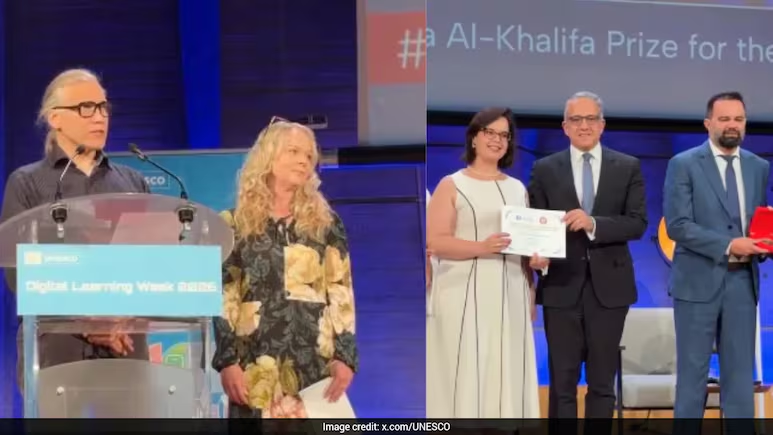
The growing use of artificial intelligence in classrooms has earned international recognition for two education initiatives from Finland and Brazil, with UNESCO naming them winners of its 2026 King Hamad Bin Isa Al-Khalifa Prize for the Use of Information and Communication Technologies (ICTs) in Education.
Finland’s Generation AI programme and Brazil’s Redacao Parana project were selected from more than 100 nominations submitted by UNESCO member states and organisations.

The two initiatives were recognised for demonstrating how AI and digital technologies can be used not simply to deliver information, but to help students think critically, express ideas creatively and take a more active role in shaping their learning.
The 2026 UNESCO ICT in Education Prize focused on innovative practices showing how teachers and learners are engaging with AI in ways that promote critical thinking, creativity and imagination.
An independent jury of experts in digital technology and education selected the two projects for their innovative use of technology in education.
Finland puts students at the centre of AI learning
Finland’s Generation AI programme is designed to move students beyond being passive consumers of artificial intelligence and encourage them to become critical and creative participants in shaping AI systems.
The programme provides evidence-based tools, learning materials and classroom activities built around inquiry and co-design. Students are encouraged to investigate how AI works, question its impact and explore how such systems could be developed and used responsibly.
The approach places learner voice and agency at its centre, treating students as active makers, investigators and future users and creators of AI technologies.
According to UNESCO, the programme has shown positive effects on students’ scientific reasoning and ethical reflection on AI and digital media. It has also helped learners develop the ability to identify, explain and critically examine complex aspects of AI while imagining alternative possibilities.
Brazil uses AI to strengthen writing skills
Brazil’s Redacao Parana combines a digital platform with a public education policy aimed at expanding access to quality writing instruction across the state of Parana.
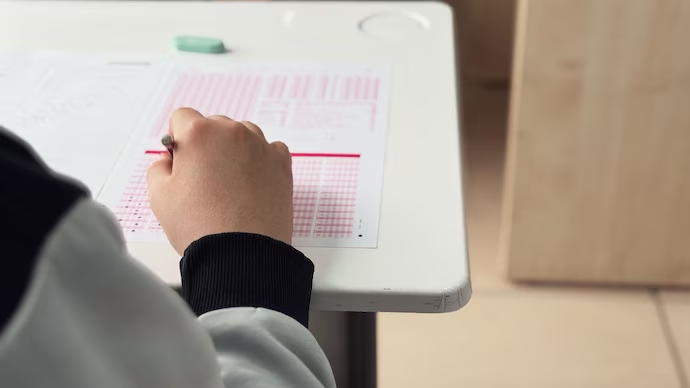
Developed by the State Secretariat of Education of Parana, the programme uses AI-assisted feedback alongside teacher guidance to help students improve their writing through structured cycles of drafting and revision.
Rather than replacing teachers, the initiative places AI within a broader learning process in which students receive feedback, revise their work and develop stronger language and higher-order thinking skills.
Teachers are also provided with structured training to support the implementation of the programme in classrooms.
UNESCO recognises responsible use of technology
The two projects reflect a broader shift in education towards using AI as a tool to deepen learning rather than simply automate classroom tasks.
The UNESCO prize is awarded annually to initiatives that use information and communication technologies to improve teaching, learning and educational outcomes in the digital age. The 2026 winners were recognised for demonstrating how technology can support creativity, critical inquiry and more equitable access to quality education.