What does it take to make a classroom work beyond the textbook? For this year’s National Teachers’ Award recipients, the answer has taken many forms: a science lab built inside an abandoned military bunker, students teaching their mothers how to use digital payments, and lessons that connect Biology to the lives of athletes and public figures.
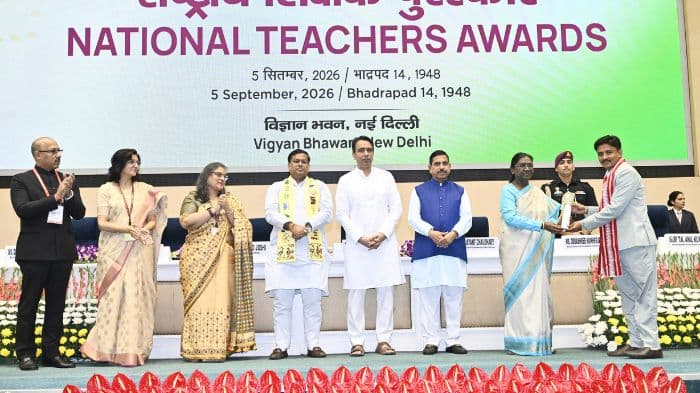
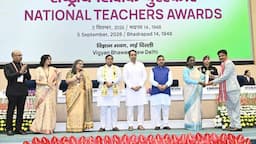
President Droupadi Murmu presented the National Teachers’ Awards to 48 school teachers on Sep 5, recognising educators from across India for their contribution to teaching and learning. Their stories offer a glimpse into the different ways teachers are using innovation, technology, community participation and hands-on learning to engage students.

The awards also recognised 21 teachers and faculty members from higher education institutions and polytechnics.
Here are some of the teachers whose work stood out this year:
Divyendu Sen, Rajasthan
A biology teacher at Mahatma Gandhi Government School in Jhalawar, Divyendu Sen has encouraged students to take part in astronomy projects despite coming from a rural school. Through a NASA-supported citizen science campaign, his students have identified 12 asteroid candidates since the Covid-19 pandemic, four of which have been provisionally recognised by scientists. He has also introduced technology-based learning initiatives and encouraged students to participate in science competitions.
Mohd Mustafa Kamal, Ladakh
Teaching in Wakha village near Kargil, Mohd Mustafa Kamal has developed unconventional ways of making lessons practical. He uses abandoned military bunkers as science laboratories and classrooms as mock parliaments. His approach has been shaped by his own childhood experiences during the Kargil War and focuses on taking learning beyond textbooks.
Rajesh Bordoloi, Assam
Geography teacher Rajesh Bordoloi turned his students into teachers at home. Through his “Each One Teach One – Students Teach Their Mother for Digital Literacy” initiative, Class 10 students help their mothers learn reading and writing, smartphone use, UPI payments, online banking and other digital services. The programme was designed particularly for families where mothers had limited access to formal education.
Radha Rajesh, Bengaluru
Biology teacher Radha Rajesh uses familiar real-world stories to make complex scientific concepts easier to understand. Lessons on the nervous system can include Parkinson’s disease, growth hormones are linked to Lionel Messi’s childhood experience, and traumatic brain injuries are explained through Michael Schumacher’s skiing accident. She also uses technology and AI tools while emphasising curiosity and critical thinking.
K P Sunil Kumar, Kerala
K P Sunil Kumar, headmaster of a government upper primary school in Kannur, has focused on addressing learning gaps and strengthening students’ language and communication skills. His initiatives include “Thenara”, which examined students’ reading habits, along with programmes designed to develop news communication, public speaking, writing and a culture of reading.
Sunita Yadav, Chhattisgarh
Sunita Yadav has combined digital resources and experiential learning with community participation at her government school in Sarangarh-Bilaigarh district. She uses DIKSHA, short films, audiobooks, podcasts and smart classes. In 2023, she also introduced a nutritional initiative that provided students with a glass of milk every day, with the stated aim of helping them remain focused on their studies.
Munmun Bhattacherjee, Jharkhand
At Madhya Vidyalaya Barmasia in Dhanbad, Munmun Bhattacherjee has worked to change perceptions about government schools. With limited teaching resources, she and her school use everyday materials, including packaging and bags, to create drawing, reading and story sheets. Her work also focuses on making learning accessible to children from communities around the coal-mining areas of the district.
Shalini Kushwaha and Iftkhar Khan, Uttar Pradesh
Shalini Kushwaha has worked with government-school teachers as an Academic Resource Person after teaching young children herself, focusing on identifying learning difficulties and finding solutions. Fellow awardee Iftkhar Khan, an art teacher, uses an approach called “Drishti Chitra”, taking students outside the classroom so they can observe and draw their surroundings directly.
Bompelli Bhavani, Telangana
Primary-school teacher Bompelli Bhavani has used real-life settings and interdisciplinary learning to make lessons more practical. She has organised visits to banks, post offices and gram panchayat offices and uses play-based methods in teaching. She has also contributed to improving technology access at her school and teaches computer skills to students on weekends.
The stories of this year’s awardees show the range of work being done inside and beyond Indian classrooms — from astronomy and digital literacy to nutrition, community participation, art and experiential learning. The National Teachers’ Awards are intended to recognise teachers who have contributed to improving school education and enriching the lives of their students.