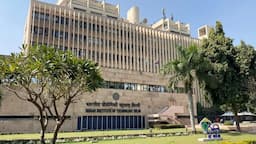
Higher Education Secretary Deepti Gaur Mukherjee inspected the National Testing Agency’s (NTA) newly relocated office in New Delhi and reviewed its infrastructure and administrative arrangements ahead of upcoming national-level examinations.
During her visit, Mukherjee met senior NTA officials and assessed the operational facilities at the new premises as the testing agency continues to strengthen its examination systems and security protocols following the NEET-UG paper leak controversy.

The Ministry of Education said the review focused on the infrastructure and administrative setup required for the smooth and secure conduct of forthcoming examinations.
“Secretary, Department of Higher Education, Ministry of Education, Smt. Deepti Gaur Mukherjee visited the new NTA office. During the visit, she interacted with senior NTA officials, inspected the operational facilities and conducted a comprehensive review of the new infrastructure and administrative setup to ensure seamless conduct of upcoming examinations,” the Ministry of Education said in a post on X.
The NTA is preparing to conduct several major examinations, including JEE Main, NEET-UG, CUET and UGC-NET. The inspection comes as the agency implements changes to its infrastructure, staffing and security systems.
The testing agency has shifted its headquarters from its earlier premises in Okhla to the Government of India Press Building on Minto Road in central New Delhi.
The new facility has more than 55,000 square feet of space across the fifth floor and parts of the fourth and sixth floors. The relocation followed a government review of the NTA's examination infrastructure and security arrangements.
The NTA had been operating from its Okhla office since its establishment in 2017 under the Ministry of Education. The agency was created to conduct examinations with a focus on fairness, transparency and standardization.
The move to a government facility is part of broader measures to strengthen the handling of confidential examination material and restrict access to sensitive operations.
Security at the new NTA premises has also been strengthened, with the Central Industrial Security Force (CISF) deployed to regulate access to confidential areas.
A total of 39 CISF personnel have been deployed at the facility, according to officials. Their responsibilities include access control, frisking and baggage screening at entry and exit points.
The security infrastructure also includes X-ray baggage screening machines and Door Frame Metal Detectors. Confidential sections have been separately demarcated, with access and movement within these areas subject to tighter monitoring.
The strengthened physical security measures are accompanied by additional controls for the handling of sensitive examination-related material.
The new premises include dedicated rooms for confidential operations and air-gapped computer systems designed to reduce the risk of unauthorized access to sensitive information.
The NTA has also introduced mandatory device-deposit protocols in restricted areas. These measures are intended to limit the movement of electronic devices and prevent unauthorized access to examination-related information.
The government is also implementing standard operating procedures covering key stages of the NTA's examination cycle. As part of the information-security overhaul, a dedicated Chief Information Security Officer has been designated, while recruitment for additional information-security personnel is also under way.
The changes at the NTA come after the agency faced intense scrutiny over the NEET-UG paper leak controversy, which triggered protests by students and raised concerns about the security and management of national-level examinations.
The investigation into the paper leak identified shortcomings in the handling of confidential material at the agency's earlier premises. The investigation also raised concerns over access controls and surveillance within sensitive sections of the office.
The controversy prompted the government to undertake a wider review of the NTA's examination framework, including its infrastructure, staffing, security protocols and question-paper handling procedures.
The government has since been working on measures aimed at reducing vulnerabilities in the examination process and strengthening safeguards around confidential material.
The agency has also initiated changes to its examination team and question-paper preparation process. Around 600 experts associated with question-paper setting were removed as part of the restructuring, with new experts being brought into the system.
The NTA has proposed a four-tier mechanism for checking question papers to strengthen scrutiny before examinations. Additional officials are also being inducted to support the agency's examination operations.
These measures are being introduced alongside the physical and digital security upgrades at the new office.
The latest inspection by the Higher Education Secretary is part of the government's continued monitoring of the NTA as the agency prepares for its upcoming examination calendar.
The focus remains on strengthening infrastructure, tightening access to confidential areas and improving administrative and examination processes.