New SMC Guidelines 2026 unveiled to strengthen accountability and participation in schools: Check key highlights and changes
The revised framework introduces monthly meetings, three-year development planning, stronger financial oversight, community-led governance, inclusive education monitoring, and coordinated support from multiple ministries for schools nationwide.
Pragya Kumari07 May 2026 14:15
Union Education Minister Dharmendra Pradhan on May 7 launched the School Management Committee (SMC) Guidelines 2026 at Vigyan Bhawan in New Delhi, introducing a revised framework aimed at strengthening community participation, accountability, and governance in schools across the country.
The event was attended by Delhi Education Minister Ashish Sood, Chhattisgarh School Education Minister Gajender Yadav, Department of School Education and Literacy Secretary Sanjay Kumar, Drinking Water and Sanitation Secretary Ashok Kumar Meena, Additional Secretary Archana S Awasthi, and other senior officials. Several state education ministers also joined the event virtually.
Addressing the gathering, Pradhan said the SMC Guidelines 2026 would play a major role in implementing the vision of the National Education Policy (NEP) 2020 across nearly 15 lakh schools nationwide.
He said the guidelines position School Management Committees as a bridge connecting students, teachers, parents, and local communities to ensure holistic child development through shared responsibility and active public participation.
Pradhan said the government remains committed to education, health, well-being, mental health support, and assistance for Children With Special Needs (CWSN).
He added that the revised guidelines also emphasize mentoring, handholding, and community ownership to strengthen school systems.
According to the minister, the framework aims to transform SMCs into a sustainable culture and a people’s movement for improving educational outcomes. Referring to initiatives such as Vidyanjali, he said the guidelines seek to revive India’s tradition of community-led education systems.
Ashish Sood said the initiative represents a major transformation in India’s education system rather than merely introducing new administrative norms.
He said earlier SMC frameworks introduced after the Right to Education Act were largely focused on infrastructure supervision and grant monitoring.
However, he noted that the revised guidelines address emerging priorities such as child safety, mental health, Foundational Literacy and Numeracy (FLN), digital transparency, learning outcomes, and community participation.
Sood said the framework transforms SMCs into “school community governing institutions” that will actively contribute to academic quality, student welfare, inclusivity, safety, transparency, and holistic child development.
Chhattisgarh School Education Minister Gajender Yadav said active public participation is necessary to improve learning outcomes and strengthen coordination between parents and schools.
New framework replaces earlier guidelines
Officials said the SMC Guidelines 2026 supersede all earlier guidelines related to SMCs and School Management and Development Committees (SMDCs) issued under Sarva Shiksha Abhiyan, Rashtriya Madhyamik Shiksha Abhiyan, and Samagra Shiksha.
The ministry said the revised framework aligns school governance structures with NEP 2020 and seeks to strengthen community ownership in learning outcomes from Balvatika to Grade 12.
Among the major changes introduced is a single SMC structure covering all grades from Balvatika to Grade 12.
The guidelines also define clear responsibilities for SMC members and Member Secretaries while strengthening transparency and financial oversight mechanisms.
The framework calls for proactive monitoring of student attendance, teacher engagement, inclusive education, school development planning, social audits, and implementation of schemes, including Samagra Shiksha, PM POSHAN, ULLAS, and PM SHRI.
The ministry has also included initiatives such as Vidyanjali, Eco-Clubs, PRASHAST App, disaster preparedness measures, and infrastructure safety monitoring within the SMC framework.
Structure and functioning of SMCs
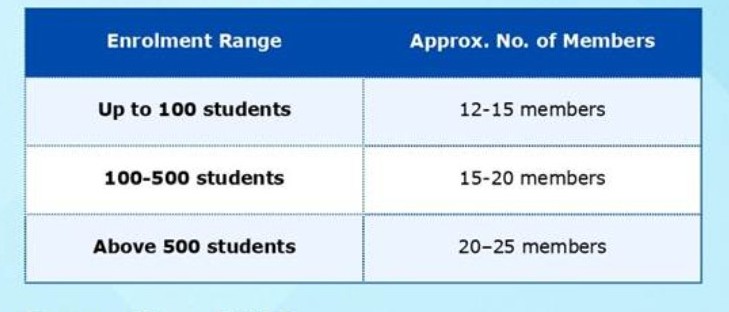
According to the guidelines, the size of School Management Committees will depend on student enrollment.
Schools with up to 100 students may form committees with 12 to 15 members; schools with 100 to 500 students may have 15 to 20 members, while schools with more than 500 students may constitute committees with 20 to 25 members.
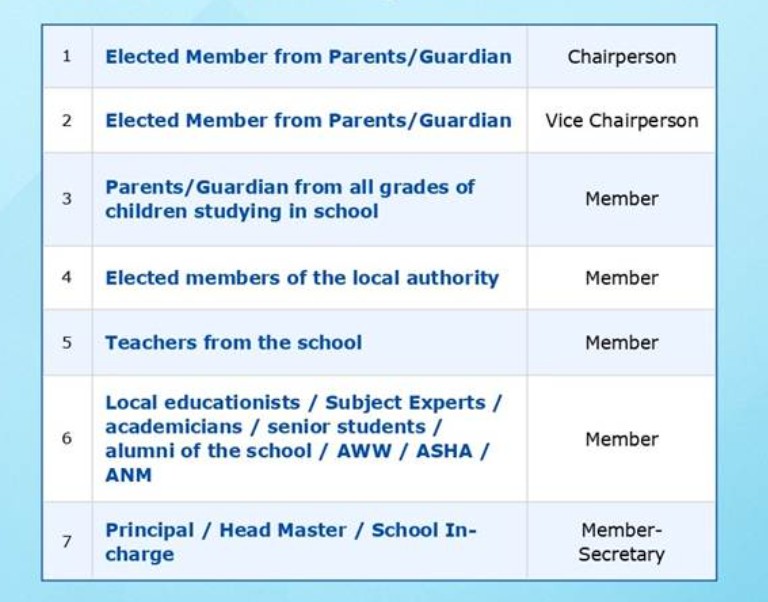
The committees will include elected parent or guardian representatives, teachers, local authority members, educationists, subject experts, senior students, alumni, Anganwadi workers, ASHA workers, and ANM representatives.
The Principal, Head Master, or School In-charge will serve as the Member Secretary.
The guidelines mandate formation of SMCs within one month of the beginning of the academic year, with the first meeting to be conducted within one week of constitution.
Meetings must be held at least once every month with a minimum quorum of 50%. Schools have also been advised to create Academic Committees and School Building Committees as sub-groups under SMCs.
The framework also requires the preparation of a three-year School Development Plan (SDP) along with annual sub-plans.
SMCs have been tasked with mobilizing resources through parents, alumni, volunteers, local organizations, and Corporate Social Responsibility (CSR) initiatives.
The guidelines additionally authorize SMCs to monitor hostels operating within school premises, including KGBVs, NSCBs, PM JANMAN, and DAJGUA facilities. Civil works up to ₹30 lakh may also be executed through SMCs.
Officials said capacity-building and training programs for SMC members will also be conducted.
Roles and responsibilities/functions of the School Management Committee (SMC):
Ensuring enrollment, regular attendance, and inclusive learning opportunities for all students
Conducting enrollment drives to bring dropouts and Out-of-School Children (OoSC) into the mainstream
Ensuring timely distribution of student entitlements
Supporting Parent-Teacher Meetings (PTMs)
Assisting in academic planning and support
Contributing to the achievement of Foundational Literacy and Numeracy (FLN) goals
Supporting PM POSHAN and health initiatives
Monitoring school infrastructure and facilities
Financial management
Assisting in social audit and monitoring
Promoting community participation and resource mobilization
Ensuring child safety, protection, and well-being in schools
Ensuring school infrastructure safety and disaster preparedness
Hostel management
Promoting environmental and green initiatives
Convergence with ministries/departments for resource utilization
School Management Committees (SMCs) may coordinate with various government departments and local bodies to ensure effective utilization of resources and avoid duplication of efforts.
This convergence supports academic performance, school infrastructure, health, nutrition, skill development, and community initiatives.
Department of Health and Family Welfare
Implementing the School Health Program (SHP) with teachers serving as Health and Wellness Ambassadors
Promoting hygiene through the Menstrual Hygiene Scheme (MHS), including access to hygiene products and safe disposal facilities
Organizing annual health, fitness, and nutrition camps with support from local health authorities
Effective implementation of Tobacco-Free Educational Institution guidelines
Conducting school health programs, including deworming and micronutrient supplementation, with special focus on adolescent girls and vulnerable groups
Department of Rural Development
Supporting school infrastructure development and strengthening BaLA (Building as Learning Aid) facilities
Utilizing funds available under Viksit Bharat Rozgar Evam Aajeevika Guarantee Mission-Grameen (VB-GRAMG) for school-related construction needs
Department of Urban Development
Seeking support from Urban Local Bodies (ULBs), including municipal corporations and Town Councils, under schemes such as AMRUT and Swachh Bharat Mission (SBM)
Department of Drinking Water and Sanitation
Ensuring maintenance of clean toilets and handwashing stations under Swachh Bharat Mission (SBM)
Promoting menstrual hygiene management (MHM) and safe disposal practices
Ensuring safe and adequate drinking water facilities in schools under Jal Jeevan Mission (JJM)
Department of Women and Child Development
Developing safe spaces and referral systems through Child Protection Services (CPS)
Coordinating with the State Commission for Protection of Child Rights (SCPCR) to ensure students receive rights under the RTE Act
Strengthening coordination between Anganwadi centers and schools
Department of Skill Development and Entrepreneurship
Coordinating skill development activities
Providing career guidance aligned with local industry requirements
Department of Social Justice and Empowerment
Utilizing the Deendayal Disabled Rehabilitation Scheme (DDRS) for Children with Special Needs (CwSN)
Identifying eligible OBC students for PM-YASASVI scholarships and assisting with applications
Supporting early intervention programs for mainstream education of students with special needs
Assisting in ensuring drug-free schools
Department of Youth Affairs and Sports
Organizing school-level sports competitions under the Khelo India initiative
Upgrading sports infrastructure through national sports development programs
Encouraging participation in National School Band Competitions to promote creativity and teamwork
Ensuring access to public sports facilities for school students
Engaging sports trainers, experts, and yoga instructors
Department of Law and Justice
Ensuring compliance with child protection laws, including the POCSO Act
Organizing legal literacy sessions for students, parents, and staff
Establishing clear reporting mechanisms for bullying, misconduct, and corporal punishment complaints
Ministry of Home Affairs
Coordinating with local police for enforcement of child protection laws
Conducting safety audits and disaster/emergency preparedness drills
Training staff to handle incidents under the POCSO Act
Department of Panchayati Raj
Motivating and organizing community volunteers for school improvement projects
Strengthening school-community participation in both rural and urban areas
Ensuring proper utilization of resources available with Panchayati Raj institutions for schools
Organizing Tithi Bhoj initiatives
The ministry said the revised guidelines aim to transform schools into inclusive and community-driven learning ecosystems where parents, alumni, local bodies, volunteers, civil society organizations, and private partners collectively contribute toward improving the quality, equity, and accountability of education across the country.
The guidelines state that schools need to be transformed into vibrant and empowered learning ecosystems through collective ownership, in which School Management Committees (SMCs) serve as the primary institutional platform for community participation.
It emphasized that community engagement should not remain limited to formal or symbolic support; rather, it must be structured, continuous, and systematic.
Parents, alumni, local bodies, civil society organizations (CSOs), the corporate sector, and citizens can collectively contribute through SMCs to strengthen the quality, equity, and accountability of education.
To empower schools, it is essential to view education not merely as the government’s responsibility but as a shared social obligation. Schools should be regarded as community assets, inclusive and nurturing spaces that belong to everyone.
Through SMCs, every stakeholder, including parents, alumni, local representatives, volunteers, and private partners, can play a meaningful role in shaping the next generation.
When communities act as custodians of public education through SMCs, reforms become more responsive to local needs, accountable, and sustainable.
Schools across the country are important pillars of national development and social unity, providing millions of students with opportunities, dignity, and equality.
Under the leadership of SMCs, communities can further strengthen these institutions through voluntary service, mentoring, innovation, resource mobilization, and participatory governance.
Advancing the vision of the National Education Policy (NEP) 2020 for “quality education for all” and reinforcing community ownership through SMCs can help India transform its schools into inclusive, dynamic, and nation-building centers.



.jpg&w=3840&q=75)

_1600x900.jpg&w=256&q=75)


.jpg&w=256&q=75)
.jpg&w=256&q=75)
