IIT-Bombay student death: Key developments, allegations, investigation and 18-point charter
The case has raised questions over academic discipline, caste-based harassment allegations, student welfare and mental-health support, while police and institutional inquiries continue to examine the circumstances surrounding his death.
Pragya Kumari21 September 2026 13:32
Professor Suryanarayana Doolla, a faculty member of IIT-Bombay’s Department of Energy Science and Engineering, has been removed from his position as Dean of Administrative Affairs following three days of student protests over the death of second-year BTech student Sahil Ravindra Wakode.
The development came after IIT-Bombay Director Professor Shireesh Kedare signed an 18-point charter of demands submitted by protesting students on Sept 20. The charter calls for an independent investigation into Wakode’s death and seeks changes to the institute’s academic, disciplinary and student-welfare systems.
The students had been holding a sit-in near the main gate of the campus and demanded accountability over the circumstances surrounding Wakode’s death. Action against Doolla was among the demands raised by the protesters.
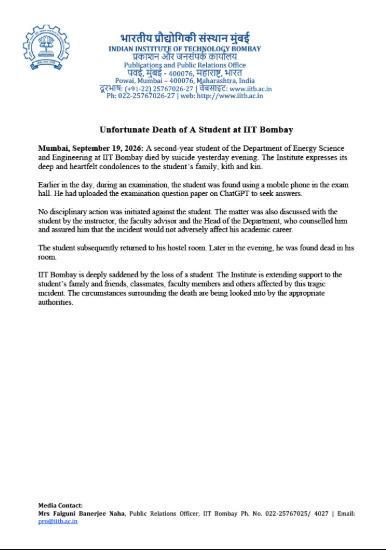
Doolla was the invigilator during the mid-semester examination in which Wakode was allegedly found using a mobile phone. IIT-Bombay had initially said that the student uploaded the examination question paper to ChatGPT to seek answers.
The institute said that no disciplinary action had been initiated against Wakode after the examination incident. According to IIT-Bombay, the instructor, faculty adviser and Head of the Department counselled him and assured him that the incident would not adversely affect his academic career.
Wakode was later found dead in his hostel room on Sept 18.
His parents subsequently alleged that he had faced harassment and caste-based discrimination. A police complaint filed by his father named Doolla and other institute officials.
Mumbai Police registered a case of abetment of suicide and invoked provisions of the Scheduled Castes and Scheduled Tribes (Prevention of Atrocities) Act. Doolla was named in the FIR.
The allegations against Doolla and the institute officials remain under investigation. The case has since been transferred to the Mumbai Police Crime Branch, which is examining the circumstances surrounding Wakode’s death and the allegations contained in the complaint.
IIT-Bombay has denied allegations of caste-based discrimination. The institute has said that students’ caste information is not available to faculty members and that Wakode had not submitted a complaint alleging caste discrimination to the administration or its SC/ST Cell.
IIT-Bombay has also maintained that no suspension or other disciplinary action was initiated against Wakode following the examination incident.
The institute later apologized for its earlier communication about the events preceding Wakode’s death, saying that the circumstances remained under investigation and should not have been characterized before the facts were established.
“We apologise for the statements contained in our earlier communication concerning the unfortunate demise of Sahil,” the institute said. “The details and circumstances leading up to the incident remain subject to investigation by the appropriate authorities,” it added.
IIT-Bombay also clarified that Director Shireesh Kedare had not resigned, following reports and social media posts claiming that he had stepped down amid the protests.
The 18-point charter
The charter signed by Kedare extends beyond the demand for action against Doolla. Students have sought an independent investigation into the circumstances surrounding Wakode’s death, with an interim report by Sept 30 and a final report by Oct 15.
The demands also include an open house involving the director, Dean of Student Affairs and other senior officials. Students have sought an apology over what they described as the public “defamation” of Wakode.
The protesters have also called for reforms in the institute’s academic, disciplinary and student-welfare systems.
Among the proposed changes are a code of conduct for professors, greater student representation in institutional decision-making, improved grievance redressal mechanisms and changes to the disciplinary process.
The charter also seeks stronger mental-health and medical support, including improvements to counseling services and a 24-hour psychiatrist-on-call facility at the institute hospital.
Students have proposed a task force comprising students, faculty members, mental-health professionals and external experts to examine student distress and recommend preventive measures.
The charter further calls for an open portal for student concerns and a written assurance that students participating in the protests would not face disciplinary, hostel, financial or legal action.
Students have also demanded financial assistance for families who lose loved ones at the institute.
The agreement reached between the administration and protesting students came after a prolonged meeting on Sept 20. The institute is expected to continue discussions with students and hold an open house to address their concerns.
Doolla’s role and Faculty Forum’s response
The controversy has also led to a public debate over Doolla’s role in the examination incident.
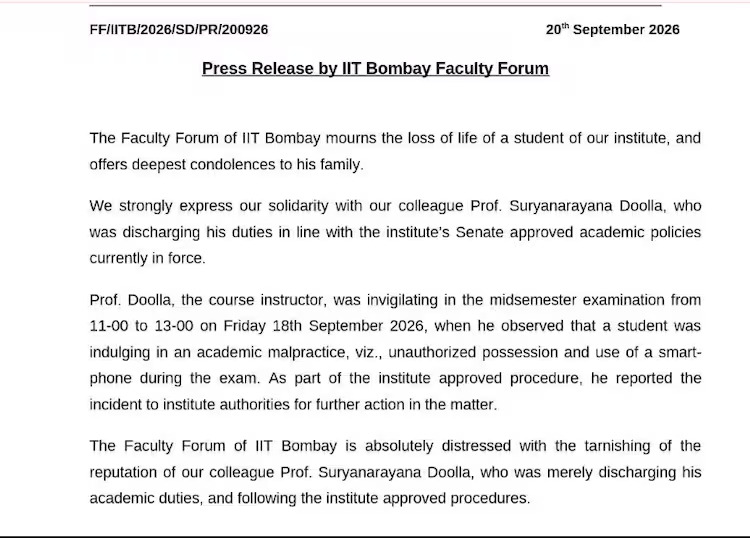
The IIT-Bombay Faculty Forum has backed the professor, maintaining that he was performing his responsibilities as an invigilator and followed the institute’s prescribed procedure after detecting the alleged examination malpractice.
In a statement issued on Sept 21, the Faculty Forum said Doolla had been carrying out his duties in accordance with IIT-Bombay’s approved academic policies.
“We strongly express our solidarity with our colleague Professor Suryanarayana Doolla, who was discharging his duties in line with the institute's Senate-approved academic policies currently in force,” the forum said, while expressing condolences to Wakode’s family.
The Faculty Forum said Doolla had reported the alleged malpractice to institute authorities through the prescribed process. It objected to what it described as “false and misleading” reports about the professor and said these had affected his reputation before the facts could be established through an inquiry.
The forum also said Doolla was temporarily relieved of his administrative responsibilities to facilitate an independent and unbiased inquiry into the circumstances surrounding Wakode’s death. It clarified that he had not been suspended as a faculty member and remained on the IIT-Bombay faculty.
The Faculty Forum highlighted Doolla’s academic and administrative record, including several teaching and research honors. It said two of his awards were based entirely on student feedback and also referred to his earlier tenure as Dean of Student Affairs, during which it said several student-welfare initiatives were introduced.
The forum said it was deeply saddened by Wakode’s death but maintained that sympathy for the student and fairness to those whose conduct is being examined could coexist while the inquiry and police investigation continue.
“Both” principles, the Forum said, should guide the institutional response while the inquiry and police investigation continue.
The statement was signed by Professor Rajkumar S Pant, president of the IIT-Bombay Faculty Forum, which represents around 750 faculty members.
Doolla’s academic career at IIT-Bombay
Doolla has been part of IIT-Bombay’s academic community for more than a decade and has worked in areas including power systems, smart grids, microgrids and renewable-energy integration.
According to information available on the IIT-Bombay website, he completed his BTech in Electrical Engineering from Nagarjuna University in 2000, an MTech in Energy Systems Engineering from IIT-Bombay in 2002 and a PhD in Power Systems from IIT Delhi in 2007.
Before joining IIT-Bombay, he worked with Power Research and Development Consultants in Bengaluru and Machine 2 Machine in Hyderabad.
At IIT-Bombay, Doolla has taken on academic and administrative responsibilities in addition to his research and teaching work. He served as warden of Hostel 6 and later as Dean of Student Affairs. He was also associated with the organization of JEE (Advanced), UCEED and CEED.
His academic record includes the Prof S P Sukhatme Excellence in Teaching Award in 2021, IIT-Bombay’s Excellence in Teaching Award in 2017 and the Young Faculty Award in 2009. He has also received recognition through IEEE awards and fellowships.
The institute’s academic malpractice rules
The circumstances surrounding Wakode’s death have also brought renewed attention to IIT-Bombay’s rules governing academic malpractice.
According to IIT-Bombay’s Senate-approved disciplinary framework issued in July 2026, possession or use of unauthorized material during an examination can attract an FR2 grade and one-semester academic suspension.
The rules specifically cover mobile phones, tablets, smartwatches and AI gadgets such as smart glasses. They also cover chits and cheat sheets, books or other unauthorized material, scribblings on the body and passing unauthorized material to other students.
The provision also applies to the use of electronic gadgets or unauthorized materials during bio-breaks while an examination is in progress.
For these offences, the prescribed punishment is FR2 and academic suspension for one semester.
The institute’s disciplinary document distinguishes between cases that can be handled by the Departmental Academic Disciplinary Action Committee, or D-ADAC, and those requiring the Academic Disciplinary Action Committee, or ADAC.
Cases that warrant punishment up to an FR grade can be handled by the D-ADAC, while cases involving punishment higher than FR are forwarded to the ADAC.
The rules also state that verbal communication between students during an examination can result in an FR grade.
The disciplinary document does not provide a general explanatory definition of FR or FR2 beyond prescribing them as penalties for specific offences.
Repeat academic malpractice attracts stricter consequences. According to the rules, repeat offenders involved in any type or combination of malpractice will face a minimum of one semester of academic suspension.
For students who are not in their final graduating semester, the suspension applies to the upcoming semester. For graduating students with pending credit requirements, the suspension applies to the ongoing semester.
For graduating students without pending credit requirements, the award of the degree can be deferred. For incidents between January and April, the degree is to be awarded in December, while incidents occurring between May and December result in the degree being awarded in July of the following calendar year.
The rules also provide students with a right to appeal disciplinary decisions once.
An appeal can be filed on grounds including procedural error, new evidence that was unavailable during the original investigation, or bias or discrimination during the process.
The appeal generally has to be filed within 10 working days of receiving the disciplinary decision. An appointed committee reviews the appeal and can uphold, modify or overturn the original disciplinary action. Its decision is final, with no further appeal ordinarily permitted.
The rules cover other forms of academic malpractice as well. For copying in home assignments, programming assignments and laboratory projects, a first offence can result in a formal written warning and zero marks in the relevant assignment or project, while a repeat offence can attract a grade penalty.
The document also addresses plagiarism in seminar reports, BTech and MTech projects and other reports. If a student reproduces material using AI tools or other sources without proper citations while falsely claiming the content as original, or falsifies experimental data, the case can result in an FR grade and re-registration for the course in the following semester. More serious cases can be referred to the ADAC.
What IIT-Bombay has said about the examination incident
IIT-Bombay’s Sept 19 statement said Wakode was found using a mobile phone during an examination earlier that day and had uploaded the question paper to ChatGPT to seek answers. The institute said no disciplinary action had been initiated and that the student was counselled by the instructor, faculty advisor and Head of Department.
In a Sept 20 statement, the institute expressed solidarity with Professor Suryanarayana Doolla, saying he was following Senate-approved procedures when he reported the alleged academic malpractice involving unauthorized smartphone use during the examination.
IIT-Bombay later apologized for its earlier communication, saying it was inappropriate to characterize circumstances preceding Wakode’s death while the matter remained under investigation. The institute said it was cooperating with the probe and urged students and others not to speculate.
Family allegations and Crime Branch investigation
Wakode’s family has alleged that he faced caste-based harassment and mental distress in the months before his death. His father’s complaint alleged that Doolla subjected him to casteist remarks and harassment and also named other institute officials.
The allegations have not been established by the investigation. IIT-Bombay has denied caste discrimination and said Wakode had not approached the institute or its SC/ST Cell with such a complaint.
Mumbai Police initially registered a case under Section 108 of the Bharatiya Nyaya Sanhita for abetment of suicide and invoked provisions of the SC/ST (Prevention of Atrocities) Act.
The investigation was subsequently transferred to the Mumbai Police Crime Branch. The Crime Branch is expected to examine the allegations made in the police complaint and establish the circumstances surrounding Wakode’s death.
The case has also led to debate over the SC/ST Act. Supporters of Doolla have argued that allegations should be investigated through due process and that accusations should not be treated as established conclusions before the facts are determined.
At the same time, Wakode’s family and protesting students have called for a full investigation into the allegations of caste-based harassment and the circumstances preceding his death. The allegations against Doolla and other officials remain under investigation.
Darshan Solanki case and renewed scrutiny
The developments have also revived discussion around caste discrimination and student welfare at IIT-Bombay, three years after the death of Darshan Solanki.
Solanki, an 18-year-old BTech student from Gujarat who belonged to the Scheduled Caste community, died in February 2023 after falling from a hostel building at IIT-Bombay.
His death led to protests and allegations of caste-based discrimination. His family and some student groups raised concerns about whether he had faced caste-related harassment.
An IIT-Bombay committee that investigated the death said it did not find evidence establishing caste discrimination as the cause of his death. Sections of the student community and activists disputed the finding, and the case became part of broader discussions around caste, inclusion and student welfare at premier educational institutions.
Wakode’s death has once again brought questions concerning caste discrimination, student welfare and grievance-redressal mechanisms at IIT-Bombay into focus.
Other reactions to the controversy
The controversy has drawn responses from faculty members, public figures and others outside IIT-Bombay.
IIT Delhi professor Pravesh Biyani said that during more than two decades of observing the IIT and IIIT systems, he had never witnessed a teacher discriminate against a student on caste lines.
BJP leader Ananthan Ayyasamy, who said he belongs to an SC community, raised concerns over what he called “misuse of the SC-ST Act” in the case. Zoho founder Sridhar Vembu said he “deeply respect[ed]” Ayyasamy’s position.
Former Rajya Sabha MP Priyanka Chaturvedi described Wakode’s death as “extremely unfortunate” but argued that removing professors to end protests would not address the wider issues facing premier educational institutions.
“While the death of the IIT Bombay student is extremely unfortunate and yet another reminder that these premier institutions need to work on the campus environment and mental health, sacking professors to end the protests is just a band-aid solution to a problem that needs surgery,” she posted on X.
She also criticized attempts to shift responsibility onto professors who were reportedly performing their duties by reporting alleged copying during an examination.
“Also, shifting the blame on the professors who were doing their job of reporting copying during an exam and making it about caste discrimination is a sad outcome,” she added.
Congress spokesperson Shama Mohamed also expressed support for Doolla while calling for mental-health support for students.
“In this suicide, I stand with Professor Doolla. If a student is caught cheating, it is normal to admonish him and ask him to leave the room. If the student was harassed due to his caste, he should have complained to the SC/ST department. When we were kids, we were admonished by teachers and parents for our wrongdoings, but our generation was mentally strong. I would request colleges to have mental health therapists for the wellbeing of the students,” she said on X.
Azad Samaj Party (Kanshi Ram) chief and Lok Sabha MP Chandrashekhar Azad 'Ravan' called for a “fair and time-bound investigation” into Wakode’s death.
“There should be no place for caste-based discrimination, humiliation, or any form of institutional harassment against students in the country's prestigious higher education institutions. Institutions must ensure accountability in matters related to student complaints and safety,” he said.
Other individuals supporting Doolla have similarly argued that the allegations should be examined through an investigation before conclusions are drawn.
Company secretary Arun K Chaturvedi said that allegations should be investigated but “an accusation cannot automatically become a conclusion”. He argued that teachers and officials should be able to enforce institutional rules without fearing that performing their duties could later become the basis for criminal charges.
Activist Tehseen Poonawalla also expressed support for Doolla, describing him as an award-winning teacher who was “simply doing his job”.
Questions surrounding Wakode’s academic record
Some people who knew Wakode have described him as a strong student. According to reports cited in the source material, he had secured an 8.5 CGPA in his first year.
His family reportedly had no indication that anything was seriously wrong before his death, while classmates have questioned aspects of the institute’s account of what happened after the examination incident.
However, an academically strong record does not by itself resolve the allegations concerning the examination incident. The institute has maintained that Wakode was found using a phone and had uploaded the examination question paper to ChatGPT, while the circumstances surrounding his death remain under investigation.
What happens next at IIT-Bombay
The immediate focus is now on the implementation of the 18-point charter and the findings of the ongoing police and institutional inquiries.
The charter calls for an interim report on the independent investigation by Sept 30 and a final report by Oct 15. It also seeks changes to disciplinary procedures, a faculty code of conduct, stronger counseling and mental-health services, greater student participation and a task force on student distress.
The institute is expected to continue discussions with students and hold an open house involving senior administrators.
The future of Doolla’s administrative role is now separate from the question of his position as a faculty member. The Faculty Forum has said he remains on the IIT-Bombay faculty and has not been suspended as a professor.
The institute has also clarified that Director Shireesh Kedare has not resigned, despite reports and social media posts suggesting otherwise.
The police investigation will examine the allegations made by Wakode’s family and the circumstances surrounding his death. At the institutional level, the implementation of the student charter and the proposed inquiry will determine the next steps.
The case has consequently expanded beyond the examination incident to encompass questions about academic discipline, student welfare, mental-health support, grievance redressal, caste-based discrimination allegations and institutional accountability.
The allegations remain subject to investigation, while IIT-Bombay, its Faculty Forum, Wakode’s family and protesting students have presented differing accounts of aspects of the events preceding his death.