Sustainability education needs to move beyond classroom awareness and environmental campaigns to bring about changes in infrastructure, employment, public policy, consumption and individual behaviour, speakers at the 8th International Conference on Sustainability Education (ICSE) 2026 said.
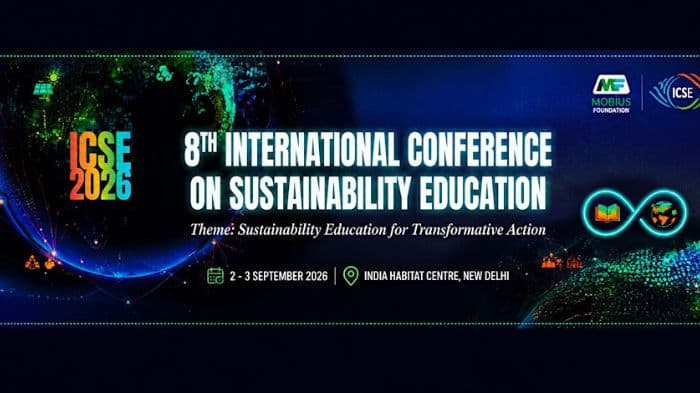
The two-day conference, organised by the Mobius Foundation at the India Habitat Centre in New Delhi, opened on September 2 under the theme “Sustainability Education for Transformative Action”.

It brought together policymakers, educators, scientists, environmentalists, industry leaders, international organisations and young climate leaders to discuss how education can prepare societies to deal with growing environmental and climate risks.
The discussions took place against the backdrop of the recent flash flood on the Nepal-Tibet border, which speakers cited as an indication that extreme climate events can no longer be regarded as distant or exceptional occurrences.
Pradip Burman, Chairman of the Mobius Foundation, said India had made progress in expanding clean-energy capacity but cautioned that a substantial gap remained between climate commitments and their implementation.
He said ICSE, which was launched in 2019, had developed from an initiative primarily focused on youth engagement into a broader programme covering climate literacy, sustainability education and green employment. Initiatives including the Pani Pahar curriculum and the Mobius Young Climate Leaders Program in the Northeast seek to connect environmental understanding with local challenges and practical solutions.
Priyanka Sharma, President and CEO of the Mobius Foundation, said sustainability was no longer limited to environmental concerns and had increasingly become connected with economic growth, livelihoods, health and social well-being.
The conference agenda reflects this broader approach, with discussions covering critical minerals, e-waste and battery recycling, sustainable agriculture, green jobs, biodiversity, technology and innovation.
Speakers also highlighted the growing importance of preparing a workforce capable of working with new technologies and systems emerging from India's transition towards cleaner energy and infrastructure.
Call for systemic environmental action
Sunita Narain, Director General of the Centre for Science and Environment, argued that the scale of the environmental crisis requires structural responses rather than incremental measures.
Referring to the Yamuna in Delhi, Narain highlighted the deterioration in dissolved oxygen levels as the river passes through the city. She also used Delhi's air pollution to argue that technological substitution alone cannot address environmental problems.
She said replacing conventional vehicles with electric vehicles would not by itself solve Delhi's mobility and pollution challenges, stressing instead the need for public transport that can reduce dependence on private vehicles.
The discussion highlighted the need for sustainability education to help citizens understand interconnected systems involving transport, water, energy, food, waste and urbanisation.
Schools as centres of practical sustainability learning
Kartikeya Sarabhai, Founder Director of the Centre for Environment Education, placed the current sustainability discussion within the longer development of environmental education.
He referred to the 1977 Tbilisi conference on environmental education and India's earlier efforts to connect environmental protection with poverty, development and lifestyles.
Sarabhai also pointed to the expansion of eco-clubs under Mission LiFE and the inclusion of environmental education in the National Curriculum Framework 2023.
He proposed that schools and other institutions could adopt a defined geographical area where students could work on practical sustainability challenges connected to the Sustainable Development Goals.
Such an approach could allow students to work on issues including water conservation, biodiversity, waste management, energy efficiency and sustainable livelihoods while connecting classroom learning with measurable local outcomes.
Climate risks increasingly affecting education
Vibha Dhawan, Director General of The Energy and Resources Institute, focused on the impact of environmental degradation on future generations.
She discussed changes in everyday consumption patterns and highlighted Delhi's air pollution as an example of how policy and economic incentives can sometimes undermine environmental objectives.
The discussion also connected sustainability with decisions affecting how students travel to school and the resulting impact on congestion and emissions.
Bhaskar Vira, Pro-Vice-Chancellor for Education and Environmental Sustainability and Professor of Political Economy at the University of Cambridge, said sustainability education should combine scientific understanding with human experience and civic participation.
He highlighted the importance of connecting environmental science with the communities affected by environmental changes. According to Vira, environmental education should help learners participate in shaping solutions rather than leaving them either overly dependent on technology or overwhelmed by climate-related concerns.
UNICEF highlights climate risks facing children
Climate change and its implications for children were another major focus of the conference.
Bo Beiskjaer, Chief of Resource Mobilization and Partnerships at UNICEF, said India is home to more than 470 million children and referred to UNICEF estimates that 55 per cent face multiple overlapping climate risks, including heat waves, floods and water scarcity.
He illustrated how climate exposure could affect a child born in 2026 through its potential consequences for schooling, health and livelihood opportunities.
Beiskjaer called for greater investment in climate-resilient infrastructure, particularly water systems, while pointing to continuing challenges around access to safe and reliable drinking water.
The discussion suggested that climate-resilient schools would require more than changes to curriculum. Schools would also need infrastructure capable of functioning during extreme heat, floods, water shortages and other climate-related disruptions.
From environmental knowledge to climate action
Ravi Singh, Secretary General and CEO of WWF-India, traced organised environmental education in India back several decades and recalled WWF India's engagement with Delhi municipal schools beginning in 1970.
He said former participants in such programmes had gone on to work in government, corporate leadership and enforcement institutions, suggesting that environmental education can have an impact beyond the classroom.
The conference discussions reflected a broader shift in the way sustainability education is viewed. Rather than being treated as a specialised environmental subject, it is increasingly being connected with education policy, urban planning, public health, industrial development, employment and economic competitiveness.
For India, this means schools and universities will need to provide climate literacy while education and skilling systems also prepare workers for emerging green industries. At the same time, cities will require resilient infrastructure and governments will need to create conditions that make sustainable behaviour economically and practically viable.
The central question emerging from ICSE 2026 is therefore not whether sustainability should form part of education, but how quickly education can move from environmental awareness towards the skills, institutional capacity and behavioural changes needed for climate action.
The conference will continue on Sep 3 with discussions on climate action, green skills, technology and innovation, biodiversity, sustainable livelihoods and youth-led solutions.