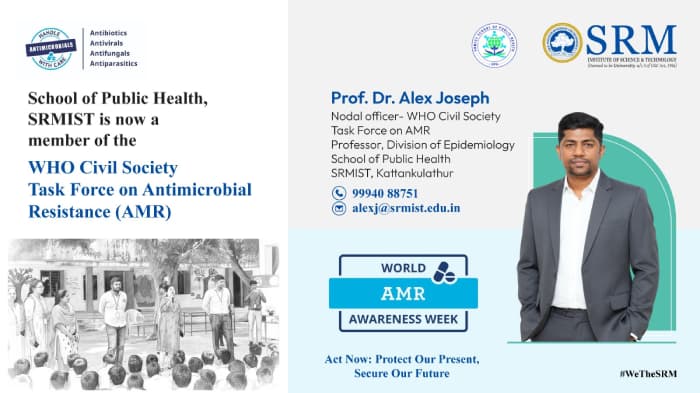
SRM School of Public Health joins 81 global organisations in the WHO Civil Society Task Force to strengthen global action against antimicrobial resistance

SRM Institute of Science and Technology (SRMIST) announces that the SRM School of Public Health has been appointed to the World Health Organisation (WHO) Civil Society Task Force on Antimicrobial Resistance (AMR). With this appointment, SRM joins 81 global organisations working together to address one of the most serious public health threats of the century.
Professor Alex Joseph, Division of Epidemiology, will lead SRM’s participation. He noted that AMR is shaped by drivers across human, animal, and environmental systems and requires a comprehensive One Health response. “Community-based participatory approaches are central to our work, and this platform allows us to amplify evidence-based strategies for AMR mitigation,” he said.

The global burden of AMR continues to rise. In 2021, 4.71 million deaths were associated with bacterial AMR, including 1.14 million directly attributable to resistant infections. Without urgent action, AMR could cause up to 10 million deaths annually by 2050.
Dr Hari Singh, Dean, School of Public Health, SRMIST, emphasised the importance of international engagement. “The School provides an enabling environment where dedicated and aspiring students meaningfully engage with global health platforms. This appointment strengthens their capacity to contribute internationally and reinforces our commitment to excellence in public health education and research.”
India’s commitment has been reaffirmed through the launch of the National Action Plan on Antimicrobial Resistance 2.0 (NAP AMR 2.0) by the Union Health Minister, Shri J. P. Nadda. SRM’s inclusion in the WHO Task Force supports these national priorities and strengthens India’s contribution to global AMR governance.

DPDP Act Explained: What is India’s Digital Personal Data Protection Law and Why is it in the News?

IIT Bombay puts stricter cheating rules on hold, drafts new procedure for exam misconduct

ISRO expands student outreach during World Space Week 2026

Gujarat launches PARAKH Cell to shift school assessments toward competency-based learning

IIT Hyderabad launches AI lab with S&P Global for finance research

DPDP Act Explained: What is India’s Digital Personal Data Protection Law and Why is it in the News?

IIT Bombay puts stricter cheating rules on hold, drafts new procedure for exam misconduct

Gujarat launches PARAKH Cell to shift school assessments toward competency-based learning

IIT Hyderabad launches AI lab with S&P Global for finance research

Nana Patekar’s advice to graduates takes on new meaning after his death

DPDP Act Explained: What is India’s Digital Personal Data Protection Law and Why is it in the News?

IIT Bombay puts stricter cheating rules on hold, drafts new procedure for exam misconduct

ISRO expands student outreach during World Space Week 2026

Gujarat launches PARAKH Cell to shift school assessments toward competency-based learning

IIT Hyderabad launches AI lab with S&P Global for finance research

DPDP Act Explained: What is India’s Digital Personal Data Protection Law and Why is it in the News?

IIT Bombay puts stricter cheating rules on hold, drafts new procedure for exam misconduct

Gujarat launches PARAKH Cell to shift school assessments toward competency-based learning

IIT Hyderabad launches AI lab with S&P Global for finance research

Nana Patekar’s advice to graduates takes on new meaning after his death
Copyright© educationpost.in 2024 All Rights Reserved.
Designed and Developed by @Pyndertech