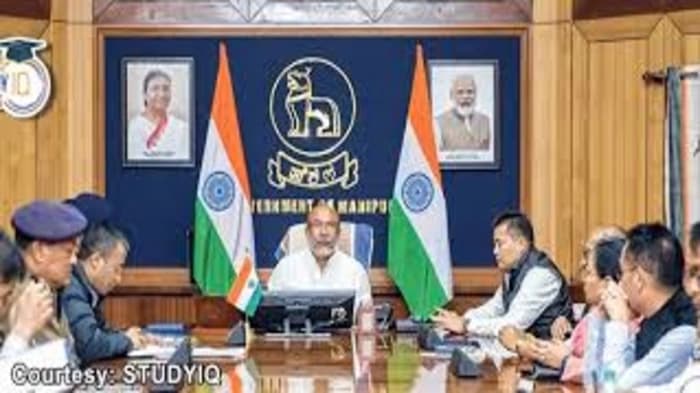
Ahead of a Prime Ministerial visit to Manipur, the central government claimed that Kuki civil groups agreed to a Free Movement Regime (FMR) and signed a revised Suspension of Operations (SoO) agreement, signaling efforts to restore peace amid prolonged ethnic tensions.
Background

Ethnic conflict roots: The violence since May 2023 between Meitei (Valley) and Kuki (Hill) communities led to displacement, fatalities, and mistrust.
FMR & border issues: The FMR allowed cross‑movement in border areas between communities and Myanmar; its suspension aggravated tensions.
SoO agreements: Previous SoO pacts aimed to maintain ceasefires, disarm combatants, and ease hostilities.
Key Provisions & Dynamics
The Kukis have agreed to respect Manipur’s territorial integrity, relocate certain camps, and disarm.
The FMR resumption allows freer movement across formerly restricted zones, contingent on mutual consent and ground rules.
Negotiations involved the Centre, state, and Kuki organisations (KNO, UPF).
Significance & Challenges
Ethnic reconciliation test: The agreement is a trust-building exercise, but deep suspicions may challenge sustainability.
Community concerns: Meitei groups have long alleged that the FMR and porous borders facilitated illegal migration, drug trade, and demographic shifts.
Enforcement & monitoring: Ensuring that the terms are adhered to — relocation, verification, disarmament — will demand oversight mechanisms.
Political legitimacy: Inclusion of grassroots stakeholders, transparency, and fairness are essential to prevent spoilers.
Way Forward / Strategies
Confidence‑building measures: Joint community forums, shared infrastructure, dialogue platforms.
Gradual roll-out: Phased implementation with pilot zones, monitoring, and dispute resolution.
Institutional mechanisms: Independent observers, security forces trained in sensitivity, grievance redressal.
Focus on development: Peace is reinforced by economic opportunity, infrastructure, education, and health services.
Conclusion
The agreement on FMR and a revised SoO marks a positive turn in Manipur’s peace efforts. Its success will depend on credible implementation, inclusive dialogue, and bridging trust deficits. In the fragile mosaic of Northeast India, such steps must be reinforced continuously to move from ceasefire to lasting reconciliation.