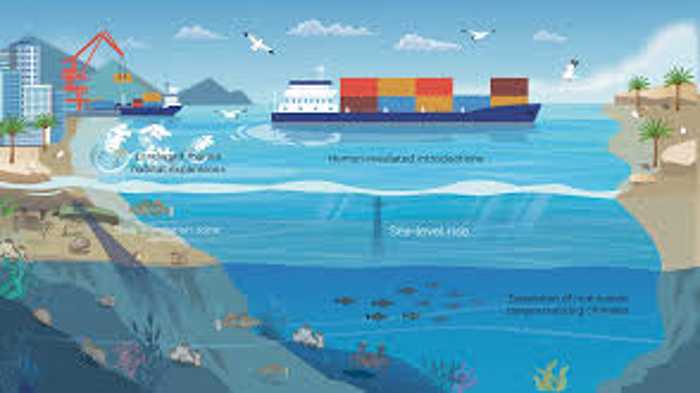
Rising sea levels are emerging as a major global climate challenge, threatening coastal communities, infrastructure and freshwater resources across the world. The issue gained renewed attention after the United Nations General Assembly adopted its first-ever declaration on rising sea levels on September 24.
According to a 2024 technical brief by the UN Secretary-General’s Climate Action Team, global sea levels could rise by around 38 cm by 2100 even under a low-emissions pathway. If emissions continue to increase, the rise could reach approximately 77 cm. Sea levels are expected to continue rising for centuries to millennia even after the world achieves net-zero emissions.

Global sea levels have risen by about 21 cm since 1880. The pace has accelerated significantly in recent decades, increasing from 2.1 mm annually during 1993-2002 to 4.7 mm during 2015-2024. In 2024, sea levels rose by around 6 mm, marking the largest annual increase recorded.
Two major factors are driving this rise. The first is the melting of glaciers and ice sheets due to global warming. Antarctica loses an average of about 150 billion tonnes of ice annually, while Greenland loses around 270 billion tonnes. The second factor is the thermal expansion of seawater as oceans absorb increasing amounts of heat. Thermal expansion accounts for roughly one-third to half of global sea-level rise.
The impacts are particularly severe for low-lying island nations such as Fiji, the Maldives and Tuvalu. However, the threat extends far beyond small island states, with nearly 40% of the global population living near coastlines. Countries including India, Bangladesh and China are especially vulnerable, particularly in densely populated river deltas.
Addressing the crisis requires rapid reductions in greenhouse-gas emissions alongside adaptation measures such as sea walls, improved drainage, flood-resistant infrastructure and mangrove restoration. Developing countries will also require greater financial support to manage the growing impacts of climate change.