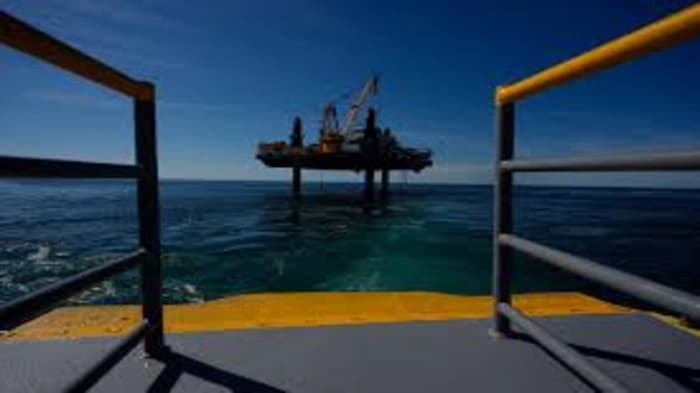
International scientists have found a vast aquifer beneath the Atlantic Ocean, marking the first worldwide mission to systematically drill under the sea for freshwater

Offshore aquifers –
The offshore aquifer represents one of several reservoirs of freshwater recognized to be present in shallow saltwater areas worldwide.

Similar to land-based aquifers, offshore aquifers are formations of rock or sediment that hold freshwater.
Researchers think that offshore aquifers may reach as far as 90 kilometres from the shore and hold more freshwater than all the water ever extracted from land-based aquifers.
Magnitude - Researchers have verified the presence of offshore aquifers in multiple areas, including near the shores of Australia, China, North America, and South Africa.
It is estimated that approximately one million cubic kilometers of freshwater existed under the ocean floor, representing about 10% of all freshwater groundwater on land.
Source of freshwater – Two theories exist -
Ice Age Hypothesis – The water could have flowed beneath the ocean floor when sea levels were decreased, and vast regions now submerged were exposed land.
Consequently, rain seeped into the soil, accumulating significant amounts of freshwater.
Connection Hypothesis - Offshore aquifers may be linked to onshore aquifers, providing them with water consistently after precipitation.
Freshwater Conservation - The freshwater located below offshore aquifers might not be mixing with saline water because of a cap rock layer formed by compacted clay-rich sediments on top of the aquifers.
Difficulties in extraction - offshore drilling incurs high costs; the effects on marine life and ecology are uncertain; and there are concerns regarding ownership and rights.
Importance - Offshore aquifers may serve as unutilized freshwater sources and assist in addressing land-based water shortages.
A 2023 United Nations report indicates that the planet is experiencing an unparalleled water crisis, with global freshwater demand expected to surpass supply by 40% by 2030.

India’s Blue Economy Push Seeks to Balance Growth and Ocean Conservation

Supreme Court Seeks Panel to Curb Unethical Pharma Marketing Practices

NMC Tightens Rules on Doctors’ Digital Advertising and AI Use

Anthropic Launches Claude Haiku 5.5 as Its Fastest and Cheapest AI Model

Karnataka HC Replaces ‘Visitation’ with ‘Parenting Time’ in Child Custody Cases

Canadian author Anne Carson wins 2026 Nobel Prize in Literature for reshaping contemporary literary forms

AMU students’ protest enters third week as union election demand widens

DPDP Act Explained: What is India’s Digital Personal Data Protection Law and Why is it in the News?

IIT Bombay puts stricter cheating rules on hold, drafts new procedure for exam misconduct

Gujarat launches PARAKH Cell to shift school assessments toward competency-based learning

India’s Blue Economy Push Seeks to Balance Growth and Ocean Conservation

Supreme Court Seeks Panel to Curb Unethical Pharma Marketing Practices

NMC Tightens Rules on Doctors’ Digital Advertising and AI Use

Anthropic Launches Claude Haiku 5.5 as Its Fastest and Cheapest AI Model

Karnataka HC Replaces ‘Visitation’ with ‘Parenting Time’ in Child Custody Cases

Canadian author Anne Carson wins 2026 Nobel Prize in Literature for reshaping contemporary literary forms

AMU students’ protest enters third week as union election demand widens

DPDP Act Explained: What is India’s Digital Personal Data Protection Law and Why is it in the News?

IIT Bombay puts stricter cheating rules on hold, drafts new procedure for exam misconduct

Gujarat launches PARAKH Cell to shift school assessments toward competency-based learning
Copyright© educationpost.in 2024 All Rights Reserved.
Designed and Developed by @Pyndertech