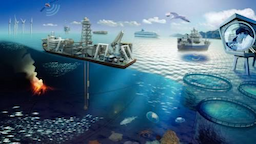
The Prime Minister of India launched the National Deep Water Exploration Mission on the 79th Independence Day to enhance offshore oil and gas exploration, focusing on regions such as the Andaman Sea and the deep waters near the Andhra coast to attain energy independence

What is it?
A leading energy security program aimed at investigating unexploited oil and gas deposits under the seabed of India.

Created to function in mission mode for expedited offshore exploration.
Nodal Ministry: Ministry of Natural Gas and Petroleum.
Backed by the Directorate General of Hydrocarbons (DGH) and related research organizations.
Goal:
Minimize reliance on imported crude oil and natural gas.
Boost national hydrocarbon output ability.
Enhance India’s enduring energy stability.
Advocate for Aatmanirbhar Bharat in the energy industry.
Main Characteristics:
Deep-Water Emphasis: Aim for uncharted marine areas such as the Andaman-Nicobar basin and Andhra coastline.
Support for Policy Reforms: Associated with the Open Acreage Licensing Policy (OALP) and recent legislative modifications favorable to exploration.
Extensive Bidding: Unlocking more than 1 million sq km of previously designated ‘No-Go’ zones for exploration.
Cutting-Edge Technology: Utilization of seismic surveys, contemporary drilling methods, and AI-driven exploration instruments.
Collaboration between Public and Private Sectors: Promoting investment from both local and international entities.
Importance:
Energy Independence – Decreases India's present 88% dependency on crude oil imports and 50% reliance on gas imports.
Economic Benefits – Reduces import expenditures by billions; reallocates resources to social programs and infrastructure.
Strategic Security – Enhances management of national energy assets in unpredictable international markets.

India’s Blue Economy Push Seeks to Balance Growth and Ocean Conservation

Supreme Court Seeks Panel to Curb Unethical Pharma Marketing Practices

NMC Tightens Rules on Doctors’ Digital Advertising and AI Use

Anthropic Launches Claude Haiku 5.5 as Its Fastest and Cheapest AI Model

Karnataka HC Replaces ‘Visitation’ with ‘Parenting Time’ in Child Custody Cases

Canadian author Anne Carson wins 2026 Nobel Prize in Literature for reshaping contemporary literary forms

AMU students’ protest enters third week as union election demand widens

DPDP Act Explained: What is India’s Digital Personal Data Protection Law and Why is it in the News?

IIT Bombay puts stricter cheating rules on hold, drafts new procedure for exam misconduct

Gujarat launches PARAKH Cell to shift school assessments toward competency-based learning

India’s Blue Economy Push Seeks to Balance Growth and Ocean Conservation

Supreme Court Seeks Panel to Curb Unethical Pharma Marketing Practices

NMC Tightens Rules on Doctors’ Digital Advertising and AI Use

Anthropic Launches Claude Haiku 5.5 as Its Fastest and Cheapest AI Model

Karnataka HC Replaces ‘Visitation’ with ‘Parenting Time’ in Child Custody Cases

Canadian author Anne Carson wins 2026 Nobel Prize in Literature for reshaping contemporary literary forms

AMU students’ protest enters third week as union election demand widens

DPDP Act Explained: What is India’s Digital Personal Data Protection Law and Why is it in the News?

IIT Bombay puts stricter cheating rules on hold, drafts new procedure for exam misconduct

Gujarat launches PARAKH Cell to shift school assessments toward competency-based learning
Copyright© educationpost.in 2024 All Rights Reserved.
Designed and Developed by @Pyndertech