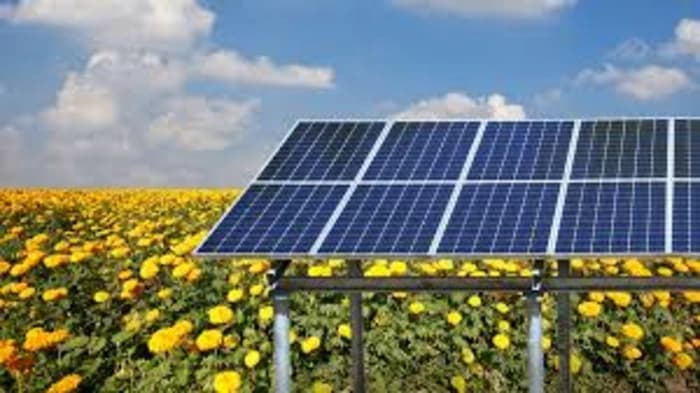
Concerning Agrivoltaics
Agriphotovoltaics (APVs) provide a combined approach to food and energy generation by merging solar panels with agricultural practices. It optimizes land utilization, enabling crops to thrive under raised solar panels while producing electricity.

Origins of Agrivoltaics:
German scientists Adolf Goetzberger and Armin Zastrow initially suggested it in 1981. The idea entails raising solar panels to enable sunlight to access crops while capturing solar energy.
Solar Power in India: Major Milestones
– 100 GW Solar Capacity Achievement: India’s solar industry has expanded by 3450% in the last ten years, increasing from 2.82 GW in 2014 to 100.33 GW as of January 31, 2025.
– Unprecedented Solar Installations: In 2024, India increased its solar capacity by 24.5 GW, exceeding the installations of 2023 by over twofold.
Of course! Please provide the text that you would like me to paraphrase. Utility-scale solar capacity experienced a 2.8-fold rise, reaching 18.5 GW installed in 2024.
Advantages for Farmers
APVs establish microclimatic environments that diminish water evaporation and shield crops from excessive heat, enhancing agricultural resilience.
Farmers are able to sell surplus solar energy to the grid at a fixed feed-in tariff, guaranteeing consistent income.
APV Success Narratives in India
Najafgarh, Delhi Pilot Project: A farmer rented his land to a solar firm for ₹1 lakh per acre each year, ensuring consistent earnings.
Expanding Agriphotovoltaics with Policy Assistance
Integrating APVs into PM-KUSUM: India does not have a specific agrivoltaics policy at present, but modifying the PM-KUSUM solar agriculture initiative to incorporate APVs could speed up acceptance.
Solar power plants connected to the grid under PM-KUSUM should adopt dual-use approaches, enabling crop cultivation and solar energy production at the same time.
Monetary Motivations for Farmers: Enhancing credit guarantees and subsidies for APV setups will assist smallholder farmers (owning under 2 hectares of land) in embracing solar agriculture.
Raising feed-in tariffs (FiTs) for solar energy produced on farmland might enhance investment feasibility.
Capacity Development and Technical Education: State-supported initiatives ought to educate farmers on APV management, assisting them in incorporating solar energy into conventional agricultural methods.
Difficulties and Upcoming Opportunities
Restricted to Pilot Initiatives: APVs are confined to pilot initiatives conducted by research institutions and private developers.
To promote the growth of APVs, it is essential to have policy backing, financial incentives, and awareness initiatives to foster their acceptance.
Infrastructure and Investment Requirements: Farmers require financing access for APV setups.
Government incentives and collaborations between public and private sectors could speed up adoption.
Policy Assistance for APVs: India’s solar energy initiatives need to incorporate APVs within national farming strategies.
Developing research and trial initiatives will aid in enhancing APV models for various climates and crops.