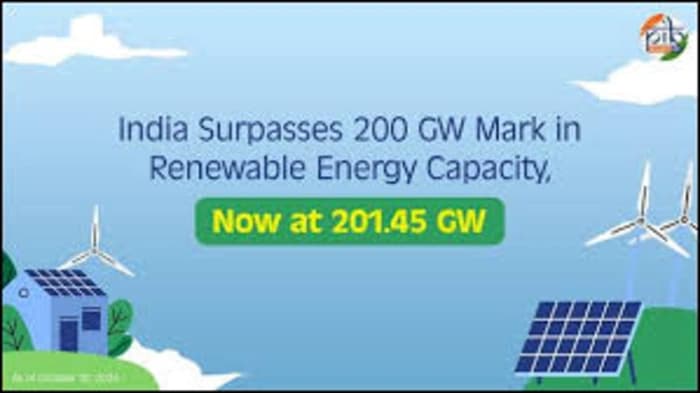
India’s renewable energy (RE) sector marked a major turning point in 2025 as the country crossed the 200 GW installed renewable capacity threshold, excluding large hydro. This achievement positions India among the world’s fastest-growing clean energy markets and reinforces its long-term goal of reaching 500 GW of non-fossil fuel capacity by 2030. The surge reflects a decade of reforms, falling technology costs, and strong policy support through mechanisms such as solar parks, wind bidding guidelines, production-linked incentives (PLI), and corporate green power procurement.
Solar power continues to be the primary driver, contributing nearly 55% of total RE capacity. Utility-scale solar parks in Rajasthan, Gujarat, Karnataka, and Tamil Nadu have expanded significantly, supported by improved evacuation infrastructure under the Green Energy Corridor programme. Rooftop solar installations crossed new highs due to the PM-Surya Ghar scheme and decreasing panel prices. Meanwhile, the wind sector has revived after years of stagnation due to the shift toward reverse bidding; new repowering policies and hybrid wind-solar tenders have brought fresh momentum.

However, India’s next phase of growth hinges on overcoming energy storage challenges. With rising variability from solar and wind, grid stability requires large-scale battery storage, pumped hydro, and flexible thermal capacity. Current storage deployment remains far below requirement, and high costs of lithium-ion batteries—along with supply-chain dependence on global mineral markets—pose risks. The National Green Hydrogen Mission offers long-term storage potential, but commercial viability will take time.
Crossing 200 GW strengthens India’s negotiating position ahead of COP30, where global expectations on emerging economies to accelerate decarbonisation remain high. India’s progress demonstrates credible action toward Nationally Determined Contributions (NDCs), especially the targets of reducing emissions intensity and increasing non-fossil energy share. Yet, meeting 2030 goals will require faster grid modernisation, state-level policy harmonisation, and predictable financing for green infrastructure.