The Union Public Service Commission (UPSC) completes 100 years on October 1, marking a century-long journey from a small advisory body to one of the country’s most important institutions for recruitment to public service.
The scale of that transformation is reflected in the numbers. Applications received across examinations and recruitment by selection rose from 42,727 in 1950-51 to 45,10,044 in 2022-23 — an increase of more than 100 times, according to a Press Information Bureau (PIB) backgrounder released ahead of the centenary celebrations.

The first Public Service Commission in India was established on October 1, 1926. It was initially an advisory body whose chairman and members were appointed by the Secretary of State in London. Over the decades, it evolved into the constitutional body known today as the UPSC.
From thousands of applications to millions
The growth in applications has accompanied a dramatic expansion in the commission’s workload.
In 2022-23, the UPSC conducted 15 examinations, attracting 33,51,916 applications. It also received 233 requisitions for 4,411 posts under recruitment by selection, drawing another 11,58,128 applications.
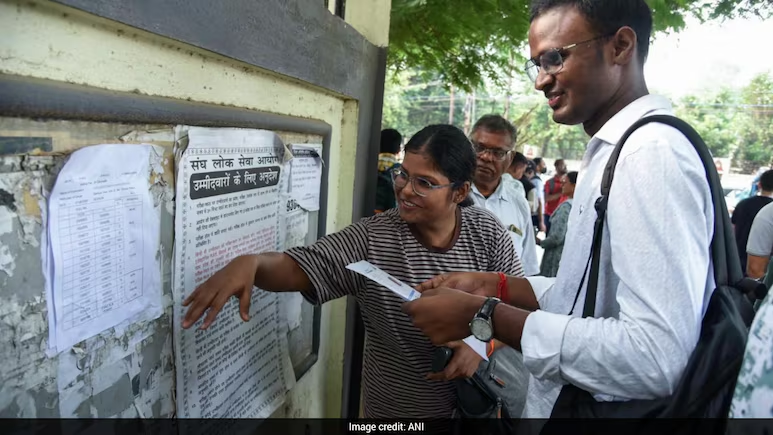
The geographical reach of the examination system has expanded as well. The number of examination centres has increased from just eight in 1950 to 86 in 2026, reflecting the growing scale of participation in UPSC examinations.
Women’s presence changes dramatically
The century-long story is also one of changing access to public service for women.
Between 1949 and 1951, only one woman was selected for the Indian Foreign Service and two for the IAS, according to the official record. In 1952, women accounted for just 3.6% of candidates recommended by the commission.
By the Civil Services Examination 2025, women accounted for 299 of the 958 candidates recommended for appointment — 31.2% of the total. Women also secured 11 of the top 25 ranks that year.
The change is reflected not only in the proportion of women recommended but also in their growing presence among top-ranked candidates.
A wider pool of aspirants
The expansion has extended beyond gender. Official data cited by the government shows a significant rise in the participation and representation of candidates from historically underrepresented communities.
The number of SC candidates recommended in the Civil Services Examination rose from nine in 1955 to 158 in 2025, while ST recommendations increased from two in 1956-57 to 73 in 2025. Applications from SC candidates across UPSC examinations increased from 1,713 in 1956-57 to 4,51,243 in 2023-24. ST applications rose from 82 to 1,47,106 over the same period.
The commission has also expanded access through language. In 1970-71, it informed the government that the Personality Test could be conducted only in English. That position changed in 1980-81, allowing candidates to answer in an Indian language with an interpreter provided by the commission.
From a colonial-era institution to a constitutional body
The evolution of the UPSC mirrors wider changes in India’s public institutions. The original Public Service Commission was created under the Government of India Act, 1919, following the recommendations of the Lee Commission. It was later known as the Federal Public Service Commission before becoming the Union Public Service Commission with the adoption of the Constitution in 1950.
Today, the commission conducts a wide range of examinations, including the Civil Services Examination, which remains one of the country’s most sought-after routes into public administration.
The UPSC’s centenary celebrations, which began in October 2025, are culminating on October 1, 2026, with events at Bharat Mandapam in New Delhi. Prime Minister Narendra Modi is scheduled to participate in the celebrations, which include the release of a commemorative coin and stamp and a book on landmark judgments relating to the UPSC and public service commissions.
A century after its establishment, the numbers tell a story of an institution that has grown alongside the aspirations of a changing India — from tens of thousands of applications in its early post-Independence years to millions of candidates seeking a place in public service today.





.webp&w=256&q=75)