


The administration cites alleged misconduct and property damage, while protesters demand withdrawal of July circulars, restored PhD fee waivers, better infrastructure and student representation in university governance.
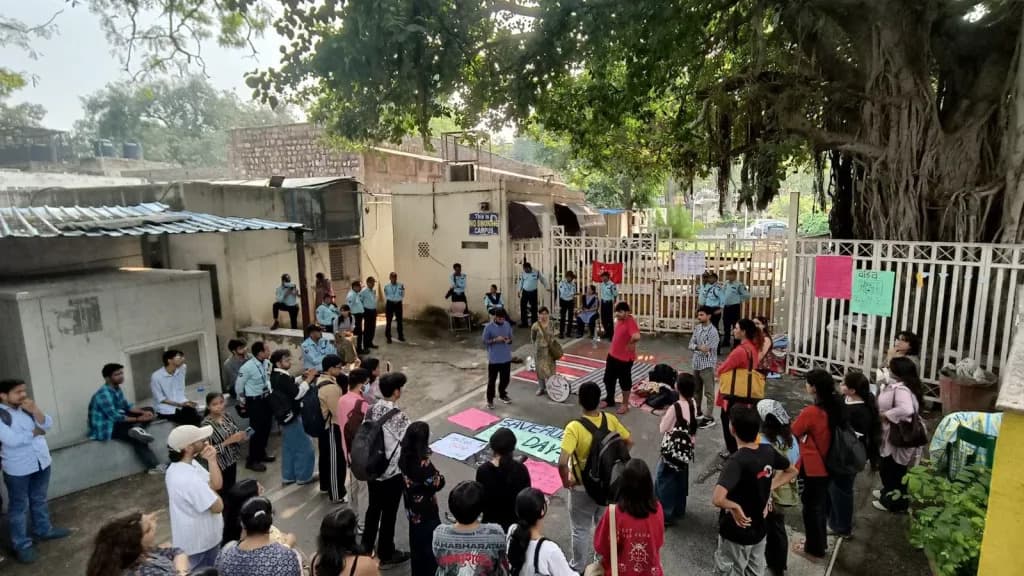
Dr B R Ambedkar University Delhi (AUD) has suspended 10 students, including elected student representatives, during an ongoing indefinite protest at its Kashmere Gate campus.
The university cited alleged indiscipline, damage to campus property and a confrontation with security personnel as grounds for the action.

The disciplinary decision followed a review of a preliminary report prepared by the university’s Proctorial Board, CCTV footage and other visual evidence relating to an incident on Oct 13, according to the administration.
Under the suspension orders, the students have been barred from entering university campuses. However, they will be permitted to take assessments and examinations scheduled during the current semester.
The orders state that the suspensions will remain in effect “pending inquiry” under the university’s Code of Discipline for Students.
The administration has also established an inquiry committee to investigate the Oct 13 confrontation and earlier complaints involving the Kashmere Gate and Karampura campuses.
The students have challenged the action, alleging that the administration is targeting those participating in the protest. The All India Students’ Association (AISA) said the suspension letters were issued on Wednesday evening without prior show-cause notices.
The university, however, has defended its decision, maintaining that disciplinary action was necessary in response to the reported incident. The suspensions have added to tensions between the administration and protesters, whose indefinite sit-in began on September 28.
Why has the university suspended 10 students?
The administration has alleged that protesters were involved in physical altercations with security personnel and university officials and damaged institutional property. It also claimed that officials who attempted to engage with the demonstrators faced abusive behavior.
Following the confrontation, the university informed the police, citing concerns about campus safety and security. The administration said it would examine the incident through a formal inquiry before deciding on further disciplinary measures.
“The University reiterates that all legitimate and permissible demands of the students had already been addressed,” the administration said. It added that violence, vandalism, misbehavior toward staff and disruption of the academic environment would not be tolerated.
The university has referred the matter for a detailed investigation and said any further action would be taken in accordance with its rules and statutes.
AISA, meanwhile, has questioned the timing and manner of the suspensions, alleging that students received the orders without being given prior show-cause notices. The students maintain that the action is connected to their ongoing agitation.
What happened during the October 13 confrontation?
The latest confrontation occurred on the evening of October 13, while students were holding a sit-in at the Kashmere Gate campus. The incident centered on a planned screening of filmmaker Anand Patwardhan’s documentary Jai Bhim Comrade near the protest site.
According to student representatives, security personnel attempted to prevent the screening, switched off the electricity supply and misbehaved with protesters. AISA also alleged that police personnel removed protest materials and dragged students out of the campus.
The allegations from the students contrast with the university’s account, which cites misconduct, property damage and confrontations with security personnel as grounds for disciplinary action.
Tensions over access to campus spaces had already been building before the October 13 incident. Students had previously alleged that security personnel prevented them from bringing food and water to protesters and manhandled some demonstrators.
The administration’s review of CCTV footage and other visual evidence forms part of its stated basis for suspending the 10 students. The inquiry committee is expected to examine the latest confrontation alongside earlier complaints concerning the university’s two campuses.
Why are AUD students holding an indefinite protest?
The sit-in began on September 28 after weeks of disagreement over two circulars issued by the university on July 31. Students have argued that the measures restrict their academic autonomy and their ability to organize demonstrations on campus.
One circular introduced an attendance-cum-whereabouts register for full-time PhD scholars receiving fellowships. Students opposed the requirement, arguing that research work does not always require scholars to be physically present on campus every day.
They also raised concerns that unauthorized absences could affect their fellowships. The students said the attendance requirement did not adequately account for the nature of doctoral research, which may involve fieldwork and other activities away from campus.
The second circular required students to provide four working days’ notice before organizing demonstrations, rallies, marches and other public gatherings on university premises. Protesters demanded that the university withdraw the restrictions.
The administration subsequently revised its PhD attendance guidelines on September 30. However, the sit-in continued because students sought the complete withdrawal of both July 31 circulars and action on a broader set of administrative and infrastructure issues.
What are the students demanding?
Beyond the attendance rules and restrictions on demonstrations, protesters have raised concerns about campus infrastructure, student representation and academic facilities. Their demands include the removal of iron gates and barriers on campus and the reinstatement of PhD fee waivers.
Students are also seeking representation in university decision-making bodies and the completion of faculty recruitment. They have highlighted shortages and inadequacies involving drinking water, classrooms, toilets and space for research scholars.
The protesters maintain that the dispute extends beyond the original attendance requirements. They have linked their demands to access to university spaces, research conditions and participation in campus governance.
The administration, in contrast, has maintained that all legitimate and permissible student demands have already been addressed. The continuing disagreement over the circulars and the handling of the protest has kept the standoff unresolved.
The suspension of 10 students has now introduced another point of contention. While protesters accuse the administration of taking punitive action against demonstrators, the university has initiated an inquiry into the October 13 confrontation and says further steps will follow its rules and statutes.

FRRO Issues Notice to Actor, an OCI Cardholder
Dipke Calls for Protest at Connaught Place

Defence PSU Invites Single Bid from Firm Linked to Former Chairman
Hindu College protest puts governance, financial transparency and Delhi University's oversight under scrutiny
Ambedkar University Delhi protest: Attendance rules, campus restrictions and suspensions deepen standoff
Hindu College protest puts governance, financial transparency and Delhi University's oversight under scrutiny
Ambedkar University Delhi protest: Attendance rules, campus restrictions and suspensions deepen standoff
NEET-UG 2026 paper leak: CBI files supplementary chargesheet against 14th accused

UK visa crackdown drives student withdrawals, putting universities at financial risk

Who holds university leaders accountable? Korea president's conviction puts institutional discipline under scrutiny

FRRO Issues Notice to Actor, an OCI Cardholder
Dipke Calls for Protest at Connaught Place
Defence PSU Invites Single Bid from Firm Linked to Former Chairman
Hindu College protest puts governance, financial transparency and Delhi University's oversight under scrutiny
Ambedkar University Delhi protest: Attendance rules, campus restrictions and suspensions deepen standoff
Hindu College protest puts governance, financial transparency and Delhi University's oversight under scrutiny
Ambedkar University Delhi protest: Attendance rules, campus restrictions and suspensions deepen standoff
NEET-UG 2026 paper leak: CBI files supplementary chargesheet against 14th accused
UK visa crackdown drives student withdrawals, putting universities at financial risk
Who holds university leaders accountable? Korea president's conviction puts institutional discipline under scrutiny
Copyright© educationpost.in 2026 All Rights Reserved.