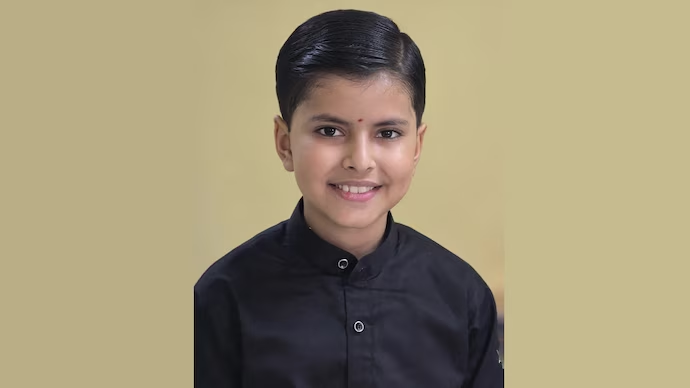
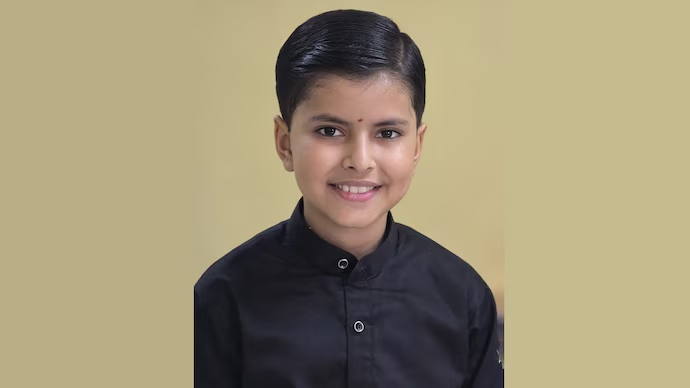
At an age when most children are still exploring their interests, nine-year-old Vrishvardhan Sharma has already brought together two worlds that rarely meet — ancient Sanskrit scholarship and modern technology.
The Bengaluru-based homeschooled student memorised all 700 verses of the Bhagavad Gita through self-study at the age of five. By eight, he had memorised Panini’s Ashtadhyayi, comprising about 4,000 sutras, as well as the Amarakosha.

His interest in the texts, however, did not stop with memorisation. Vrishvardhan has gone on to develop digital tools and hardware aimed at making classical Indian texts easier to access.
From Sanskrit memorisation to national competitions
Vrishvardhan’s achievements in Sanskrit have taken him to national-level competitions, where he has competed against much older participants.
In March 2026, he secured first place in the Ashtadhyayi Kanthapatha category at the 63rd Akhil Bharatiya Shastrotsav in Kanchipuram. The category was open across age groups, with participants in the competition field aged between 18 and 25.
The win marked his third consecutive year on the national podium. He had earlier won silver medals at Ayodhya in 2024 and Haridwar in 2025.
He has also handwritten the complete Bhagavad Gita in 11 Indian scripts, adding another dimension to his engagement with the text.
A Gita app that works without the internet
Vrishvardhan’s most distinctive project is GitaVardhan, a free app featuring the complete Bhagavad Gita in 13 Indian languages.
The app brings together Sanskrit verses, audio recitations in Vrishvardhan’s own voice, English grammar explanations and commentaries associated with Adi Shankaracharya and Ramanujacharya.
Its key feature is that it works offline once installed. According to its official documentation, the app carries no advertisements, subscriptions or trackers. Its Google Play listing also states that it is fully offline and does not collect personal data.
He built the devices, too
Vrishvardhan has extended the project beyond smartphones by building compact Gita readers using an ESP32 microcontroller, microphone, amplifier and display.
One version uses an e-ink screen, while another features a touchscreen. A third combines touch and voice controls.
The devices are designed to function without a network connection, while the accompanying software has been developed using C and Python, according to his documentation.
He has also developed Kannada, Tamil and Telugu learning applications, continuing his effort to use technology to make Indian languages and classical texts more accessible.
Where ancient texts meet modern technology
What sets Vrishvardhan’s journey apart is not simply the scale of what he has memorised or his early interest in coding. It is the way he has connected the two.
His Sanskrit knowledge has become the foundation for technology projects built around the very texts he studied.
His documented achievements include national Sanskrit competition wins, technology projects and recognition from institutions including Central Sanskrit University. In August 2026, he was also felicitated at the Art of Living in Bengaluru, where he demonstrated GitaVardhan and his voice-enabled device.
For Vrishvardhan, Sanskrit scholarship and technology appear less like separate pursuits and more like two parts of the same experiment — learning ancient knowledge and finding new ways to carry it into the digital age.