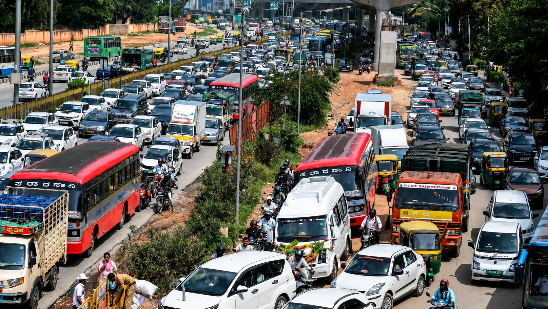
With India’s vehicle fleet crossing 413 million amid rapid urbanisation, experts on Monday called for a renewed urban transport framework as the Indian School of Public Policy (ISPP) launched a review of the country’s 2006 National Urban Transport Policy.
India’s registered vehicle fleet increased from approximately 90 million vehicles in 2006 to more than 413 million in 2025, with over 320 million vehicles added during the last two decades alone, the statement said.

The review was launched by ISPP through its Centre for Urban Transitions (ICUT) and the launch event drew transport and policy experts, found the National Urban Transport Policy’s vision for public and non‑motorised transport was not matched by outcomes and it recommended a new policy in 2026 to reflect contemporary challenges.
The implementation of current policy often prioritised stand‑alone metro rail projects that were not integrated with broader mobility networks and land‑use planning.
The report also noted that several issues that have become central to urban transport planning today, including parking management, urban freight movement, the mobility needs of smaller cities, app-based transport services, e-commerce logistics and climate resilience, were not sufficiently addressed.
“India has never really had a comprehensive urbanisation policy because we long believed that India lives in its villages, and cities were often treated as an afterthought," said Dr Parth Shah, Dean and Co-founder, Indian School of Public Policy. Many problems targeted by the 2006 urban transport policy have actually worsened due to lack of urban governance policy, he added.
BVR Subrahmanyam, former CEO of NITI Aayog, said that India’s economic growth will increasingly be driven by its cities, yet urbanisation still lacks a comprehensive plan. "The next generation of policy must embed urban transport within a broader urbanisation framework that plans for growth, manages congestion and creates more liveable cities,” he added.
“If public transport and walking remain inconvenient, people will continue to prefer private vehicles. The future of urban mobility lies in making public transport easier, more accessible and more reliable,” said Sanjiv Sahai, former Managing Director of DIMTS and former Secretary, Ministry of Power.
(Except for the headline, this article has not been edited by Education Post)