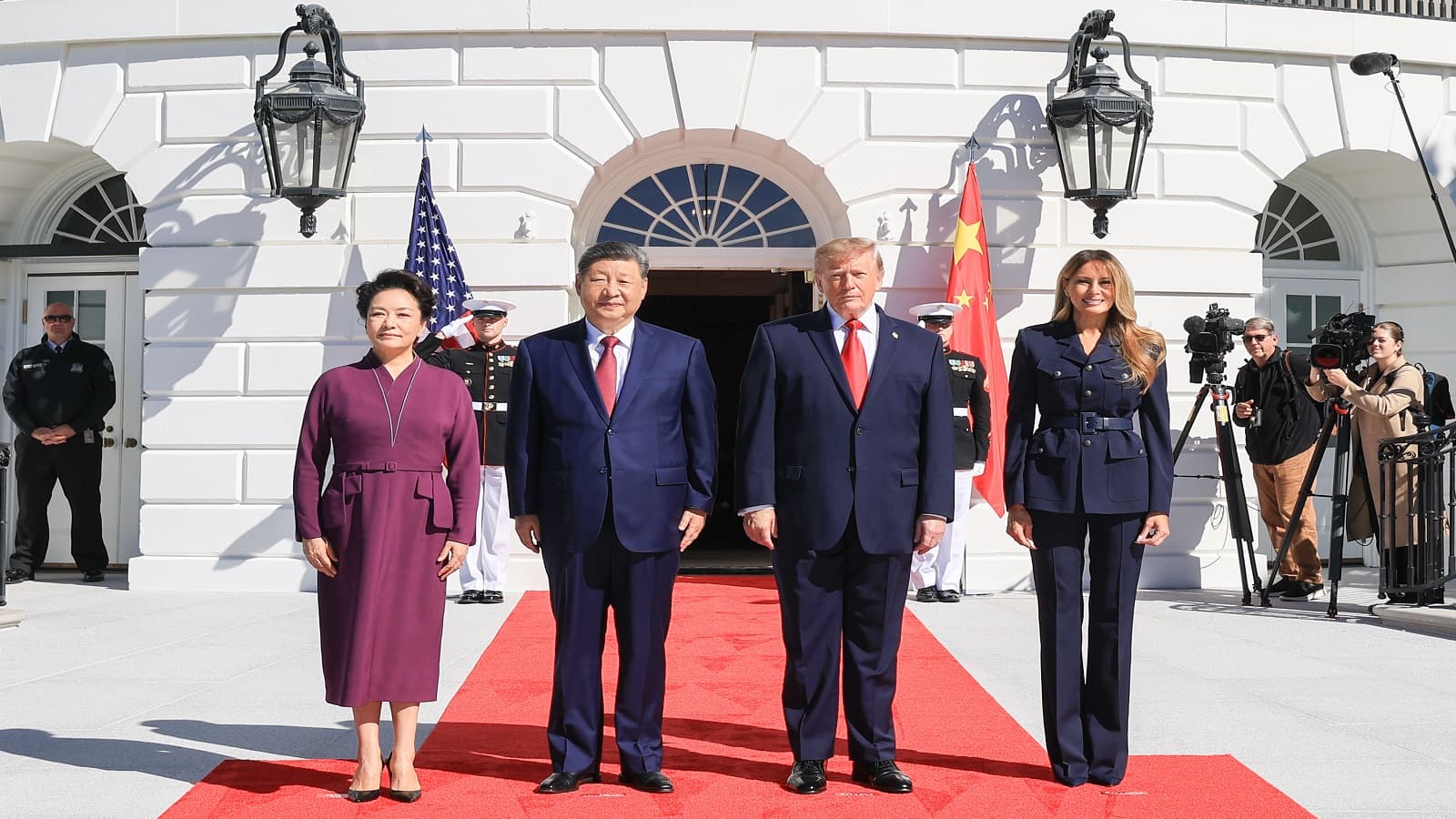
US President Donald Trump and Chinese President Xi Jinping agreed to establish a bilateral communication channel for artificial intelligence (AI) incidents and use the term "super intelligence" rather than AI during their summit in Washington this week, the White House has said. Trump and Xi also agreed that no country can be allowed to impose tolls on international waterways, the White House said in a fact sheet on outcomes from their summit, as Iran asserts control over the Strait of Hormuz, a crucial shipping route for oil, natural gas and other commodities, reports Yonhap news agency.
During the summit, the leaders discussed a range of ongoing global concerns, including North Korea, Russia and Iran, the White House said. It did not elaborate on their discussions about North Korea amid questions over whether the leaders reaffirmed their commitment to the North's denuclearization. "The two countries established the U.S.-China Super Intelligence (SI) Dialogue to exchange views on risks and benefits related to SI," the fact sheet said. "The next exchange will occur by November 2026.

The United States and China also agreed to establish a bilateral communication channel for SI incidents." The reference to the next SI exchange appears to point to the anticipated Trump-Xi meeting in November, when China will host the Asia-Pacific Economic Cooperation summit in Shenzhen. Trump has pushed for the new term, SI, saying that all U.S. documents will use the "much more accurate" term because the word "artificial" makes intelligence sound "fake." On Iran, the leaders agreed that the Islamic Republic can never have a nuclear weapon, and that no country or institution can be allowed to impose tolls on international waterways.
The fact sheet did not mention the Strait of Hormuz. During the White House summit, Trump urged Xi to increase production of refined petroleum products to stabilize global supply, the document said, amid concerns over high energy prices -- a crucial economic issue that could affect voter sentiment ahead of the U.S. midterm elections in November. As they highlighted the need for cooperation between the superpowers, the two sides discussed fostering peace and prosperity "to enhance confidence for businesses and consumers around the world," according to the fact sheet.
"The two countries agreed to build a constructive relationship of strategic stability on the basis of respect, fairness, and reciprocity," it said. The leaders also operationalized the government-to-government mechanisms of the bilateral Board of Trade and the Board of Investment, which were chartered during their previous summit in Beijing in May.
The Board of Trade is designed to manage bilateral trade across nonsensitive goods, while the Board of Investment is a government-to-government forum for discussing investment-related issues. Under the Board of Trade, the two countries reached consensus on recommendations for more favorable tariff treatment for US$30 billion of nonsensitive goods in each direction, according to the fact sheet.
The board also launched a working group focused on addressing market access barriers in the agricultural sector. Moreover, China plans to import at least 10 million metric tonnes of coal from the U.S. in both 2027 and 2028. On rare earths and other critical minerals, the fact sheet noted that the two countries continue to work on U.S. concerns regarding supply chain shortages, "with the goal of ensuring shipment levels return to appropriate levels." On Friday, Xi wrapped up his three-day state visit to the U.S. -- his first trip to Washington in more than a decade. This week's summit marked the leaders' third in-person meeting since Trump's return to office, following their meetings in Busan last October and in Beijing in May.
Disclaimer: "This story has been published from a syndicated news feed. Only the headline and subtitle have been edited by EPN."