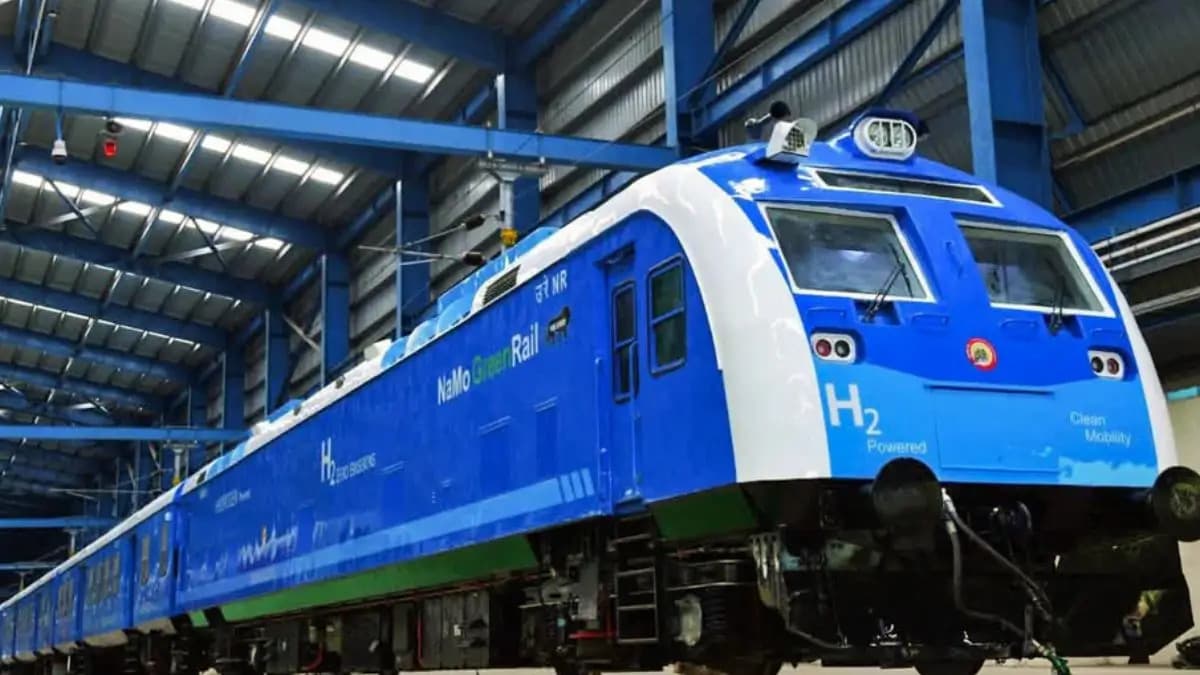
India has achieved a major milestone in sustainable transportation with the development of its first indigenous Hydrogen Fuel Cell Train, marking a significant step towards building a domestic hydrogen-powered rail ecosystem and advancing the country's clean mobility ambitions, the government announced on Sunday.
The hydrogen-powered train will operate on the Jind-Sonipat section of Northern Railway and has been designed, engineered and integrated in India using indigenous technology.

With a carrying capacity of 2,600 passengers, the train is expected to showcase the potential of hydrogen as a clean alternative to conventional diesel-powered rail transport.
“India's first indigenous Hydrogen Fuel Cell Train on the Jind–Sonipat section of Northern Railway has a capacity of 2,600 passengers,” according to the official statement.
Powered by a Proton Exchange Membrane Fuel Cell (PEMFC), the train generates electricity through a chemical reaction between hydrogen and oxygen across a proton-conducting Perfluorosulfonic Acid (PFSA) polymer membrane.
The process produces only water vapour and heat as by-products, making the train a zero-emission and environmentally friendly mode of transport.
“Powered by a Proton Exchange Membrane (PEM) fuel cell, it produces only water vapour and heat as by-products, making it a clean, zero-emission alternative to diesel,” it added.
The train has an operational speed of 75 kmph, while its design speed is 110 kmph, enabling it to efficiently serve regional passenger routes while reducing carbon emissions.
To support the operation of the hydrogen-powered train, a dedicated hydrogen refuelling ecosystem has been established at Jind in Haryana.
The facility includes hydrogen production, storage, compression and dispensing infrastructure, creating a comprehensive ecosystem for hydrogen-based railway operations.
Safety has been a key focus in the development of the project. The train is equipped with hydrogen leak detectors capable of identifying even the smallest leaks instantly, helping prevent potential hazards and ensuring safe operations.
The indigenous hydrogen fuel cell train represents more than a technological breakthrough for Indian Railways.
It lays the foundation for a domestic hydrogen rail ecosystem and reinforces India's commitment to developing sustainable, zero-emission transportation solutions.
(Except for the headline, this article has not been edited by Education Post)