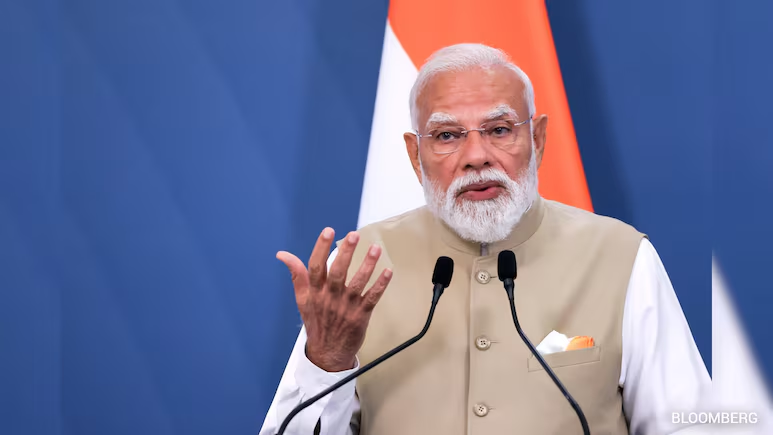
Prime Minister Narendra Modi will make a high-profile pitch to global investors on Thursday as he inaugurates a major semiconductor conference in New Delhi, putting India’s ambitious bid to build a domestic chip industry firmly in the global spotlight.
The three-day Semicon event is expected to showcase an industry that was barely on India’s manufacturing map a decade ago but is now at the centre of the government’s push to attract investment, expand exports and move the economy towards higher-value manufacturing.

Modi is expected to use the platform to engage semiconductor manufacturers, equipment makers, component suppliers, technology companies and potential customers, while highlighting the opportunities emerging for Indian companies and startups as global demand for chips surges with the rapid expansion of artificial intelligence.
“Semicon in New Delhi is PM Modi’s way of signalling that India has a long-term commitment to growing the chip industry,” said Pranay Kotasthane, deputy director of the Bangalore-based Takshashila Institution. “That’s his message to global investors.”
The stakes are significant for India, one of the world’s fastest-growing major economies. The government sees semiconductor manufacturing as an important part of its broader effort to modernise the economy, strengthen exports and create better-paying jobs outside agriculture.
The event will bring together more than 600 exhibitors, over 150 speakers and representatives of 300 global companies across 15,000 square metres of a state-of-the-art convention centre in New Delhi. Startup showcases and a student hackathon are also planned, underscoring the government’s attempt to build an ecosystem that extends beyond large manufacturers.
The gathering comes just two months after India announced an additional 1.9 trillion rupees ($19.8 billion) in subsidies aimed at accelerating domestic chip and electronics manufacturing.
The strategy draws on the experience of India’s electronics manufacturing push, where government incentives helped Apple expand iPhone production in the country. India now accounts for about 25 per cent of the company’s flagship iPhone manufacturing.
New Delhi is hoping to reproduce some of that momentum in semiconductors.
An initial $10 billion semiconductor fund launched under the government’s earlier programme helped set the industry in motion. Some of those investments are now moving from plans to production.
The Tata Group and Murugappa Group have begun chip packaging and assembly operations, while US-based memory chipmaker Micron Technology has also started production in India. Tata is building a semiconductor fabrication plant in Gujarat, which is expected to become operational in early 2028.
For India, however, the challenge extends well beyond building a handful of factories.
Governments across the world are pouring billions of dollars into domestic semiconductor capacity as artificial intelligence transforms industries ranging from automobiles and healthcare to financial services and fraud detection. With advanced computing capacity increasingly becoming a strategic resource, control over semiconductor technology and manufacturing has taken on greater economic and geopolitical importance.
India’s semiconductor ambitions remain at an early stage, but the government is seeking to build an ecosystem covering the entire supply chain.
That includes seed funding for semiconductor startups, support for chip-making equipment, incentives for fabrication plants and assistance for assembly and packaging facilities.
The road ahead, however, is long.
Countries such as Taiwan, South Korea, the United States and Malaysia spent decades developing the expertise, infrastructure and supply chains needed to become major semiconductor players. India initially focused on less sophisticated legacy chips, which are widely used in electronics and power systems.
The next challenge will be considerably harder: moving up the technology ladder to advanced chips and sophisticated packaging while building the skilled workforce and supply networks needed to sustain the industry.
For Modi, the Semicon gathering is therefore more than a showcase of factories and investment figures. It is an attempt to convince global companies that India wants to become a serious, long-term participant in one of the world’s most strategically important industries.