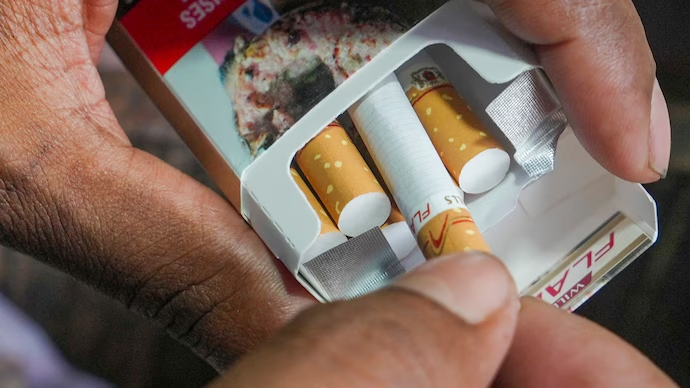
New tax regime to replace GST compensation cess, signaling a tougher stance on sin products.

The Indian government has announced a significant overhaul in the taxation of tobacco products and pan masala, with a fresh excise duty and Health and National Security Cess set to come into force from February 1, 2026. This move replaces the existing GST compensation cess, signaling a renewed focus on public health and revenue generation.
Under the new framework, tobacco and pan masala will continue to attract GST but at elevated rates — pan masala, cigarettes, and similar products will face a steep 40% GST, while biris will be taxed at 18%. Beyond GST, pan masala manufacturers will incur a newly introduced Health and National Security Cess, and tobacco products will be subject to an additional excise duty as mandated by the Finance Ministry.

This policy shift follows the Parliament’s approval in December of two landmark Bills authorizing these new levies. The changes aim to phase out the GST compensation cess, initially designed to cushion state revenues post-GST rollout, replacing it with targeted duties intended to reinforce the government’s stringent stance on harmful products.
In addition, fresh rules have been framed for assessing production capacity and duty collection from manufacturers of chewing tobacco, jarda scented tobacco, and gutkha, ensuring tighter regulation of these products.
The impact of this revised taxation regime is expected to reverberate across manufacturers, pricing strategies, and consumer behavior once implemented early next year — reaffirming the government’s commitment to curbing consumption of sin products through fiscal deterrence.

India’s Blue Economy Push Seeks to Balance Growth and Ocean Conservation

Supreme Court Seeks Panel to Curb Unethical Pharma Marketing Practices

NMC Tightens Rules on Doctors’ Digital Advertising and AI Use

Anthropic Launches Claude Haiku 5.5 as Its Fastest and Cheapest AI Model

Karnataka HC Replaces ‘Visitation’ with ‘Parenting Time’ in Child Custody Cases

Canadian author Anne Carson wins 2026 Nobel Prize in Literature for reshaping contemporary literary forms

AMU students’ protest enters third week as union election demand widens

DPDP Act Explained: What is India’s Digital Personal Data Protection Law and Why is it in the News?

IIT Bombay puts stricter cheating rules on hold, drafts new procedure for exam misconduct

Gujarat launches PARAKH Cell to shift school assessments toward competency-based learning

India’s Blue Economy Push Seeks to Balance Growth and Ocean Conservation

Supreme Court Seeks Panel to Curb Unethical Pharma Marketing Practices

NMC Tightens Rules on Doctors’ Digital Advertising and AI Use

Anthropic Launches Claude Haiku 5.5 as Its Fastest and Cheapest AI Model

Karnataka HC Replaces ‘Visitation’ with ‘Parenting Time’ in Child Custody Cases

Canadian author Anne Carson wins 2026 Nobel Prize in Literature for reshaping contemporary literary forms

AMU students’ protest enters third week as union election demand widens

DPDP Act Explained: What is India’s Digital Personal Data Protection Law and Why is it in the News?

IIT Bombay puts stricter cheating rules on hold, drafts new procedure for exam misconduct

Gujarat launches PARAKH Cell to shift school assessments toward competency-based learning
Copyright© educationpost.in 2024 All Rights Reserved.
Designed and Developed by @Pyndertech