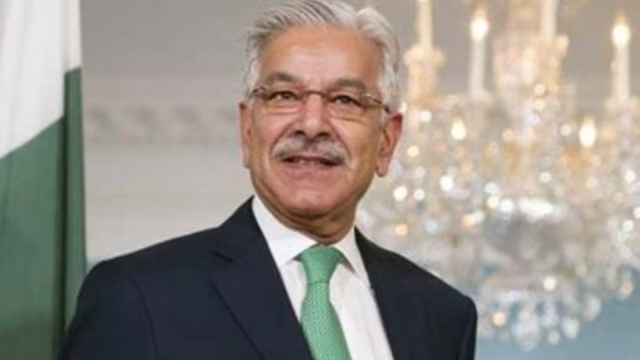
Pakistan’s Defense Minister Khawaja Asif has reignited controversy by declaring that while the United States is governed by a “deep state,” his own country functions under a “hybrid regime” where the army and civilian leadership share power through consensus.
In an interview with British-American journalist Mehdi Hasan, Asif dismissed the suggestion that he reports directly to Army Chief General Asim Munir. “I’m a political appointee, I’m a political worker,” he said. Pressed on whether generals in Pakistan wield ultimate authority compared to their US counterparts, Asif remarked, “They [the US] have a different model over here. It’s called the deep state.”

When Hasan pushed further, noting Pakistan’s own reputation as a “deep state,” Asif conceded its military dominance is “more visible” but insisted that decision-making rests on a consensus-driven “hybrid system.” “It’s not equal… we can agree to disagree,” he said, claiming neither side imposes unilateral decisions.
The remarks came just a day after Prime Minister Shehbaz Sharif and Gen. Munir met former US President Donald Trump at the White House, underscoring the complex interplay between civilian and military power in Islamabad.
Asif has previously defended Pakistan’s hybrid governance as a “practical necessity” amid economic and governance crises. Yet his comments also dredge up an April admission on Sky News, where he confessed Pakistan had “for about three decades” supported and trained terrorist groups “for the United States and the West, including Britain.”
That statement, following the Pahalgam terror attack that killed 26, drew a sharp rebuke from India at the UN. New Delhi called it an “open confession” that exposed Pakistan as “a rogue state fueling global terrorism.”
By suggesting that both Washington and Islamabad are influenced by entrenched power structures, Asif has once again spotlighted the uneasy balance between democracy, militarism, and shadow governance—both at home and abroad.




.jpg&w=256&q=75)





.jpg&w=256&q=75)
