Kolkata has now been drawn into Pakistan’s expanding list of warnings to India, with the latest remarks once again marked by sweeping claims but no supporting evidence.
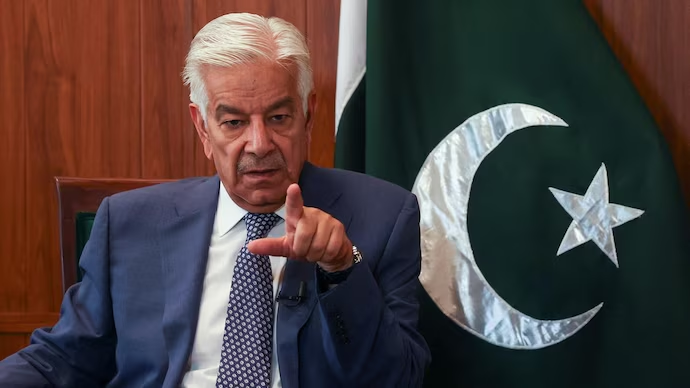
Pakistan’s Defense Minister Khawaja Asif recently cautioned that any future conflict would not remain confined to border areas and could extend deep into Indian territory, naming Kolkata as a potential target.

“If India tries to stage any false flag operation this time, then God-willingly, we will take it to Kolkata,” Asif said while addressing reporters in Sialkot.
He further alleged the possibility of a “false flag” operation involving “their own men or Pakistanis in their detention”, claiming bodies could be used to fabricate terror narratives. No evidence was presented to substantiate the claim.
Escalation in rhetoric
Sharpening his tone, Asif suggested that any future confrontation would go significantly beyond previous engagements.
“If they try again, they will face even greater humiliation than last year. This time, the conflict will not remain limited to 200 to 250 km. We will enter their territory and strike them inside their own homes,” he said.
The remarks echo earlier signals from Pakistan’s establishment about expanding the geographical scope of any potential conflict, though without clarity on any shift in ground realities.
India signals strong retaliation
The warning follows a firm response from India’s Defense Minister Rajnath Singh, who underscored that any provocation would invite a decisive reply.
Speaking in Kerala, Singh referred to India’s actions after the April 2025 Pahalgam terror attack, which claimed 26 lives.
“I would like to tell you the operation is not over yet. If such dirty actions are repeated by Pakistan, our armed forces will give a befitting reply which they would not forget ever,” he said.
From Pahalgam to ceasefire
Tensions between the two countries sharply escalated following the April 22, 2025 attack in Pahalgam, triggering a four-day military confrontation.
India responded with Operation Sindoor, targeting terror infrastructure across Pakistan and Pakistan-occupied Kashmir using missile and drone strikes. Pakistan retaliated with artillery fire, drones and missile attacks, widening the conflict’s scope.
A ceasefire was eventually reached on May 10, 2025, after direct talks.
Former envoy fuels controversy
Adding to the charged atmosphere, former Pakistan High Commissioner to India Abdul Basit recently stirred controversy with remarks about targeting Indian cities in a hypothetical scenario.
“If America attacks Pakistan we have to attack India, Mumbai, New Delhi, without a second thought,” Basit said during a discussion, while also noting that such a situation remains unlikely.
He added that Pakistan would retaliate “wherever it wants” if threatened, though he stressed that neither side desires such an outcome.
Regional tensions simmer
The developments come against a backdrop of rising regional strain, with Pakistan also facing friction along its western frontier.
Afghan authorities have accused Pakistani forces of carrying out airstrikes in areas including Kabul, Kandahar and Paktika. Taliban spokesperson Zabihullah Mujahid has alleged that civilian locations were hit.
While independent verification remains limited, reports point to casualties and damage, adding to an already volatile regional security environment.
India has not officially responded to Asif’s latest remarks so far, but the statements have intensified debate as rhetoric on both sides continues to harden.




.jpg&w=256&q=75)





.jpg&w=256&q=75)