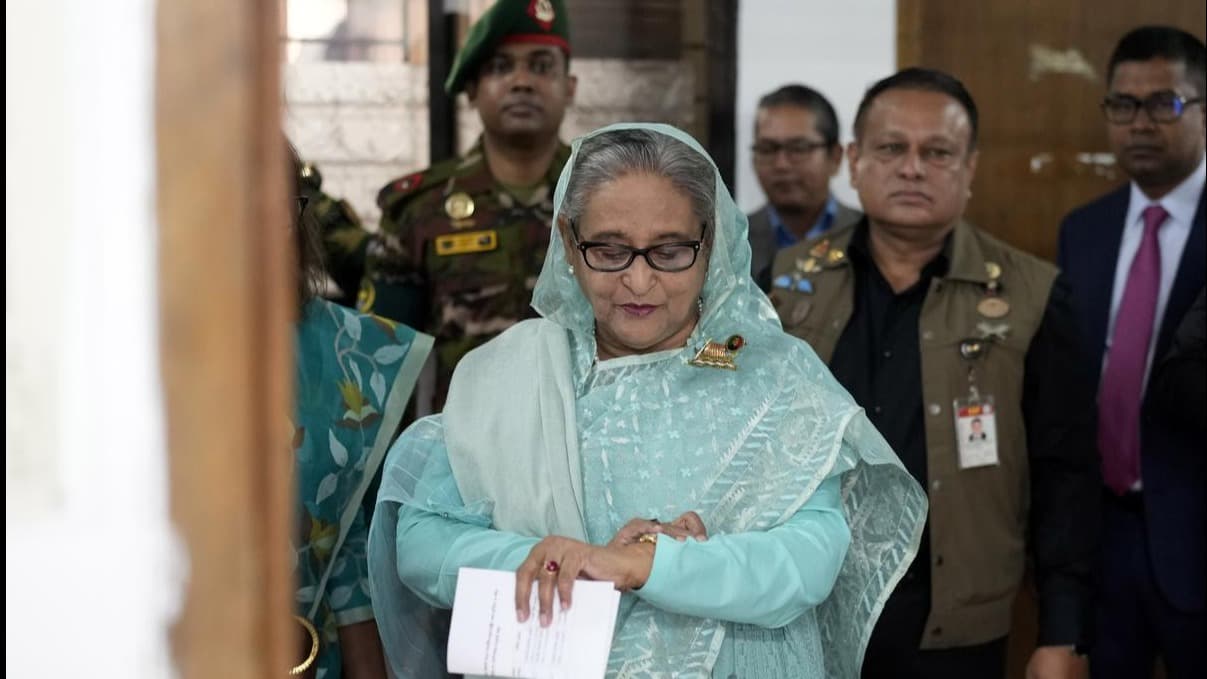
In a significant development, the Commission of Inquiry on Enforced Disappearance set up by the interim government of Bangladesh in its report on Dec 14 stated that it found the deposed Prime Minister Sheikh Hasina and high-ranking officials of her government involved in enforced disappearances of individuals during her tenure.
The commission, set up by the interim government of Muhammad Yunus, implicated Hasina in as many as 3,500 cases of forced disappearances.

"The commission has found evidence of former Prime Minister Sheikh Hasina's involvement as the instructor in the incidents of enforced disappearances," Muhammad Yunus' government said in a statement on Saturday.
The report, titled "Unfolding the Truth," presented preliminary evidence against Hasina, who fled the country following a student-led uprising.
The report also claimed that many high-ranking officials, including former military and police personnel, believed to be involved, fled abroad after the fall of Hasina's Awami League government on August 5.
The report recommended disbanding the anti-terror outfit Rapid Action Battalion (RAB) which was instrumental in a crackdown against terror suspects and was accused of human rights abuse. The commission said it has recorded 1,676 cases of disappearances and that the total number of such cases during the Hasina era could cross 3,500.
Meanwhile, the authorities arrested four persons in connection with attacks on the minority Hindu community on Dec 3. The arrests came days after the Indian Foreign Secretary visited Dhaka and urged the authorities to “acknowledge” the attacks on minorities in Bangladesh.
The case of violence against Hindus involved a social media post by one Akash Das which created communal tension in Sunamganj district, leading to attacks against Hindu-owned businesses and a place of worship. Those arrested in this incident were identified as Ali Hossain (19), Sultan Ahmed Raju (20), Imran Hossain (31) and Shajahan Hossain (20).
Commenting on the inquiry, a statement from the Chief Adviser’s Office said, “The commission chairman said they had found the prima facie involvement of former Prime Minister Sheikh Hasina and some high-ranking officials of security forces and her government, including her defense adviser, Major General (retd.) Tarique Ahmed Siddique, in the enforced disappearances.”
Presenting the report at a special event in the residence of the Chief Adviser Mohammad Yunus, the commission informed that it would bring out another interim report in March and would require another year to complete the scrutiny of all the complaints received so far.
Apart from Hasina and Siddique, the commission also found the involvement of the former director general of the National Telecommunication Monitoring Centre and sacked Major General Ziaul Ahsan, senior police officers Monirul Islam and Harun-Or-Rashid with “several incidents of enforced disappearance”.
Submitting the report, the commission’s chairman said it had detected a “systematic design” to avoid detection of the cases of enforced disappearances.
The interim government set up the commission under the leadership of Justice Moyeenul Islam Chowdhury on August 27. Other members of the commission include Justice Farid Ahmed Shibli, human rights activist Nur Khan, BRAC University teacher Nabila Idris, and human rights activist Sajjad Hossain. Bangladesh also joined the UN Convention on Enforced Disappearances on August 30.




.jfif&w=256&q=75)



.jpg&w=256&q=75)
.jpg&w=256&q=75)
.webp&w=256&q=75)
.jpg&w=256&q=75)