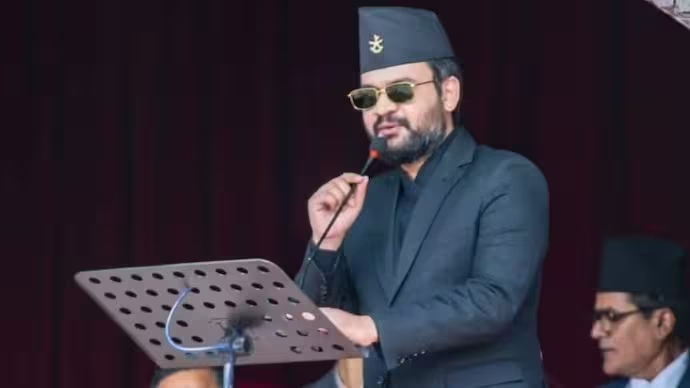
In a historic political shift, Balendra Shah—widely known as Balen—was sworn in as Nepal’s youngest Prime Minister on March 27, capping a stunning electoral surge that has upended the country’s entrenched political order.
The 35-year-old rapper-turned-politician assumed office after being unanimously elected parliamentary leader of the Rastriya Swatantra Party (RSP), securing his path to the nation’s top executive post.

“The parliamentary party meeting unanimously elected Balen as its leader,” said Shanker Shrestha, secretary of the RSP’s central organization committee, confirming his formal elevation.
A landslide that redraws Nepal’s political map
Shah’s rise follows a commanding victory in the parliamentary elections, where the RSP secured 182 of 275 seats in the House of Representatives—an overwhelming mandate that dismantled the dominance of legacy parties.
The electoral outcome reflects a sweeping generational shift, driven largely by last year’s youth-led protests demanding systemic reform and a corruption-free governance model. The RSP’s performance signals a decisive break from traditional political alignments.
In contrast, the Nepali Congress was reduced to just 38 seats, while the Communist Party of Nepal (Unified Marxist–Leninist) managed only 25. The Nepal Communist Party trailed further with 17 seats.
High-profile defeat and symbolic shift
In one of the most symbolic contests, Shah defeated four-time prime minister K P Sharma Oli in the Jhapa-5 constituency—a long-standing stronghold of the CPN-UML—by a decisive margin, underlining the scale of the political upheaval.
Government formation begins
Following the oath-taking of newly elected lawmakers at the federal parliament in Singha Durbar, administered by senior-most member Arjun Narasingha KC, Shah was sworn in at Sheetal Niwas, the President’s official residence.
The RSP’s central committee has authorized Shah to form the new government, with a cabinet expected to include 15–18 members. Announcements are likely to follow shortly.
A new political era
Shah’s ascent marks a watershed moment in Nepal’s democratic journey—where a non-traditional leader, propelled by youth support and anti-establishment sentiment, has not only entered mainstream politics but decisively redefined it.




.jpg&w=256&q=75)





.jpg&w=256&q=75)
