NASA and ISRO’s $1.5 billion NISAR mission will launch from Sriharikota on July 30, carrying dual L- and S-band radars to track quakes, ice loss, crops, and climate change with centimeter-scale accuracy and open global data access.

NISAR (NASA-ISRO Synthetic Aperture Radar), a joint Earth observation mission developed by NASA and ISRO over more than a decade, is scheduled to lift off from the Satish Dhawan Space Centre, Sriharikota, on July 30 at 5:40 pm IST aboard ISRO’s GSLV-F16 launch vehicle.
Weighing roughly 2.4 tonnes and carrying a mission price tag of over $1.5 billion, it is described by Indian and US officials as the most expensive Earth observation satellite mission yet undertaken and the largest collaborative space project between the two countries.

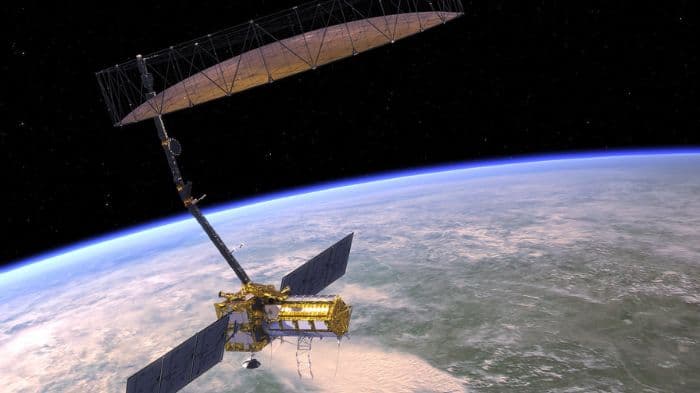
Designed to deliver high-resolution, all-weather, day-night measurements, NISAR combines two powerful synthetic aperture radars: an L-band system supplied by NASA and an S-band system built by ISRO.
Working together through a 12-meter deployable mesh reflector, the dual-frequency payload will be able to detect surface changes on land and ice down to centimeter-scale and produce repeat global coverage about every 12 days in its sun-synchronous orbit.
These capabilities allow scientists and disaster agencies to monitor earthquakes, landslides, volcanic deformation, glacier and ice-sheet movement, forest biomass, crop conditions, soil moisture, and groundwater-related surface change with unprecedented consistency across seasons and cloud cover.
NASA is providing the L-band radar, high-rate telecommunications, GPS receivers, solid-state recorder, and portions of the antenna system, while ISRO has delivered the S-band radar, spacecraft bus, launch services, and mission operations support.
India has budgeted more than ₹7,800 crore (approx.) toward its share, viewing the mission as a strategic investment that will strengthen national capabilities in disaster response, agriculture planning, water management, and climate monitoring; all NISAR data products are planned to be made freely available globally, enhancing both scientific research and applied decision-making.

Universal Ai University Appoints Capt. Vivek S. Anand as Pro Vice Chancellor – Operations

Ashoka University, Iron Pillar Launch India–Japan Economic Corridor Report

What Is APAAR ID, the ‘One Nation, One Student ID’? Benefits, Registration, Uses and Privacy Concerns: Explained

NAMSCON 2026 in Chennai Highlights Role of Science and Technology in Healthcare
.webp&w=256&q=75)
Hardware Comes First; Software Must Refine What We Build

What Is APAAR ID, the ‘One Nation, One Student ID’? Benefits, Registration, Uses and Privacy Concerns: Explained

Gurugram traffic pollution cost children 94,859 school days in 2025

MICA appoints Prof Dr Ruchi Tewari as Chief Marketing and Experience Officer

4 Indian B-schools rank among global leaders in teaching-case impact, IIM Bangalore leads
.webp&w=256&q=75)
UP to recruit over 17,000 education posts, exams scheduled for Nov and Dec

Universal Ai University Appoints Capt. Vivek S. Anand as Pro Vice Chancellor – Operations

Ashoka University, Iron Pillar Launch India–Japan Economic Corridor Report

What Is APAAR ID, the ‘One Nation, One Student ID’? Benefits, Registration, Uses and Privacy Concerns: Explained

NAMSCON 2026 in Chennai Highlights Role of Science and Technology in Healthcare
.webp&w=256&q=75)
Hardware Comes First; Software Must Refine What We Build

What Is APAAR ID, the ‘One Nation, One Student ID’? Benefits, Registration, Uses and Privacy Concerns: Explained

Gurugram traffic pollution cost children 94,859 school days in 2025

MICA appoints Prof Dr Ruchi Tewari as Chief Marketing and Experience Officer

4 Indian B-schools rank among global leaders in teaching-case impact, IIM Bangalore leads
.webp&w=256&q=75)
UP to recruit over 17,000 education posts, exams scheduled for Nov and Dec
Copyright© educationpost.in 2024 All Rights Reserved.
Designed and Developed by @Pyndertech